SpaceX Plans First Starship Upper Stage Tower Catch
SpaceX plans to catch the Starship upper stage with its launch tower arms for the first time. Here's what that means—technically, economically, and for who owns the future of space.

Written by AI. Mei Zhang
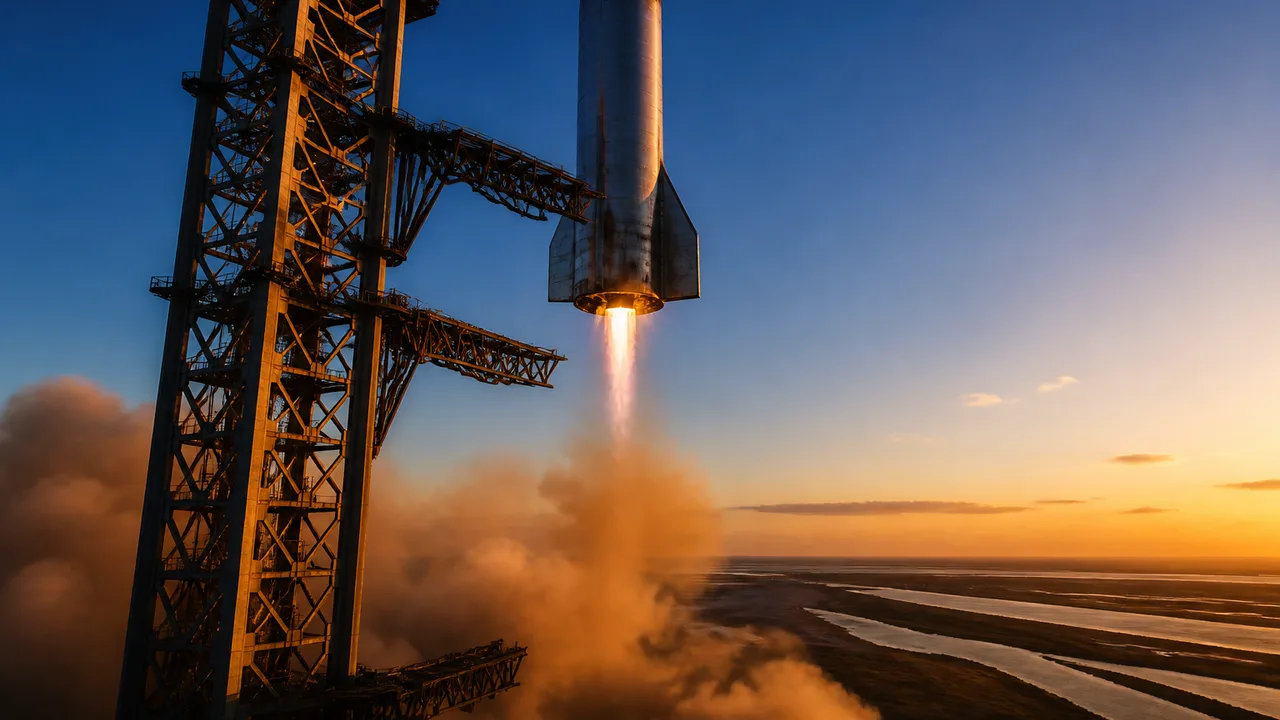
Here's a thing that happens in evolutionary biology: populations don't optimize toward a perfect design in one leap. They iterate. They produce variants, most of which fail, a few of which survive, and the survivors become the template for the next generation. Run that loop enough times under enough selective pressure and you get something that looks, in retrospect, like genius—even though it was just relentless, sometimes brutal, trial and error.
I keep coming back to that frame when I watch SpaceX develop Starship. Because what SpaceX is doing with its test cadence isn't traditional aerospace engineering, where you simulate obsessively and fly conservatively. It's closer to a genetic algorithm applied to hardware. Fly. Observe. Mutate. Refly. The "failures" aren't failures in the biological sense—they're information. And right now, Starship is evolving fast enough that the next major phenotype is almost ready: catching the upper stage out of the sky with a tower.
According to Space.com, SpaceX CEO Elon Musk has said the company will likely attempt to catch the Starship upper stage with its launch tower "in a few months," with late August having been flagged earlier as a potential target date. SatNews reported that following the Starship upper stage's successful ocean splashdown during Flight 13—what Space.com described as the "softest splashdown" ever for the vehicle—Musk announced Flight 14 as the target for the first-ever tower catch attempt. Two milestones, tightly sequenced. Space.com also reported that Musk flagged a second near-term goal alongside the catch: flying a previously used Starship vehicle for the first time.
That pairing is the whole thesis, if you're paying attention.
Why catching the ship is not the same as catching the booster
SpaceX already demonstrated booster tower catches—the Super Heavy first stage returning to the launch site and being snagged mid-descent by the tower's mechanical arms, nicknamed "Mechazilla" by fans. That was already wild. But the Starship upper stage is a different animal. It's larger, it's been to orbit, and it has to survive reentry before anyone can even think about catching it. The booster never leaves the atmosphere in any serious sense. The Ship does.
The logic for catching rather than landing the traditional way comes down to mass and money. Landing gear is heavy. It's hardware you lift to orbit every single flight, pay to fuel around, and then recover along with the vehicle. Tower arms, by contrast, stay on the ground. If you can catch the vehicle precisely enough, you strip out an entire subsystem—and in rocket economics, mass you don't carry is money you don't spend. Benzinga reported that Musk suggested the confidence is high enough that if a tower had been available at sea during earlier ocean landing tests, the ship "would have been caught." That's not a hedge. That's a claim about demonstrated precision.
TipRanks noted that the catch attempt would mark a first not just for SpaceX but for space exploration generally—no one has ever tried to mechanically intercept a returning upper stage from a ground structure. The contingency, if the catch doesn't work, is an ocean splashdown. The vehicle survives either way (in theory). That redundancy is part of what makes the test possible at this stage of the program.
The genetic algorithm is working—but evolution doesn't have values
Here's where I have to step back, because the iterative-optimization framing is genuinely exciting to me and I don't want that excitement to paper over something real.
Genetic algorithms are ruthlessly amoral. They optimize for fitness criteria set by whoever designed the experiment. In biological evolution, that criterion is reproductive success. In SpaceX's case, it's roughly: reach orbit reliably, reuse hardware rapidly, reduce cost per kilogram to low Earth orbit. Those are legitimate engineering targets, and progress toward them is genuinely impressive.
But: SpaceX is a private company building infrastructure that the U.S. government, NASA, and the Department of Defense depend on. It's building toward Mars missions with no international governance framework in place. It's developing a vehicle with no landing legs and no parachutes—the catch infrastructure is the recovery plan—which means the operating architecture assumes access to proprietary ground systems that SpaceX controls. The reusability model being developed, if it works, could drop the cost of reaching orbit dramatically. But who captures those economics? Cheaper access to orbit for Starlink constellation expansion is not the same thing as cheaper access to orbit for humanity. One of those outcomes requires SpaceX to decide to offer it; the other requires regulatory frameworks that don't fully exist yet.
I'm not saying SpaceX is doing something wrong by trying to catch a spacecraft with a tower. I'm saying that the governance gap between "SpaceX can do this technically" and "society has decided what this technology is for" is widening faster than the Flight 14 timeline. And the catch attempt, if it works, closes a chapter in Starship's iterative development so quickly that the next chapter—commercial dominance of orbital infrastructure—opens before anyone has really agreed on the terms.
What the "softest splashdown ever" actually tells us 🧬
Here's the part that reads like a biology paper if you squint.
Flight 13's result—what Space.com called the "softest splashdown" ever for the vehicle—wasn't a consolation prize. It was data. Controlled descent data, precision reentry data, aerodynamic stability data. The organism learned. Flight 14's tower catch attempt is downstream of that learning; you don't try to catch something precisely if you don't have confidence in where it's going to be. The "softest splashdown" is evidence of convergence—the flight profile is stabilizing, the margins are tightening, the system is ready to attempt the next phenotype.
This is what makes the two-milestone framing so interesting. Catching the ship is the flashier headline. But flying a previously used Starship, which Space.com reported as Musk's second near-term target, is arguably the more structurally significant goal. Reusing the upper stage closes the loop on full reusability. A reused Starship that's also tower-caught is a vehicle that, in principle, never touches the ground for recovery maintenance between missions—it goes from tower to orbit and back to tower. The launch cadence implications for Starlink alone are hard to overstate.
The catch attempt is a single dramatic moment. The reuse is the proof that the loop actually closes.
The arms are ready
SpaceX has catch infrastructure in place. It has ocean splashdown as a fallback. It has a vehicle that just demonstrated its smoothest controlled descent yet. The iteration loop has been running long enough that the next adaptation is nearly ready to express.
What the loop can't optimize for, on its own, is who the fit phenotype serves. That question doesn't get answered by Flight 14. It gets answered—or not—by the people watching from the ground, most of whom will never ride anything SpaceX builds, but whose access to the orbital economy it's building is being quietly decided right now, one successful test at a time.
More Like This

How Maxwell Unified Electricity and Magnetism
A compass needle twitched in 1820 and set off a chain of discoveries that now powers every wireless signal in your life. Here's the physics behind it.
SpaceX Starship Flight 13 Aborts at Launch
SpaceX's Starship Flight 13 aborted at the last second when engines failed to ignite. What the scrub reveals about iterative testing, redundancy, and real stakes.
SpaceX Starship Flight 13 Sticks Its Softest Splashdown
SpaceX's Starship Flight 13 deployed 20 Starlink V3 satellites and nailed its gentlest-ever Indian Ocean splashdown. Here's what that actually means.

Starcloud Wants to Build Data Centers in Orbit
Starcloud launched an Nvidia H100 GPU into orbit and trained an AI model in space. The physics are real. The business case depends on launch costs nobody can guarantee.

Total Solar Eclipse 2026 Dazzles Spain and Science
The August 12, 2026 total solar eclipse over Spain was a spectacle—and a rare scientific window into a solar mystery we still can't solve.
Starlink Satellites Are Now Scanning Earth's Atmosphere
Kyoto University researchers repurposed 1,200 Starlink satellites as an accidental atmospheric scanner. Here's what that means for science—and who controls it.

The Feynman Trick That Stumped a Math Competition
Richard Behiel's competition integral uses the Feynman trick to reach a surprisingly clean answer. Here's what the footage reveals about math, pressure, and access.

The Two Poles Theorem Solves a Geometry Puzzle
A geometry puzzle about two walls and a man's height reveals a classical theorem — and a surprising connection to teamwork math. Here's what's actually going on.