How Heat Pumps Work: The Physics of Moving Heat
Heat pumps can be 5x more efficient than gas boilers. Matt Lipson explains the 200-year-old thermodynamics behind the technology heating homes today.

Written by AI. Olivia Meng
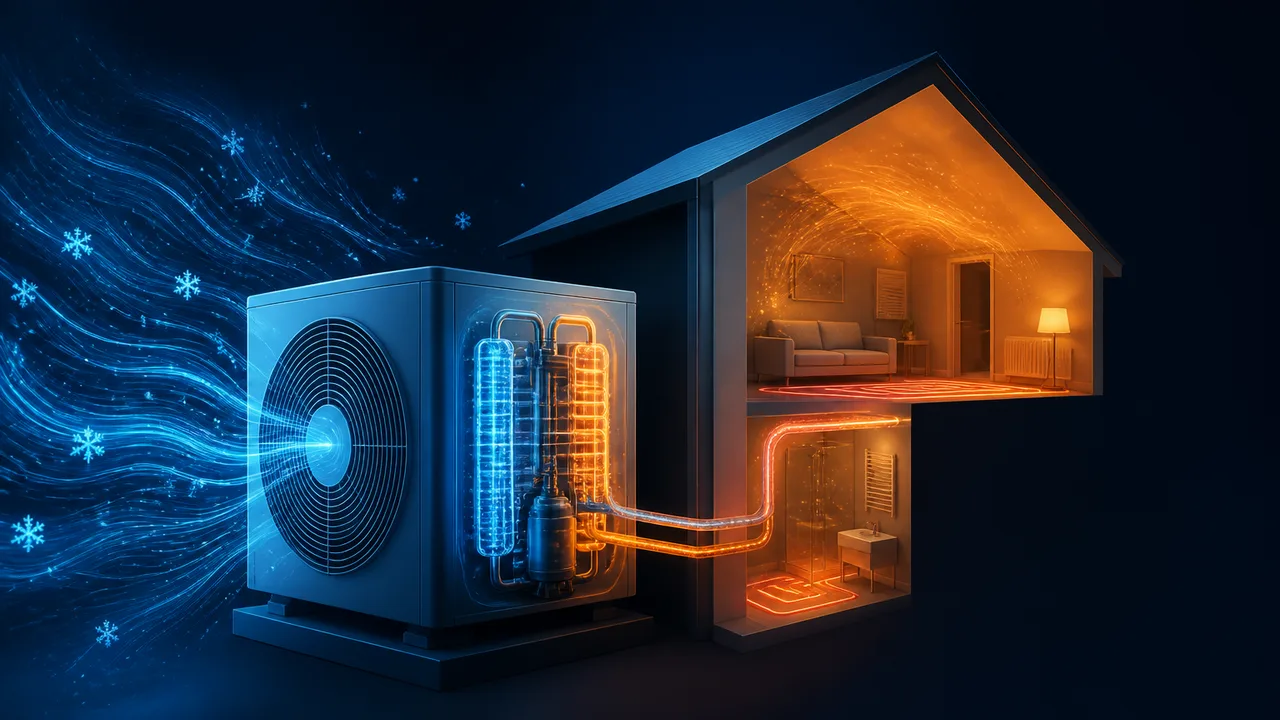
Photo: AI. Dante Nwosu
There is something genuinely disorienting about the central claim of heat pump technology: that you can pull warmth from cold air and use it to heat a home. It sounds like the kind of promise that belongs on a late-night infomercial, not in a serious conversation about decarbonizing the built environment. And yet the physics is not only real — it is, as Matt Lipson puts it in a recent Royal Institution explainer, roughly 200 years old.
Lipson, who works at Undaunted, Imperial College London's clean tech innovation hub, and is an associate at Nesta, the UK's innovation agency for social good, delivers his explanation from the same lecture theatre where the electric motor and analog photography were first announced to the world. The setting is not incidental. His implicit argument is that heat pumps belong in that lineage — not as novelties, but as mature science that the public has been slow to recognize.
Whether or not that framing lands is partly a matter of taste. But the underlying mechanics are worth understanding clearly, because the gap between what heat pumps actually do and what most people think they do is doing real damage to adoption rates.
The Fridge You Already Own
The most useful thing Lipson does in his explainer is refuse to let heat pumps remain abstract. "Heat pumps don't make heat, they move it," he says. "And you already have one. It's called a fridge."
That analogy is more load-bearing than it first appears. A refrigerator extracts heat from inside its insulated box and dumps it into your kitchen. The box gets cold; the room gets fractionally warmer. A heat pump runs the same cycle in reverse — extracting heat from outside and depositing it inside your home. The mechanism is identical. What changes is which side of the transaction you care about.
The working fluid — a refrigerant chosen specifically because it boils at temperatures well below freezing — circulates through a closed loop. Outside the house, it absorbs heat from the ambient air and boils into a gas. The heat pump then compresses that gas, which raises both its pressure and its temperature (this is the first law of thermodynamics at work: do mechanical work on a gas, and its internal energy increases). That now-hot gas travels inside, releases its heat into the home's water circuit, condenses back into a liquid, expands and cools, and the cycle begins again.
The second law of thermodynamics, which Lipson also invokes, is what makes the initial step possible: heat flows naturally from warmer regions to cooler ones. Even on a cold winter day, the outdoor air contains thermal energy. The refrigerant, at its sub-zero boiling point, is colder than that air — so heat flows into it spontaneously. No conjuring required.
The Efficiency Number That Confuses Everyone
Here is where most public communication about heat pumps stumbles. The claim that they can operate at 300 to 500 percent efficiency sounds either like a misprint or a violation of something fundamental. It is neither.
Efficiency, as applied to a boiler, measures how much of the fuel's chemical energy becomes useful heat. A good modern gas boiler converts roughly 85 percent of its fuel to heat; the rest escapes up the flue. One hundred percent is the ceiling, because you cannot get more energy out than you put in.
Heat pumps are not measured against that ceiling, because they are not converting energy — they are moving it. For every unit of electrical energy consumed to run the compressor, the system can deliver three to five units of heat into the home. The extra two to four units were already present in the outside air; the electricity just paid the transport cost. As Lipson explains: "That extra heat wasn't created, it was already outside. You're just moving it into your home."
This is not a loophole in thermodynamics. It is thermodynamics. The distinction matters because misunderstanding it is one of the reasons heat pumps face skepticism they have not earned.
Three Myths, Examined
Lipson addresses the most persistent objections directly, and they are worth examining without simply deferring to his authority.
"They only work in well-insulated homes." Lipson's rebuttal is blunt: "The laws of physics don't change from home to home. You can heat any home with a heat pump, even a shed in the Arctic. You just need a bigger system." This is technically accurate. A heat pump can be sized to match any heat loss rate. The practical caveat — which Lipson gestures at without dwelling on — is that a poorly insulated home will require a larger, more expensive system, and the economics become less favorable. The physics permits it; the bill may not.
"They don't work in the cold." The Scandinavian counterexample is persuasive and empirically solid. Norway and Sweden have deployed heat pumps at scale for decades, in climates that make a British winter look mild. Performance does decline as temperatures drop — the coefficient of performance falls as the temperature differential between source and output increases — but the systems continue to function. "Physics doesn't stop working in winter," Lipson observes, with a dryness that suggests he has had this conversation before.
"They're noisy." This one may have been true of older installations but is largely obsolete for modern equipment. Lipson invites skeptics to arrange a visit to a local installation through visitheatpump.com and listen for themselves. It is a reasonable suggestion.
The Hierarchy of Heat Sources
Not all heat pumps pull from the same reservoir. Lipson walks through the main variants: air source systems draw from the ambient atmosphere; water source systems draw from rivers, lakes, canals, or sewers (Lipson adds, with evident relish, that they move the heat, not the smell); ground source systems draw from the relatively stable thermal mass of the earth itself.
Water and ground temperatures fluctuate less than air temperatures across seasons, which generally makes water and ground source systems more efficient. The trade-offs are practical rather than physical: not everyone lives near a body of water, and burying ground loops is expensive. Air source heat pumps remain the dominant option partly because they are easier and cheaper to install, not because they are the best-performing technology in every context.
This is a tension the video acknowledges without fully resolving. The cheapest option is not always the most efficient, and the most efficient option is not always accessible. Deployment at scale requires grappling with both.
What Comes Next
The portion of Lipson's talk devoted to emerging technology is brief but points toward the open questions the current generation of heat pumps leaves unanswered.
Terrabora, a startup that Undaunted has worked with, is focused on reducing the cost and complexity of installing ground source systems — potentially widening access to higher-efficiency heat pump types. Anzen is developing a wall-mounted unit designed for flats and apartments, spaces where conventional heat pump installation is often impractical or impossible. The device is described as capable of heating, cooling, and air purification — a single unit addressing multiple needs.
Whether either startup delivers on that promise at meaningful scale is an open question. The heat pump industry's history includes plenty of promising iterations that moved slowly from demonstration to deployment. But the direction of travel is worth noting: the engineering work is moving toward access rather than performance improvements alone.
There is also the question that Lipson raises at the outset but does not fully pursue: heat pumps run on electricity, which means their carbon footprint tracks the carbon intensity of the grid they are connected to. In the UK, where the grid is substantially cleaner than it was a decade ago, this is increasingly favorable. In grids still heavily dependent on coal, the calculus is different. The technology is not carbon-neutral by definition — it is carbon-neutral when the electricity behind it is.
The Royal Institution building where Lipson filmed the video now runs on air source heat pumps, reportedly reducing the building's carbon emissions by 42 percent and landing it in the top 20 percent of non-domestic energy performance ratings in the UK. It is a useful data point. A Grade I listed building in central London is not a typical installation, but it is a demonstration that the constraints most commonly cited as prohibitive — age, architecture, protected status — are not necessarily disqualifying.
The physics has been settled for two centuries. What remains unsettled is the infrastructure, the economics, and the political will to act on what the physics permits.
More Like This

Can Directed Heat Beams Help Reverse Global Warming?
Caltech researcher Yae-Chen Lim thinks we can engineer thermal radiation into directed beams—and aim our waste heat straight into outer space.

Rethinking Cosmic Acceleration: A Local Illusion?
Exploring the debate on whether the universe's acceleration is a local phenomenon, challenging the concept of dark energy.

How the Asteroid Impact Ended the Dinosaur Era
Explore the catastrophic asteroid impact that ended the dinosaurs, its immediate aftermath, and the long-term environmental changes.

Subcritical Reactors: Nuclear Power's Safety Fix?
A new generation of subcritical reactors promises to make nuclear meltdowns physically impossible. But can they deliver on cost, scale, and timeline?

Understanding the Real Risk of Brain-Eating Amoebas
Explore the facts and myths surrounding brain-eating amoebas. How real is the threat, and can climate change affect its spread?

How Nanoparticles Are Already Changing Everyday Life
From self-cleaning glass to cancer detection, UCL's Professor Ivan Parkin maps what nanoparticle science can actually do right now — and where it still falls short.

Three Gorges Dam: Engineering at Planetary Scale
China's Three Gorges Dam generates more power than 20 nuclear reactors and measurably slowed Earth's rotation. The physics are astonishing. The cost was human.

Utah's Giant Solar Project Is Real—and Complicated
Utah's Green River Energy Center pairs 400 MW of solar with 1,600 MWh of battery storage. Here's what the press release leaves out.