A Victorian Train Delay Exposes Space Weather Risk
A disputed Victorian train delay links geomagnetic activity to telegraph faults, showing how space weather affected systems before satellites and power grids.

Written by AI. Olivia Meng
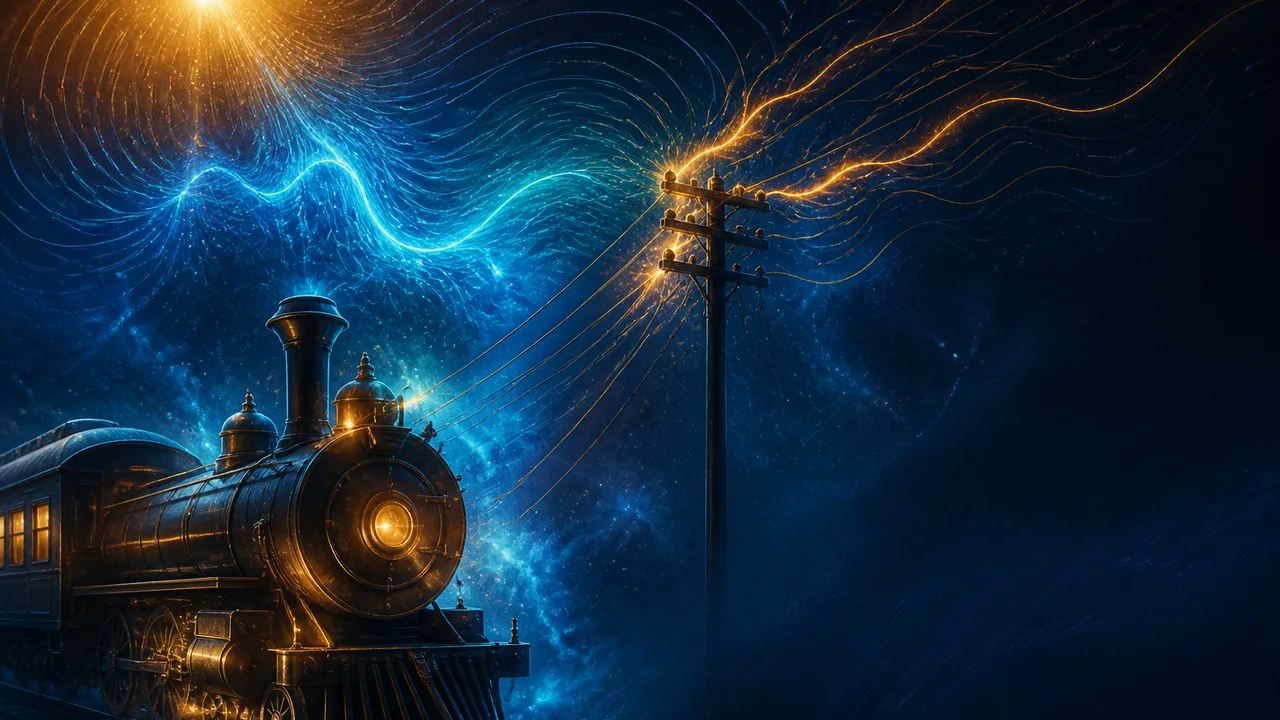
A British train reportedly lost 16 minutes in 1848 after unwanted electrical currents interfered with railway telegraph equipment. The incident sounds almost modest beside modern warnings about disabled satellites and regional blackouts. Its value lies in that modesty: one short delay may preserve an early record of space weather reaching into daily infrastructure.
The date, however, has become part of the investigation. Space.com describes researchers connecting the delay to a geomagnetic storm in 1848. Sci.News reports that the famous episode actually occurred seven years later, pointing to 1855.
That discrepancy does not erase the underlying event, but it changes how confidently researchers can associate it with conditions on the Sun and around Earth. Historical space-weather analysis depends on matching records across time. A misplaced date can connect an equipment fault to the wrong magnetic disturbance, the wrong auroral observations or the wrong configuration of a railway network.
The story therefore contains two investigations. One asks whether a geomagnetic disturbance disrupted Victorian technology. The other asks when the train was delayed at all.
A Delay Reconstructed from Paper
Modern investigators can examine magnetic observatory data, satellite measurements of the solar wind and precise timestamps from grid equipment. Researchers examining a nineteenth-century railway disruption face a thinner archive: timetables, operating records and written descriptions of electrical apparatus behaving strangely.
According to Phys.org, the historical case links a 16-minute delay with a solar storm that disrupted Victorian technology. Knowridge Science Report likewise reports that a solar storm delayed the train. These accounts support the broad reconstruction, although agreement among news reports cannot substitute for independent measurements that were never taken.
The surviving evidence has to carry several steps of the argument. Researchers must establish that the delay happened, identify a telegraph malfunction, determine that unusual currents entered the system and connect those currents to a disturbance in Earth’s magnetic environment. Each step can have a different level of confidence.
The dating dispute illustrates the problem. If an archival source places the delay seven years later than previously believed, the relevant solar and geomagnetic context also shifts. Railway equipment, routes and operating procedures may have changed during that interval. A corrected date could strengthen the proposed link if it aligns the malfunction with independent reports of magnetic disturbance. It could weaken the case if those indicators fail to line up.
The supplied accounts do not provide enough detail to resolve that chronology here. Calling the episode an 1848 delay remains convenient shorthand, but the year should carry an asterisk until the archival disagreement is settled.
How the Sun Can Enter a Telegraph Wire
The physical principle behind the proposed explanation is well established. Solar activity can disturb Earth’s magnetosphere, producing rapid changes in the magnetic field measured at the surface. A changing magnetic field creates electric fields in the ground. Those fields can drive geomagnetically induced currents through long conductors, especially systems that connect to the ground at separated points.
A telegraph line provided such a path. Its normal signals relied on controlled electrical currents. An external current could overwhelm, distort or imitate those signals, leaving operators with unreliable communications. The proposed chain places the electrical problem in railway telegraph equipment and the 16-minute delay downstream, as an operational consequence.
How much current flowed through the Victorian system remains harder to establish. The result would have depended on the line’s length and orientation, the rate of magnetic change, the electrical properties of the ground, and the design of the telegraph circuit. A historical description of erratic equipment cannot supply all those variables.
This distinction separates mechanism from attribution. Physics shows that geomagnetic disturbances can drive current through long conductors. The archival case argues that this process caused one documented railway delay. The first proposition rests on electromagnetism and extensive observation. The second depends on records assembled long after the event.
Ordinary equipment failure also belonged to the Victorian railway landscape. Telegraph components could malfunction without help from the Sun, and incomplete records can make coincidence look causal. A persuasive historical case therefore needs more than a delay and a nearby report of unusual skies. It needs timing, descriptions consistent with induced current and, ideally, evidence from more than one affected system.
What Historical Evidence Can Establish
Researchers often reconstruct early space weather through overlapping proxies. Reports of auroras can indicate disturbed geomagnetic conditions, especially when displays appear at unusual latitudes. Magnetometer records, where available, provide stronger evidence. Telegraph operators’ descriptions add another layer because the infrastructure itself could respond to electrical changes.
Each source has limits. Auroral accounts depend on weather, location and the language used by observers. Early magnetic instruments lacked the global coverage of modern networks. Operational records were written to run railways and telegraphs, not to answer questions posed by researchers in 2026.
The train case is useful precisely because infrastructure records capture consequences. An aurora establishes that observers saw light in the sky. A communications failure shows that a disturbance may have crossed from geophysics into an engineered system. A recorded delay then provides a social and economic outcome, albeit a small one.
The 16-minute figure can create an illusion of precision. It may accurately describe railway timekeeping while saying little about the storm’s strength. A precisely recorded consequence does not automatically yield a precise measurement of its cause.
That boundary should shape how the event is described. The evidence supports a historically inferred space-weather disruption. It does not provide the equivalent of a modern instrument trace showing the current, voltage and magnetic field at the railway line minute by minute.
From Telegraph Circuits to Interconnected Networks
Victorian telegraph systems were an early demonstration of a vulnerability that expanded as societies installed more conductors and depended more heavily on continuous communications. Modern exposure includes electric transmission networks, pipelines, communications systems, navigation services and satellites.
Those systems do not all fail through the same pathway. Geomagnetically induced currents can enter grounded power and pipeline infrastructure. Changes in the upper atmosphere can degrade radio propagation and satellite navigation. Charged particles and radiation can interfere with spacecraft electronics, while atmospheric expansion during strong solar activity can increase drag on satellites in low Earth orbit.
Interconnection raises the potential consequences. A railway telegraph fault could delay a train while leaving much of the surrounding economy untouched. Contemporary transport, finance, communications and energy systems exchange timing and location data continuously. A disruption in one service can travel through dependencies that engineers outside the affected sector may not control.
Modern society also has advantages the Victorians lacked. Space-weather forecasts, satellite observations, magnetic monitoring networks and operational procedures can give infrastructure managers time to respond. Grid operators can adjust configurations, satellite operators can protect equipment, and navigation users can receive warnings about degraded accuracy. Forecasting remains imperfect, particularly when estimating the local effects of an arriving solar disturbance.
The historical comparison therefore resists a simple claim that modern technology has made society helpless. Exposure has grown, cascading failures carry higher stakes, and monitoring has improved. Risk emerges from all three conditions at once.
The Archive as a Stress Test
Old disruptions help researchers extend the record beyond the period covered by satellites and dense instrument networks. That longer view matters for rare hazards. Engineers estimating events that may occur only occasionally cannot rely solely on a few decades of modern observations.
Historical cases also reveal how institutions classify unfamiliar failures. Telegraph operators could describe currents they did not request and equipment that behaved against expectation, even when the wider physical cause remained obscure. Later investigators can compare those reports with reconstructed geomagnetic conditions, but every missing ledger and disputed date widens the uncertainty.
The strongest reading of the train episode is restrained: a documented railway delay appears consistent with a known space-weather mechanism, and archival work may revise its date from 1848 to 1855. The weakest reading treats 16 minutes as proof of a fully measured solar storm. The surviving record cannot support that level of certainty.
Whether the ledger ultimately settles on 1848 or 1855, the episode captures a durable engineering fact. Once societies stretch conductive networks across the landscape, events above the atmosphere can acquire a timetable.
More Like This
Solar Cycle 25 Was Twice as Strong as Predicted
Solar cycle 25 peaked at nearly double forecast levels. Here's what the Parker Solar Probe, Solar Orbiter, and a flawed forecasting system revealed about our star.
SpaceX Launches 27 Starlink Satellites, Lands Booster at Sea
A Falcon 9 launched 27 Starlink satellites from Vandenberg on Sept. 6. What the routine flight reveals about the industrial pace of low-Earth orbit.
Private Satellites and AI Are Rewriting How We Watch Earth
Commercial satellite constellations and AI can track forests, ice and fires in near real time. The catch: who can audit the data, and who gets to see it.
Cold War Flashes and Alien Technosignatures
Astrophysicist Beatriz Villarroel's VASCO project found mysterious flashes in 1950s sky photos linked to nuclear tests. Here's what the evidence actually shows.
How Cyrus Field's Transatlantic Cable Wired the World
In 1858, a bored paper millionaire attempted the Victorian era's greatest moonshot. The story of the first transatlantic telegraph cable—and what it actually changed.
The War of the Currents: AC vs DC History
The War of the Currents was won on physics, not propaganda. A look at how Edison, Westinghouse, and Tesla shaped the electrical grid we still live with today.
Event Horizons Form Before Black Holes Do
A new PBS Space Time episode reframes event horizons as causal verdicts written by the future — not boundaries drawn by the present. The implications run deep.

Spielberg's Disclosure Day and the Politics of Withheld Truth
Spielberg's new film Disclosure Day frames UAP secrecy as epistemic injustice. A climate reporter finds the argument uncomfortably familiar.