Solar Cycle 25 Was Twice as Strong as Predicted
Solar cycle 25 peaked at nearly double forecast levels. Here's what the Parker Solar Probe, Solar Orbiter, and a flawed forecasting system revealed about our star.

Written by AI. Olivia Meng
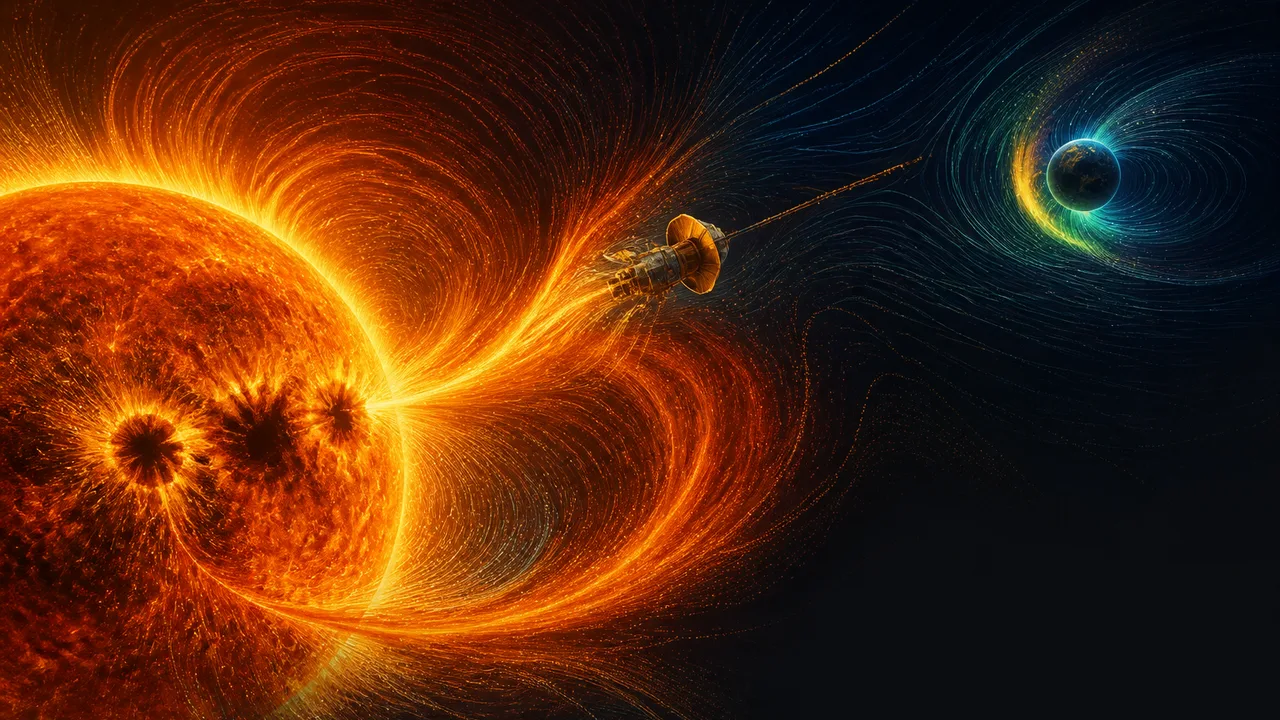
Photo: AI. Dexter Bloomfield
In May 2024, auroras blazed over Florida, the Bahamas, and Hawaii. People photographed them from their backyards with mild bewilderment. The light show was genuinely spectacular — and also a sign that something had gone significantly wrong with our ability to predict what the sun was going to do.
Solar cycle 25, which began in 2020, was supposed to be quiet. An international panel convened by NASA and NOAA reviewed the available forecasts in 2019 and settled on a peak of around 115 sunspots — a below-average maximum, consistent with a decades-long weakening trend. Instead, August 2024 delivered 216 sunspots, nearly double the projection and the highest count in 23 years. As the Astrum channel summarizes it, the result "shaken some of our most fundamental assumptions about the sun."
The panel wasn't negligent. They used the best available tool: the polar field precursor, which works by tracking magnetic flux left behind by decaying sunspots as it drifts toward the poles. That polar field at solar minimum is the seed of the next cycle's activity. Measure it accurately, and you have a reasonable forecast. The logic is sound. The problem, it turned out, was the instrument doing the measuring.
The Measurement Problem — and the Institution That Trusted It
NASA's Helioseismic and Magnetic Imager, aboard the Solar Dynamics Observatory, has been the workhorse of solar field observation since 2010. In 2025, researchers at the National Solar Observatory ran synthetic magnetic field data through a virtual model of the HMI and found the real instrument had been capturing only about half of the sun's actual polar field strength. The tool at the center of the forecasting consensus had a systematic blind spot, and no one caught it for over a decade.
That's worth sitting with. The 2019 panel wasn't making reckless guesses — they were following the consensus methodology, using what the community had agreed was the most reliable approach. But consensus methodology can calcify. When three consecutive cycles each came in weaker than the last, the prior of a weak cycle 25 felt reinforced by pattern. It was, in hindsight, the kind of institutional confidence that mistakes instrument limitations for physical reality. The forecasting system wasn't just a victim of bad data; it was also a system that didn't build in enough skepticism about where its data came from. That's a different kind of failure — quieter, and harder to fix.
Even correcting for the HMI calibration issue doesn't fully account for cycle 25's intensity, which suggests the measurement problem was compounding something structural.
Where the Dynamo Actually Lives
For decades, the leading model placed the sun's magnetic engine at the tachocline — a boundary layer more than 200,000 kilometers below the surface, where differential rotation was thought to wind up magnetic field lines like coiled springs. It was a compelling picture. It was also, apparently, wrong.
In 2024, researchers from MIT, Northwestern, the University of Edinburgh, and other institutions used a NASA supercomputer to run the most detailed solar simulations yet attempted. What they found was that the magnetic dynamo originates just 32,000 kilometers below the surface — roughly a sixth of the depth the standard model assumed. The mechanism proposed is magnetorotational instability: a weak magnetic field bridging two plasma layers rotating at different speeds, amplifying the difference rather than damping it, generating self-sustaining turbulence. One consequence of this model, if it holds, is that it could explain why consecutive solar cycles vary so dramatically in strength — something the tachocline model struggled to account for.
This is still a simulation result. It will need observational confirmation. But it reframes what we think we're looking for.
Parker, the Probe, and a Long Vindication
The Parker Solar Probe launched in 2018 with, among other aims, the goal of studying the solar dynamo firsthand. On Christmas Eve 2024, it made its closest-ever approach to the sun — approximately 6 million kilometers above the surface, traveling at nearly 700,000 kilometers per hour, making it the fastest human-made object in history. What it has gathered over 27 orbits is genuinely transformative.
The corona problem had nagged solar physicists for generations. The sun's surface sits at roughly 5,500°C. Its outer atmosphere — the corona — reaches temperatures between one million and ten million degrees. The energy had to come from somewhere; the mechanism was unclear. The Parker probe found it encoded in the structure of the solar wind itself. Viewed from near Earth, the solar wind looks like a continuous turbulent fluid. Up close, it resolves into discrete streamlets that match the sizes of super-granules on the sun's surface, with magnetic field lines twisted into S-shaped structures called switchbacks. These appear to form when closed magnetic loops collide with open ones in interchange reconnection events — generating heat, ejecting material, warming the corona from below.
It's a mechanism that rhymes with what the University of Chicago astrophysicist Eugene Parker proposed — that convective super-granules could tangle coronal magnetic fields until they snap and reconnect, transferring stored energy as heat. Parker's contemporaries largely dismissed the idea. Parker died in 2022, having lived to see a probe bearing his name confirm what the field had spent decades doubting. The instrument built in his honor found the evidence his critics said wasn't there.
There's a specific irony in that sequence that solar cycle 25 has now extended. The same community that dismissed Parker's field-line braiding hypothesis trusted, for fifteen years, a magnetograph that was only reading half the sun's field. The probe named for a man who was wrong in the right direction is now teaching us how much more we've misread.
The South Pole, Seen for the First Time
Because nearly every spacecraft orbits in the ecliptic plane — the flat disc traced by the planets — humanity had never seen the sun's poles face-on. Solar Orbiter was built to change that, using a series of Venus gravity assists to tilt its orbit progressively higher. On March 23, 2025, it crossed 17 degrees below the solar equator and captured the first direct images of the sun's south pole.
What it found there was not order. During solar maximum, both magnetic polarities coexist at the south pole simultaneously — tangled, intermixed, the orderly north-south distinction collapsed into chaos. Out of this, the sun resolves itself by flipping its entire magnetic field: north becomes south, south becomes north. The full magnetic cycle — known as the Hale cycle — takes 22 years, twice the familiar 11-year sunspot cycle.
Solar Orbiter's SPICE spectrometer then went further, mapping the velocity of solar material at the polar transition region and tracing solar wind back to its actual source for the first time, rather than inferring origins from measurements taken millions of kilometers downstream. And a November 2025 paper using Solar Orbiter data showed that the poleward migration of sunspot magnetic fields — the process that builds the polar field for the next cycle's precursor — may be moving faster than our models assumed. If the flux arrives ahead of schedule, the forecasting methodology is miscalibrated at its foundation, not just at the measurement level.
What a Serious Storm Would Actually Mean
The May 2024 event compressed Earth's plasmasphere — the bubble of charged plasma that shields our magnetosphere — dramatically inward, leaving satellites in geostationary orbit and most in medium Earth orbit exposed to the full force of the storm. GPS frequency bands took direct interference, producing position errors, data gaps, and tracking failures across global airspace. Hundreds of spacecraft were affected in Europe alone. Ionospheric disturbances were severe enough to produce sudden deviations in aircraft flight tracks.
The recovery took more than four days — far longer than the typical one to two. Research linked to the storm established for the first time a direct, conclusive connection between negative ionospheric storms and delayed plasmasphere recovery: the storm drove nitrogen and molecular oxygen into the upper atmosphere, depleting the atomic oxygen ions that normally power the replenishment process. The supply chain for the plasmasphere's recovery was cut off at the source.
That was a storm that produced auroras over the Caribbean, not a Carrington-scale event. The Carrington event of 1859 — still the strongest geomagnetic storm on record — hit so violently that telegraph wires caught fire. A Lloyd's of London analysis estimated that a comparable event striking the United States today could cause between $600 billion and $2.6 trillion in damages.
The warning window, if such a storm were headed our way, would be between 15 and 60 minutes — measured from the moment solar plasma reaches the L1 Lagrange point, 1.5 million kilometers away, where we can finally determine the magnetic field orientation that governs how destructive the impact will be.
NOAA's SWFO-L1 satellite arrived at L1 in January 2026, providing the first dedicated continuous operational space weather monitoring. NASA's IMAP mission is also stationed there. ESA's Vigil mission, slated for 2031, will position itself at the L5 point — off to the side of the Earth-sun line — where it can observe active solar regions rotating into Earth-facing position before they arrive, potentially extending warning times from minutes to days.
Solar cycle 26 is expected to begin somewhere between 2029 and 2032. What we now know, with some confidence, is that the models we would have used to predict it were wrong in multiple compounding ways simultaneously — the dynamo theory, the instrument calibration, the rate of polar flux migration. The corrected picture is still being assembled.
Eugene Parker spent years being told his ideas about the corona didn't hold up. The probe named for him proved otherwise. The question now is how many other things we're currently confident about will require a similar reckoning — and whether we'll need another instrument we don't yet have to find out.
More Like This
How the Asteroid Impact Ended the Dinosaur Era
Explore the catastrophic asteroid impact that ended the dinosaurs, its immediate aftermath, and the long-term environmental changes.
Triton's Strange Orbit and the Ice Giants' Secrets
Triton's retrograde orbit, nitrogen geysers, and the chaotic magnetic fields of Uranus and Neptune reveal how little we understand our own solar system.
Solar Orbiter Captures First Direct View of the Sun's Poles
Solar Orbiter has captured the first direct images of the Sun's poles, revealing a chaotic magnetic field mid-reversal—and what it means for space weather forecasting.
Mars Lost Its Water. Rovers Are Piecing Together How.
Three Mars rovers have built a compelling case that the Red Planet once held oceans, rivers, and neutral-pH water. Here's what the evidence actually shows.
SMILE Spacecraft: X-Raying Earth's Magnetic Shield
ESA and China's SMILE spacecraft launched May 2026 to image Earth's magnetosphere in X-rays—here's why that perspective shift matters for space weather science.
Gravity's Strangest Effects, From Time to Cosmic Voids
From gravitational time dilation to the Dipole Repeller and LIGO's detections, here's what gravity actually does—and what it still can't explain.
Anil Menon Reaches the ISS on His First Spaceflight
NASA astronaut Anil Menon launched to the ISS on July 14 aboard Soyuz MS-29. His eight-month mission raises questions about what space cooperation looks like next.

Ontario Wildfire Smoke Chokes Cities Across North America
Roughly 100 uncontrolled Ontario wildfires are sending smoke 1,000 miles into the U.S. Midwest and Northeast, ranking Toronto worst air quality globally.