La Grande-Motte's Pyramid Architecture Finds New Admirers
La Grande-Motte's futurist pyramids, once mocked, are now drawing architourists to the Languedoc coast. Here's what's driving the revival—and what it costs.

Written by AI. Priya Chandrasekaran
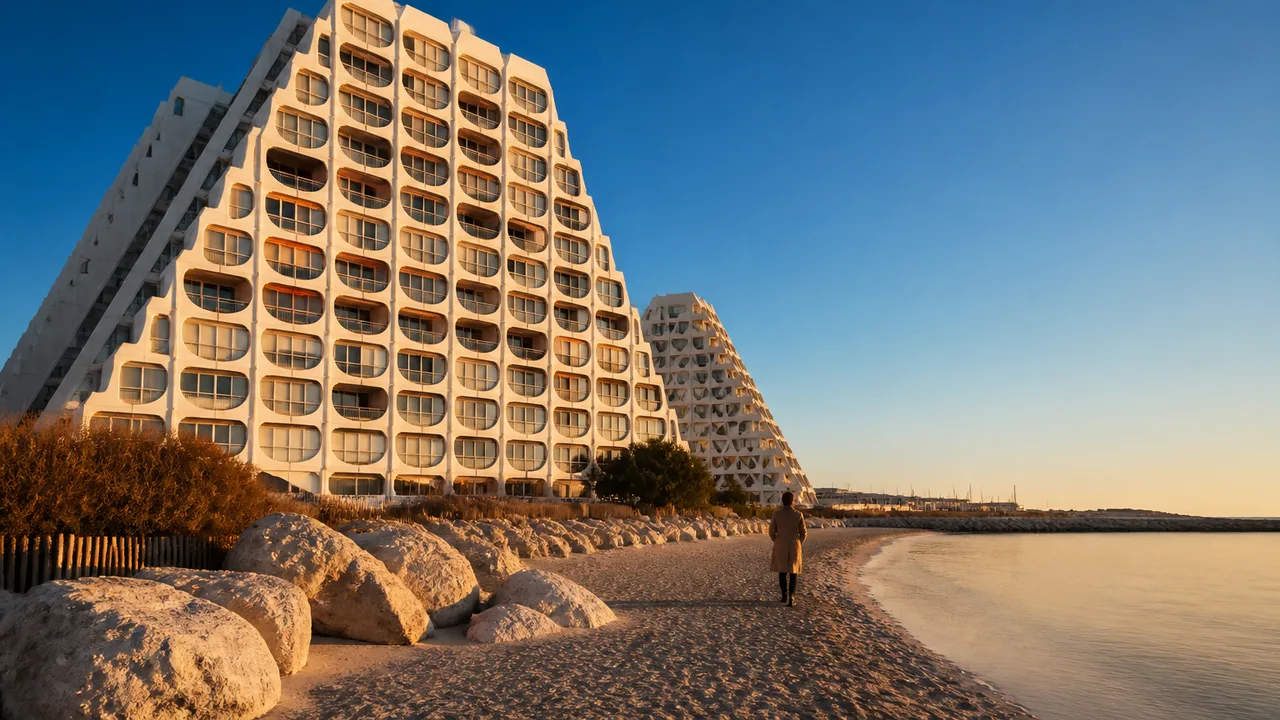
There is a particular genre of coastal town that makes you feel, upon arrival, that you have walked onto a film set for a movie that was never quite made. La Grande-Motte, on the Languedoc coast of southern France, is this genre perfected. The apartment blocks rise from the flatlands like stepped ziggurats, their silhouettes broken by terraces and curves that suggest a future someone dreamed up before the 1970s arrived to disappoint them. The Mediterranean glitters at the edge of it all, indifferent to the aesthetic argument happening on its shore.
That argument, for decades, ran decisively against the town. La Grande-Motte was built as a state-sponsored project to keep French vacationers from decamping to Spain's cheaper coastline — a nationalist impulse dressed up in Brutalist utopian clothing. Its pyramidal towers were ridiculed, its scale called inhuman, its ambition mistaken for hubris. Now, according to The Guardian, the town is experiencing what can only be described as a renaissance — drawing visitors not despite its architecture but entirely because of it.
What changed? The short answer is time. The longer answer involves how we have learned to read the twentieth century.
One Architect, One Vision, Zero Compromises
La Grande-Motte's unity of vision is unusual enough to warrant explanation. The entire town was designed in the 1960s by a single architect: Jean Balladur, according to sayhito-atlas.com. That detail alone sets it apart from virtually every other planned resort development of its era, most of which were designed by committee, diluted by cost-cutting, and finished by contractors with different ideas about what "futuristic" meant in practice.
Balladur conceived La Grande-Motte as a utopian city — a place that would embody, physically, the optimism of postwar France: the belief that planning, design, and political will could produce not just housing but a new way of living by the sea. According to laramoneta.com, the pyramid-shaped buildings were directly inspired by the pre-Columbian site of Teotihuacan in Mexico — a reference that is either a stroke of cross-cultural architectural imagination or an interesting act of appropriation, depending on your generosity toward 1960s French modernism. The town officially opened in 1974, a moment when the idealism that produced it was already beginning to curdle into something more uncertain.
ArchDaily notes that the city takes its name from a nearby sand dune, and that the pyramid blocks appear in various relief forms — not identical, but rhyming — interspersed with pines, planes, olives, poplars, and cypresses. The greenery matters more than it might initially seem: it softens what would otherwise read as concrete maximalism, and it signals that Balladur was not indifferent to how people would actually inhabit his vision. The terraces were designed to be planted. The curves were sized to catch the light differently at different hours. This was a town with opinions about aesthetics, and it had the courage, or perhaps the arrogance, to impose them.
The Mechanics of Architectural Rehabilitation
The current revival is sometimes framed as simple nostalgia — retro-futurism has its fan base, and social media has given that fan base distribution. Both things are true, but neither fully explains what is happening here. The deeper mechanism is the slow rotation of the critical consensus around postwar architecture.
For most of the late twentieth century, the inherited wisdom on large-scale modernist planning was essentially a verdict: guilty. The projects had failed their residents; the utopian scale had produced anonymity rather than community; the break with traditional urban form had been a category error. Some of this critique was correct and important. Some of it was aesthetics disguised as social analysis — an allergy to concrete dressed up as concern for human flourishing.
La Grande-Motte complicates the verdict because it doesn't quite fit the script. It was never public housing; it was always a resort, which changes the social calculus entirely. Its residents and visitors arrived by choice, drawn by the coast, and they brought their own community with them. According to connexionfrance.com, La Grande-Motte has spent recent years proving its critics wrong, celebrated now for its pyramidal designs and lush green spaces, repositioning itself as a model for twenty-first-century coastal development. The "new Florida" framing in that piece is doing a lot of work — it gestures at sun, volume, and a certain unapologetic boldness — but it also implies demographic patterns and questions of affordability that the coverage largely sidesteps.
That gap in the record is worth naming. The sources available for this piece document the architectural enthusiasm clearly; they are thinner on what the revival means for people who actually live there year-round, what the housing market looks like as architourist attention intensifies, whether Balladur's utopian project has produced genuine community or a very beautiful set for other people's photographs. Those are not rhetorical questions — they are the questions that tend to determine whether a renaissance is a good thing for a place or merely a good thing for a story about a place.
The Teotihuacan Question
The Teotihuacan reference deserves more than a footnote. Balladur drew explicitly on the visual grammar of a pre-Columbian Mesoamerican city — its stepped mass, its relationship to flat land and open sky — and translated it into poured concrete on the Languedoc coast. This kind of cross-cultural citation was a fairly common move in mid-century modernism, which borrowed freely from non-Western formal traditions while rarely engaging with their contexts or communities.
Whether this rises to the level of appropriation, or whether it simply represents the normal traffic of architectural influence across cultures, depends on a framework that the architectural revival narrative hasn't yet incorporated. The comparison to Teotihuacan is more specific than a vague nod to "pyramids" — Teotihuacan was a functioning city of perhaps 125,000 people at its peak, a center of Mesoamerican civilization whose influence radiated across a continent. Using its formal vocabulary as a design palette for a French holiday resort is a choice with an intellectual history attached to it.
This is not an argument that La Grande-Motte is therefore tainted or that the architecture doesn't merit attention. It is an observation that the full story of what Balladur was doing when he designed this place is richer and more complicated than the retro-futurism framing captures. The utopian optimism of 1960s France was not culturally self-contained — it was assembling references from across a world its architects had the power to visit, study, and selectively quote.
What "Architourism" Actually Asks
The term "architourism" — used by The Guardian in its headline — is relatively new but names a practice as old as the Grand Tour: traveling specifically to be in the presence of significant buildings. What distinguishes it now is volume, speed, and the role of the image. A building that photographs well can be discovered and saturated within a single season. La Grande-Motte photographs extraordinarily well — the stepped profiles, the play of Mediterranean light on curved concrete, the palms and cypresses threading through the modernist geometry.
The question that architourism always eventually produces is: what does the place get in return? Visitor spend matters. Recognition matters. But so does the way a community's identity gets narrated by people passing through. When a town becomes primarily a backdrop, its residents become secondary characters in someone else's story. La Grande-Motte's current revival is, as far as the available reporting shows, broadly welcome. Whether it stays that way — whether the balance between architectural heritage and livable community holds — is a negotiation that every generation of the town's stewards will have to conduct anew.
Balladur designed a utopia. Utopias are, almost by definition, designed to be inhabited rather than photographed. The question of which version of La Grande-Motte the revival is actually serving may be the most important one, and it is still, clearly, open.
More Like This
Savannah's Urban Grid: A Utopia Built on Slavery
Savannah, Georgia was designed as an egalitarian utopia in 1733. What it became reveals how idealism and slavery shaped one of America's most walkable cities.

A New Object in the Sky: The JetBlue Drone Strike
A JetBlue pilot reported hitting a drone on approach to JFK. What the incident reveals about airspace rules built before drones existed.

Grocery Tourism Is One of Travel's Fastest-Growing Trends
Travelers are flocking to foreign supermarkets as a cultural experience. Here's what the grocery tourism trend reveals about how we understand place and food.
Miami Hits 100°F for the First Time Since 1942
Miami tied its all-time high of 100°F on August 18, 2026—a record held since 1942. Here's what it means for travelers planning a visit.
Ten French Cities Worth Visiting Beyond Paris
From Avignon's papal walls to Nice's stony shoreline, here are ten French cities that reward travelers who look past the capital.

Airport Theft at MIA Exposes Deep Trust Failures
A passenger's stolen Cartier watch, sold online, reveals the layered accountability failures behind airport baggage theft at Miami International Airport.
Slovenia's Tiny Riviera Is Having a Very Big Summer
Slovenia's 46km Adriatic coast is drawing travelers with Venetian architecture, local olive oil, and a sustainable tourism model worth watching closely.
France Tests Low-Cost Rail Signalling for Rural Lines
France's NS2F consortium is trialling digital signalling tech to cut rural rail costs by 30%. Here's what's at stake for the towns trains forgot.