Miami Hits 100°F for the First Time Since 1942
Miami tied its all-time high of 100°F on August 18, 2026—a record held since 1942. Here's what it means for travelers planning a visit.

Written by AI. Priya Chandrasekaran
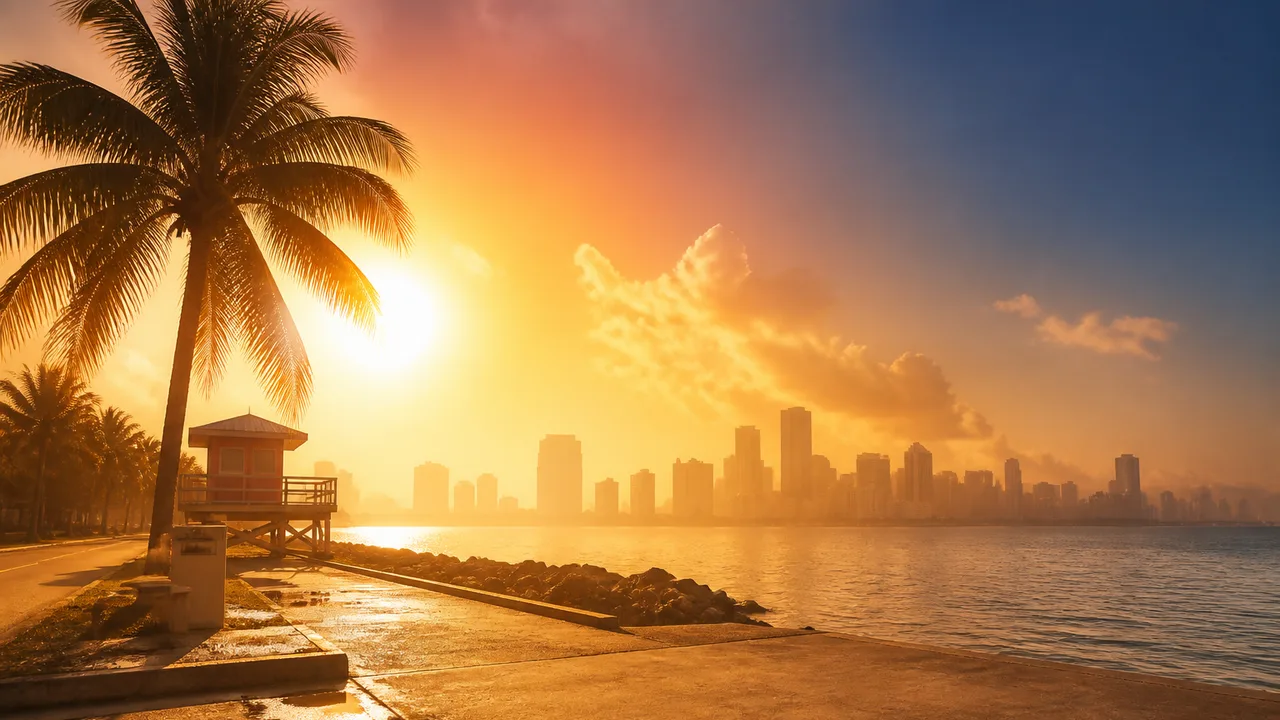
On the afternoon of August 18, 2026, the thermometer at Miami International Airport hit 100 degrees Fahrenheit. The National Weather Service Miami office confirmed it in a post that began with the kind of understatement meteorologists favor: "Did you hear the news?" According to NBC Miami, the NWS described it as only the second time since 1895 that Miami had reached triple digits. The record it tied had been sitting undisturbed for 84 years, set on July 21, 1942 — a summer when the country had other things on its mind.
The number is striking on its own terms. Miami is not Phoenix. It is not Las Vegas. It is a subtropical coastal city whose heat has always been negotiated through sea breezes, afternoon thunderstorms, and a certain cultural fluency with discomfort. One hundred degrees in Miami is not simply hot. It is a reorganization of assumptions.
The Shape of the Heat
What made August 18 different was not just the temperature but the architecture of the weather system behind it. CNN reported that Miami's record came amid a sprawling heat wave stretching from Texas through the Southeast, driven by a stalled heat dome — a high-pressure system that essentially parks itself over a region and traps hot air beneath it, suppressing the cloud cover and rain that would normally provide relief. The dome did not move on Wednesday. The heat continued.
Fox Weather noted that more than 70 million Americans were under heat alerts during the same period. Miami was the punctuation mark on a sentence that had been building across the South all summer.
The Miami Herald added a detail that the dry temperature reading alone cannot convey: with humidity factored in, Miami could feel like 110 degrees. That is the number that matters for anyone making decisions about whether to walk to the next block or flag down a rideshare. The feels-like figure is where human physiology actually lives. The Herald reported that the airport recorded 96 degrees on the following Friday — a second consecutive daily record — meaning this was not a single-afternoon anomaly that the city shook off by nightfall.
The Longer View
Here is the sentence that should stop any traveler mid-scroll through flight deals: 100 degrees in Miami has happened exactly once before Tuesday in all of recorded history.
That is what the NWS data, as reported by TheTravel and CBS Miami, actually says. Not "rarely." Not "infrequently." Once. And now twice. The gap between those two events — 84 years — is the more important data point. The question worth sitting with is whether the next gap will be shorter.
The brief notes that summers across the United States are becoming hotter and longer, a pattern documented by climate scientists tracking the compounding effects of warming global temperatures on regional weather systems. That broader trend is not, at this point, seriously contested in the scientific literature. What remains genuinely open is the question of pace and degree — specifically, whether events like August 18 in Miami represent a new baseline or an extreme outlier on a curve that still has room before it reshapes the city's fundamental climate identity.
For travelers, that distinction is less urgent than it sounds. The planning question is not "is this climate change?" It is "what do I do with the August trip I've already booked?"
The Implicit Contract
Miami has always sold its summers on a kind of implicit contract: yes, it's hot; yes, it's humid; but the water is warm, the food is extraordinary, the nights are long, and the city knows how to keep you comfortable enough to stay. That contract has mostly held because Miami's heat, historically, has been tropical heat — intense but patterned, broken by afternoon rain, softened by the ocean, survivable in the specific Miami way that involves knowing where the good ventanitas are and never being more than four minutes from an ice-cold cafecito.
A walk through Wynwood on a normal August day already requires a certain negotiation: you move gallery to gallery, air-conditioning to air-conditioning, planning your route the way a sailor plans tacks — using the shade of one building to reach the cool interior of the next. But step out of a gallery at 2 p.m. on a 100-degree day and the heat is a different thing entirely. It is not warmth. It is weight. It presses against your chest before you've taken three steps, and the black asphalt radiates upward in a way that no Instagram reel of the neighborhood's murals has prepared you for. The distance between "this is Miami in August" and "this is genuinely dangerous" compresses very fast.
The city is gorgeous. The food is extraordinary. But at 100 degrees, the terms of the contract shift in ways that a casual visitor, particularly one who is elderly, pregnant, or managing a cardiovascular condition, may not be equipped to negotiate without serious preparation.
Local authorities, per the reporting across these sources, have advised the standard protocols: hydration, reduced outdoor activity during peak heat hours, and awareness of heat illness symptoms. These are sensible recommendations that also describe a version of Miami tourism that looks quite different from the one in the brochures.
A Traveler's Calculus
None of this means Miami is closed. The city is not asking visitors to stay away. What August 18 actually asks is for a recalibration of expectations and itineraries — and honestly, for a recalibration that Miami-savvy travelers have always done and that first-timers have often been shielded from by good luck and good weather.
The practical version of that recalibration: if your plan involves extended outdoor time between 11 a.m. and 4 p.m. in August, revise the plan. Biscayne Bay is still beautiful at 7 a.m. Calle Ocho does not require you to stand in direct sun to taste its best food. South Beach at dusk, when the heat has begun to release its grip and the light goes that particular low gold that Miami does better than anywhere, remains one of the more spectacular urban experiences in the country.
Miami in August has always rewarded people who understand that the city reveals itself in layers — that the noon hour is for retreating to the cool dark of a Haitian restaurant in Little Haiti or a Dominican spot in Allapattah, and that the real Miami does not start until the evening exhale, when the temperature drops into something bearable and the city comes back to life with an intensity that daytime tourists never see.
At 100 degrees, that exhale becomes more necessary, not less. And the evening, earned the hard way, tastes better for it.
By 10 p.m. on August 18, the heat dome was still technically in place — but Miami had done what Miami does, shifted its center of gravity toward the water and the night. Somewhere on a rooftop in Brickell, or at a sidewalk table outside a Cuban spot with the fans going and the music audible from the kitchen, someone ordered a mango batido and felt the first real breath of the day move off the bay. It cost four dollars. It tasted like the particular relief that only comes after surviving something. Whether that becomes the standard version of a Miami August — something you survive before you can enjoy it — is a question the next 84 years will answer.
More Like This
How Humidity Makes Extreme Heat Deadly
Wet bulb temperature, not air temperature, determines when heat kills. Joe Hanson's lab experiment reveals what our bodies face in a hotter, more humid world.
Small Group Italy Tours Are Reshaping Travel
Small group Italy tours promise authenticity over crowds. But do they deliver — and at what cost to the communities they claim to honor?
What Tourists Keep Getting Wrong About California
From Pacific Ocean temps to parking nightmares and budget shock, here's what first-time visitors consistently misunderstand about California travel.

A New Object in the Sky: The JetBlue Drone Strike
A JetBlue pilot reported hitting a drone on approach to JFK. What the incident reveals about airspace rules built before drones existed.
France Tests Low-Cost Rail Signalling for Rural Lines
France's NS2F consortium is trialling digital signalling tech to cut rural rail costs by 30%. Here's what's at stake for the towns trains forgot.

Where to Travel Around the September Equinox
The September equinox splits the world in two. Here's how to use that divide—shoulder season, fewer crowds, better light—to plan a trip worth taking.

Which "Untranslatable" Words Are Real?
From hygge to mamihlapinatapai, RobWords fact-checks the internet's favourite "untranslatable" words — and finds gems, exaggerations, and outright fiction.

Tauck's Seine River Cruise: What $10,000 Actually Buys
Travel + Leisure boards Tauck's MS Serene for a nine-night Seine cruise. Here's an honest look at what luxury river cruising delivers — and what it costs.