What Tourists Keep Getting Wrong About California
From Pacific Ocean temps to parking nightmares and budget shock, here's what first-time visitors consistently misunderstand about California travel.

Written by AI. Mariel Fontaine
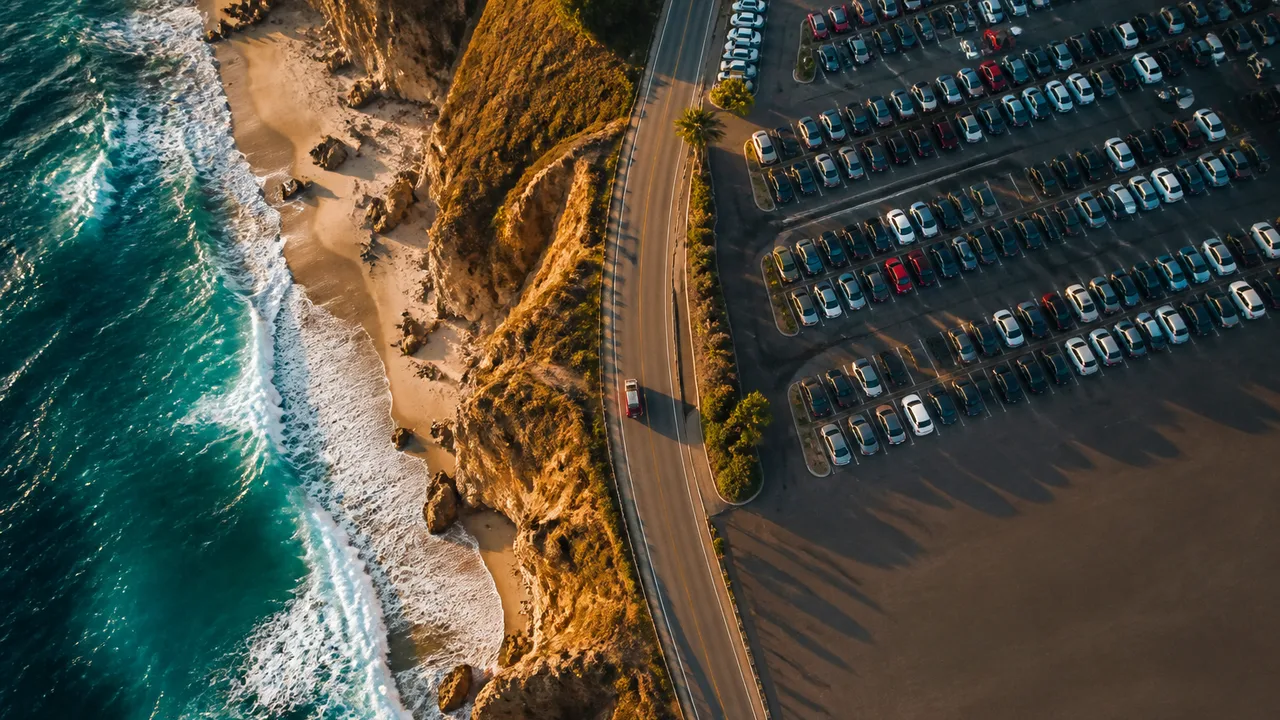
Photo: AI. Rio Sanchez
No destination on earth has a wider gap between its mythology and its reality than California. That gap is precisely what Mark Wolters, of the travel channel Wolters World, spends nearly twenty minutes trying to close in his recent video filmed in San Diego — and the exercise is more useful than it might first appear, because the mistakes he catalogs are not random. They follow a pattern. They are, almost without exception, the product of consuming California as a media product rather than approaching it as an actual place.
That distinction matters. And it's worth thinking through carefully before you book anything.
The State Is Not a State of Mind
The foundational error Wolters identifies is treating California as a monolith. "When they think of California, they think of, oh, it's all beaches and blond long-haired surfer dudes, you know, chill action in the sun," he says. "No."
He's right, and the consequences of that misread are significant. California spans roughly 770 miles from its northern border to its southern tip — a distance comparable to driving from London to Edinburgh and back. Los Angeles, San Francisco, and San Diego do not merely have different attractions; they have fundamentally different climates, cultures, economies, and rhythms. Northern California's coastline behaves more like the Pacific Northwest: foggy, cold, frequently dramatic. The Central Valley is an agricultural engine that most tourists fly directly over. Death Valley and Joshua Tree exist in a geological register that has nothing to do with the Baywatch imagery still lodged in the collective imagination.
The practical upshot is that a first-time visitor who tries to "do California" in a single trip is setting themselves up for frustration. The more honest framing is to treat a California trip the way you'd treat a trip to Western Europe — as a region with distinct subcultures, not a single destination with varying photo opportunities.
On Cars, Traffic, and the Stubborn Fantasy of Public Transit
If there is a single operational mistake that costs tourists the most time and money, it's the assumption that California's public transportation infrastructure is sufficient for meaningful exploration. It isn't. Wolters is direct on this point: "Public transportation isn't really your best option when you're getting around California."
That's not a knock on the systems that exist — San Diego's trolley, San Francisco's streetcars, and LA's expanding metro network are real and functional. But they are designed primarily for commuters within dense corridors, not for visitors who want to move between cities, access beaches that require a parking lot, or detour to Yosemite on a Wednesday. The train between LA and San Diego is scenic and pleasant; it is also not particularly fast, and it deposits you at a station rather than a destination.
The car rental calculus here is unavoidable, though not uncomplicated. Rental fees, California's notably high gas prices, parking costs (Balboa Park in San Diego now charges for parking, a fact Wolters notes with audible resignation), and the variable tax load on urban hotel rooms all stack up in ways that visitors who've budgeted loosely will not anticipate. Wolters recommends building in 30% more time than you think you'll need for any given itinerary — not because California is especially chaotic, but because it is simply large, and large places require proportionally more logistics.
One genuinely useful navigation note: Californians refer to freeways by number without the "Interstate" prefix. It's "the 5," not "I-5." It's "the 405," not "the I-405." It's a small thing, but it's the kind of thing that marks you immediately as someone who learned about the state from a streaming service.
The Ocean Is Cold. The Weather Is Not Infinite.
"The internet got you fooled," Wolters says of the perpetual-sunshine myth, and this is probably the most actionable corrective in the entire video.
The Pacific Ocean along California's coast is cold year-round because of the California Current, a south-flowing surface current that carries cold sub-Arctic water down the coast. Average summer water temperatures in San Francisco hover around 55°F (13°C). Even in San Diego, the water rarely climbs past the mid-60s Fahrenheit in peak summer. People accustomed to the Atlantic coast, the Gulf of Mexico, or Caribbean waters will find the Pacific bracing in a way that forecloses the kind of casual, prolonged swimming that California's beach imagery implies.
The atmospheric weather is more nuanced than the mythology allows as well. "June gloom" is a genuine meteorological phenomenon along the Southern California coast — a marine layer that suppresses sunshine through much of May and June. San Francisco is famously foggy for significant stretches of summer. Even in ostensibly sunny San Diego, Wolters recommends bringing a jacket for evenings. The idea that California delivers wall-to-wall warmth regardless of month or geography is a confection of tourism marketing and mid-century television.
The Cost Problem, Honestly Framed
California is expensive. This is not news, but the particular ways it is expensive for tourists sometimes are. Hotel taxes in urban cores can be substantial. Gas prices run well above the national average. Attraction pricing at theme parks and popular tourist sites has escalated sharply. Restaurant prices in high-visibility neighborhoods like San Diego's Gaslamp District or San Francisco's Fisherman's Wharf reflect rent structures, not food quality.
Wolters's advice — eat where locals eat, consult hotel staff about neighborhood spots, consider grocery stores for some meals — is standard issue but worth restating because tourists so rarely follow it. The divergence between where locals eat and where visitors eat in California is particularly pronounced, partly because the state's food culture is genuinely excellent at a neighborhood level. Carne asada fries and California burritos in San Diego's less-touristy taquerias. Mission burritos and cioppino in San Francisco's Mission District. Korean tacos and street food throughout LA. The state produces a disproportionate share of the country's fruits and vegetables, and its farmers markets reflect that abundance.
The tipping question comes up, and Wolters addresses it squarely for international visitors: "California's expensive for you as a tourist. Imagine how expensive it is for the people that live here." Service industry workers in high-cost-of-living cities depend on gratuity in ways that visitors from countries with different wage structures may not intuitively grasp. It's not a debatable point about custom; it's a structural feature of how those workers are compensated.
What the Safety Warnings Actually Mean
Wolters shifts register notably when he addresses wildfires and ocean safety, and that shift deserves attention. "When there's wildfires happening, people die. This is not a joke. It's not social media content to go film the wildfires." Rip tide flags at beaches are not decorative. Drought warnings are not suggestions.
He also names something that doesn't come up often in mainstream travel content: the phenomenon of tourists treating San Francisco's Tenderloin neighborhood, or analogous areas in other California cities, as something to observe. "It's degrading to humanity," he says plainly. California's housing crisis and the visible homelessness it has produced in its urban cores are well-documented — but documentation is the province of journalism, not vacation itineraries. People in crisis are not local color.
The Geography You Think You Know
California's coastline looks accessible on a map. In practice, much of it is bounded by private development, cliffs, or simple lack of public access points. Wolters flags this directly: finding a beautiful stretch of coast and then being unable to get down to the water — or finding a parking lot full to capacity — is a genuinely common experience. The advice to ask your hotel for specific beach access recommendations rather than relying on general maps is practical and worth taking seriously.
The city-boundary confusion he raises, via a shout-out to San Diego-based creator Chris from Yellow Productions, is also more than a trivia point. What a tourist considers "San Diego" (the Gaslamp District, Little Italy, a few miles of downtown) is a fraction of what locals consider San Diego. La Jolla is technically its own community, not a San Diego neighborhood, despite being folded into San Diego County. Getting this wrong doesn't ruin a trip, but it does produce a kind of cognitive disorientation that compounds other navigation errors.
The underlying dynamic here is the same one that runs through almost everything Wolters addresses: California has been so thoroughly pre-imagined for visitors, through decades of entertainment, advertising, and now social media, that the pre-imagining actively interferes with the experience of being there. The 50 people waiting off-camera to take the same Instagram shot is a useful image — not as cynicism, but as a reminder that the California most people think they're going to see is a collective production, and the California that actually exists requires a different kind of attention.
Whether that recalibration happens before you land or after your third circling of a full parking lot is largely up to you.
More Like This
Why Everyone on Earth Commutes for 78 Minutes a Day
New research finds humans worldwide average 78 minutes of daily travel—regardless of wealth, distance, or transport mode. Here's what that means for energy and climate.
California's "Don't Stop" Towns Have a Deeper Story
A viral video warns drivers not to stop in 12 California towns. The crime stats are real. So is everything the warning leaves out about the people who live there.
California's Forgotten Places and What They Cost
From a Nazi compound in the Pacific Palisades to a toxic mercury mine, California's abandoned places reveal what the state built, forgot, and left behind.

The 30-Second Hotel Safety Check You're Not Doing
A quick hotel room safety check—doors, locks, windows, exits—could prevent theft or worse. Here's what travel creator Mark Wolters says to do first.
Why Americans Travel Differently—And Who's Really to Blame
Mark Wolters and Shebz tackle overtourism, EES border chaos, and why U.S. vacation policy shapes how Americans see the world—for better and worse.
What Poles Actually Want Tourists to Know
From geography to drinking etiquette, here's what Polish locals wish visitors understood before arriving—and why it matters more than you think.
Airport Behavior That Makes Flying Worse for Everyone
From gate lice to baggage claim crowding, Mark Wolters of Wolters World maps the airport habits that slow everyone down—and why they persist.
Basic French Phrases That Help Tourists in France
A handful of French words can shift how locals treat you in France. Here's what actually matters, and why the effort carries more weight than fluency.