How Venus's Slow Spin Could Have Destroyed Its Moon
New simulations suggest Venus's slow rotation could doom a former moon, but cannot show one existed. Here is what the model reveals and still misses.

Written by AI. Priya Sharma
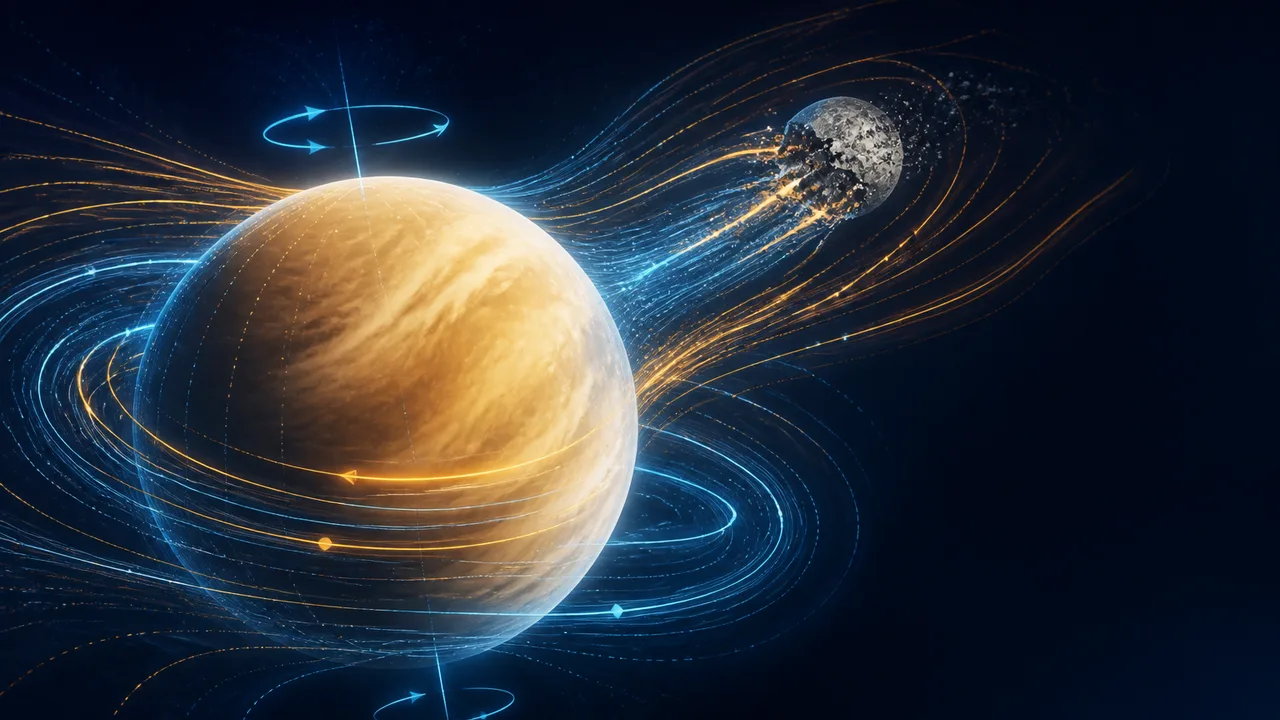
Venus takes about 243 Earth days to complete one rotation, a sluggish retrograde spin that may explain why the planet has no moon.
A new study in The Astrophysical Journal asks what would happen if early Venus acquired a moon, perhaps from the debris of a giant impact. In computer simulations, most of the hypothetical satellites eventually spiralled inward and collided with the planet. The larger moons generally fell sooner.
This result has produced headlines saying Venus “swallowed” or “ate” its moon. Those verbs perform more work than the evidence can carry. The simulations show that a moon could have been destroyed if one formed under the modelled conditions. They provide no evidence that Venus actually possessed one.
The distinction separates a plausible history from a discovered history. Stephen Kane, Franck Selsis, Jérémy Leconte and Sean Raymond modelled the survival problem, as a summary of the paper and its authors explains. Whether a moon formed remains an open question.
A Moon Can Form and Still Be Doomed
Earlier explanations for Venus's missing moon generally followed two routes. One proposed that no moon-forming collision occurred. Another proposed that Venus acquired a moon which was subsequently destroyed by a separate large impact. The University of California, Riverside release presents the new study as a third route: a satellite forms, then ordinary tidal evolution carries it back toward Venus without another collision arriving to remove it.
Kane and colleagues constructed a model coupling the planet's spin to the satellite's orbit through tides raised by the moon and the Sun. They first checked whether it could reproduce the known evolution of the Earth-Moon system. They then varied Venus's rotation and tested hypothetical satellites ranging from half to 10 times the mass of Earth's Moon.
Reproducing the Earth-Moon system is a useful consistency check. It does not demonstrate that the model captures early Venus perfectly, because researchers lack direct measurements of several relevant ancient conditions. The exercise shows how the assumed physics behaves in a familiar case before it is applied to a planet with an obscure past.
Across most of the Venus simulations, the satellite struck the planet. A detailed account of the modelling reports that larger moons reached that end more rapidly. The authors also had to satisfy two conditions together: remove the satellite and slow an initially fast-spinning Venus. Their paper says those conditions coincide only within a restricted portion of the tested parameter space, favouring moderate post-impact rotation periods and moons with lunar to super-lunar masses.
That restriction deserves equal billing with the dramatic collision. The model supplies a viable evolutionary route, rather than an all-purpose explanation for every possible early Venus. Initial spin, satellite mass and the way the planet's interior dissipated tidal energy all affected the outcome.
Earth Shows the Same Physics Running the Other Way
The Earth-Moon system provides the clearest comparison. Apollo 11 astronauts left reflectors on the lunar surface, allowing researchers to measure the changing distance between Earth and the Moon. The Moon currently recedes at about four centimetres per year, while Earth rotates once in roughly 24 hours. Rotational energy transferred through tides helps move the Moon outward.
Venus sits at the opposite end of this comparison. Its present rotation takes 243 Earth days and runs retrograde. Under the conditions considered by the researchers, that slow spin prevents a hypothetical satellite from following the Moon's outward route. Tidal interactions instead drive it inward.
The comparison clarifies why planetary size alone tells us so little. Earth and Venus are similar in size and mass, yet their spin states create different prospects for retaining a large satellite. In the simulations, an early Venusian day shorter than about 12 hours could allow a moon with roughly lunar mass to survive for billions of years. With slower post-impact rotation, destruction occurred after approximately 30 million to 1.7 billion years, according to the reported numerical results.
Earth remains an imperfect precedent. Its present recession rate does not provide a simple clock that can be run backward for Venus. The two planets experienced different solar influences, spin histories and internal evolution. Researchers also tested two assumptions about how Venus's rocky interior dissipates tidal energy. Those approaches agreed for slower spins but diverged for massive moons when Venus rotated rapidly.
That divergence identifies a central methodological limitation. Tidal evolution depends partly on an interior scientists cannot yet describe with confidence. The model's broad result, that slow rotation imperils a moon, appears across much of the tested range. Precise lifetimes and survival boundaries carry greater uncertainty.
One Impact May Have Produced Two Puzzles
Separate impact simulations add an intriguing connection. Collisions capable of producing Venus's slow retrograde rotation also tend to produce debris that falls back without forming a moon, or a satellite near the boundary between survival and destruction. Combined with the tidal calculations, those results suggest a more economical history: Venus's unusual spin and its lack of a moon could be related consequences of the same early event.
That is an inference from compatible models, not a reconstruction established by physical remains. A giant impact might have generated no lasting satellite. It might have generated one that later fell inward. A subsequent impact could still have destroyed an earlier moon. The new work makes an additional catastrophe unnecessary within its successful scenarios; it does not exclude one from Venus's history.
Physical evidence may be difficult to recover. Roughly 80% of Venus's surface is similar in age, a pattern interpreted as evidence for extensive resurfacing about a billion years ago. Such geological turnover could have erased obvious surface traces of an ancient satellite collision. Researchers have suggested that clues might instead survive within the planet, but comparable subsurface or seismic measurements remain prospective rather than available evidence.
The timing also complicates the search. A modelled moon could disappear tens of millions or more than a billion years after formation, depending on the assumptions. A scar surviving from that period would then have to endure Venus's later geological activity. Planetary history has poor archival discipline.
What Venus Changes About the Search for Other Earths
The study extends beyond one missing moon. Researchers assessing Earth-like exoplanets sometimes consider whether a large satellite might stabilize rotation, generate tides or influence long-term environmental conditions. Kane cautions that scientists do not know whether a moon is required for habitability, although Earth's Moon has affected our planet's evolution.
Venus adds a second question to that assessment. Formation does not guarantee retention. A rocky planet could experience a moon-forming impact and later lose the satellite because of its spin, tidal response and proximity to its star. For slowly rotating worlds, present moonlessness may conceal several distinct histories.
No population-wide conclusion follows from one Venus model. Exoplanet spin rates and interiors are difficult to determine, and the simulations do not establish how often large moons form or disappear. Their contribution is narrower and useful: a moon's existence is an evolutionary outcome, not a permanent accessory attached at planet formation.
Venus therefore remains a test case with a missing piece at its centre. The calculations explain how a moon could die. Establishing whether one lived will require evidence that billions of years of resurfacing may already have buried.
More Like This
How Lunar Surveillance Found McGetchin's New Crater
NASA's McGetchin crater shows how 17 years of lunar change detection can reconstruct impacts and guide debate over engineered craters on the lunar surface.
New Simulations Say the Moon Formed in Five Hours
New Southwest Research Institute simulations suggest the Moon formed within five hours of the Theia impact, challenging decades of gradual accretion theory.
Two Small Worlds With Atmospheres They Shouldn't Have
A Kuiper Belt rock and a distant rocky exoplanet both carry atmospheres that shouldn't exist. What these discoveries reveal about planetary science.
NASA and IBM Launch AI Model to Search the Moon's Data Archive
NASA and IBM have released an open AI model trained on 17 years of lunar data. What it maps, what it cannot do yet, and why researchers are still testing.
Mars, Enceladus, and the Search for Life
From Mars's vanishing water to Enceladus's hidden ocean, planetary science is reshaping our understanding of where life might exist.
Jupiter's Storms Run Deeper Than Anyone Expected
NASA's Juno probe reveals Jupiter's storms plunge 1,800 miles deep—and the sun isn't powering them. Here's what scientists think is going on inside.
Fire Tornadoes on a Lake: The Bardstown Bourbon Disaster
In 2003, fire tornadoes erupted on a Kentucky lake. The cause wasn't paranormal—it was 800,000 gallons of burning bourbon and the right wind geometry.
The Maths Behind Palindrome Ages Explained
Mathematician Kat Phillips unpacks why some pairs of people have reversible ages—and the surprisingly elegant number theory that governs when it happens.