Two Small Worlds With Atmospheres They Shouldn't Have
A Kuiper Belt rock and a distant rocky exoplanet both carry atmospheres that shouldn't exist. What these discoveries reveal about planetary science.

Written by AI. Amelia Nwofor
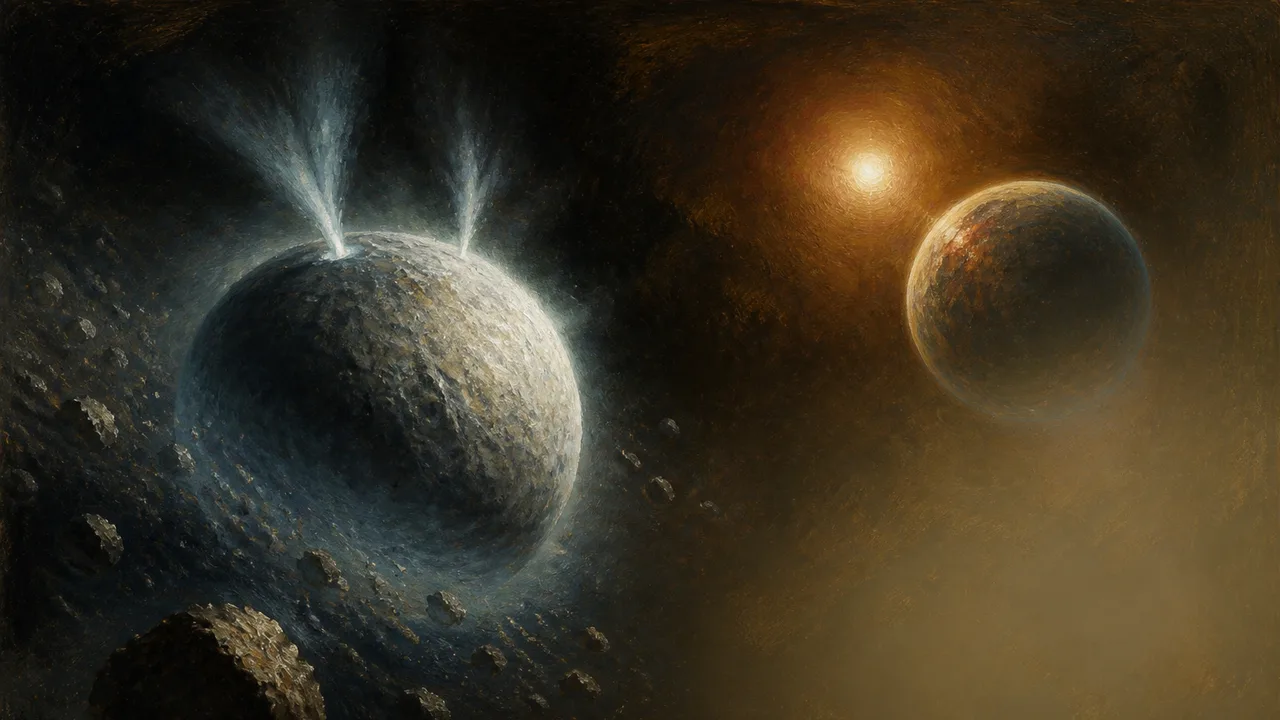
Photo: AI. Henrik Solberg
The rule was simple and, we thought, airtight: to hold an atmosphere, you need gravity, and to have gravity, you need mass. Small, cold, distant objects don't get atmospheres. They get frost.
That rule now has two very inconvenient exceptions.
The first is a chunk of ice and rock in the outer solar system, formally designated 2002 XV93, roughly 310 miles wide and sitting nearly 4 billion miles from the sun. The second is LHS 1140b, a rocky world orbiting a red dwarf star about 48 light-years away. Neither of them, by prior reasoning, should be wrapped in gas. Both of them are. And the scientific community is, to put it precisely, not done thinking about why.
The Rock That Shouldn't Have Air
XV93 is not large. The Territory channel's narrator, Mathew McQuinn — a voice actor whose credits are documented by Behind The Voice Actors — frames the scale this way: "You could drive across the entire world of XV93 in about 5 hours." For comparison, Pluto, the only other Kuiper Belt object previously confirmed to have an atmosphere, is nearly 1,500 miles across. XV93 is, gravitationally speaking, a pebble with delusions of planethood.
The detection itself is worth sitting with, because it's easy to hand-wave past methodology when the result is exciting. A team of researchers in Japan didn't photograph XV93's atmosphere — they couldn't. Instead, they used stellar occultation. They calculated the precise moment XV93 would drift in front of a distant background star, then pointed a network of ground-based telescopes across Kyoto, Nagano, and Fukushima at that star and waited. As XV93 crossed, the starlight didn't snap off cleanly. It dimmed — gradually, softly — before vanishing entirely. That gradual dimming is what refraction through a gaseous layer looks like. The researchers published their findings in Nature Astronomy.
What the light-bending tells us about composition is necessarily indirect: the atmosphere appears to be dominated by methane, nitrogen, or carbon monoxide, based on how the light scattered. The atmosphere is extraordinarily thin — between five million and ten million times less dense than Earth's air — but it is unambiguously there. A gas halo around a world that, thermodynamically, should be a frozen rock.
The question is how. Two theories are in play, and they're not mutually exclusive.
The first is an impact event. The Kuiper Belt is not the static, orderly ring it's sometimes portrayed as — it's a crowded orbital highway with millions of objects on overlapping paths. A collision with a smaller body at some point in the geologically recent past could have generated enough kinetic heat to vaporize surface ice in bulk, wrapping XV93 in a temporary gaseous shroud. Under this reading, what we're observing is exhaust from a crash, slowly bleeding into space. The atmosphere is finite and doomed.
The second theory is considerably stranger, and, if true, considerably more significant. Cryovolcanism — ice volcanism — would mean XV93 isn't passively leaking old impact gases; it's actively producing new ones from internal heat. That heat could come from the radioactive decay of elements buried in the rocky core, or from tidal friction if XV93 turns out to have an undiscovered moon. Pressurized gases would crack through the frozen crust and vent continuously into space. As the Territory narrator puts it: "If cryovolcanism is actively happening on XV93, it changes everything."
That's not hyperbole, or at least not unearned hyperbole. A geologically active object this small implies that the Kuiper Belt may be hiding a population of dynamic, venting worlds we've been categorically dismissing as inert debris. Our census of the outer solar system may be built on a premise that isn't universally true.
What we cannot yet determine from the data is which theory is correct. The paper establishes the atmosphere's existence. The mechanism remains an open question.
The Planet That Held On
The second finding is different in kind but shares the same structural surprise: something retained air when it had every reason not to.
LHS 1140b orbits a red dwarf star in the constellation Cetus. Red dwarfs are the galaxy's most common stellar type — cool, small, dim — and their habitable zones sit very close in, because the stars put out so little warmth. LHS 1140b completes a full year in just under 25 Earth days. It is roughly 1.7 times Earth's radius, and its density, per mass and radius constraints published in a 2023 study on arXiv, suggests it may be a water world — with estimates pointing to somewhere between 9 and 19 percent of the planet's total mass potentially being water. Earth's oceans, for context, account for a tiny fraction of a percent of our planet's mass. If those figures hold, LHS 1140b is soaking.
But water, even a lot of it, doesn't help you if you're too cold to keep it liquid — and without a greenhouse effect, you need an atmosphere to generate one.
Finding an atmosphere around a small rocky exoplanet is technically brutal. The host star's light tends to drown out the subtle chemical fingerprints of any gas envelope. The research team got around this by targeting helium specifically. Helium is light; on an atmosphered rocky world, it migrates to the uppermost layers and begins to escape into space, forming a diffuse cloud. When the planet transits its star, starlight filters through that helium cloud, and the gas absorbs a very specific infrared wavelength. You look for the gap in the spectrum.
They found it. A clear helium signal escaping from LHS 1140b's outer atmosphere — the first time atmospheric detection has been achieved on a rocky world inside a habitable zone. According to reporting by ScienceDaily citing the research team, the LHS 1140 system is at least 3.1 billion years old, which means this atmosphere has been fighting off stellar radiation for billions of years and apparently winning.
The system provides its own control experiment. LHS 1140c, a smaller planet orbiting closer to the same star, shows no helium signal whatsoever. The star apparently stripped it clean. LHS 1140b, sitting farther out, apparently threaded the needle — close enough to potentially be warm, far enough to keep its gas.
To be clear about what helium detection does and doesn't tell us: helium doesn't support life. Its presence is proof of a substantial gas envelope, not proof of a habitable world. What it does do is open the door. If the lower atmospheric layers contain greenhouse gases like carbon dioxide, surface temperatures could rise enough to allow liquid water. There's also the possibility that LHS 1140b is tidally locked — one face permanently pointed at its star, the other in permanent darkness — which would create a particular planetary architecture: a dayside potentially harboring a liquid ocean, a nightside encased in ice. Astronomers have a name for this: an eyeball planet. It sounds absurd until you do the math, at which point it just sounds eerie.
The next step is James Webb. JWST's infrared sensitivity is designed precisely to probe deeper atmospheric layers and identify gases like CO₂, carbon monoxide, or water vapor. Helium told us the atmosphere exists. Webb will attempt to tell us what it's actually made of.
Taken individually, either of these findings would be a significant paper. Together, they land differently — not as coincidence but as pressure on a prior assumption: that atmosphere is a privilege of the large and the warm. XV93 has roughly five million times less atmospheric density than Earth and sits in one of the coldest neighborhoods in the solar system. LHS 1140b orbits a star that has spent over three billion years trying to scour it clean.
Both of them kept their air anyway. The models that said they couldn't will need updating. The more interesting question is what else those models have been quietly misfiling as dead.
More Like This
The Deeper Geometry Behind the Pythagorean Theorem
Explore why the Pythagorean Theorem appears in unexpected places, from geometry to relativity.
Why Finding Earth's Twin Among Exoplanets Is So Hard
The TRAPPIST-1 system looks promising—seven rocky planets, three in the habitable zone. But tidal locking and migrating gas giants make it far more complicated.

Why Light Beams Seem to End: Physics Explained
Discover why searchlight beams appear to stop and how physics and atmospheric conditions contribute to this phenomenon.
Curiosity at Sol 4948: Reading Mars Like a Genome
Curiosity Rover hit Sol 4948 in Gale Crater. What its mineralogy tells us about Mars' chemical autobiography—and why that question is getting urgent.

Donald Hoffman: Evolution Hid Reality From Us
Cognitive scientist Donald Hoffman argues on StarTalk that evolution gave us a VR headset, not a window—and the math behind Darwin backs him up.
Did the Milky Way's Spiral Arms Shape Earth's Continents?
A new study from Curtin University links Earth's continental formation to the Milky Way's spiral arms. The evidence is intriguing — and contested.

Why Physics Still Cannot Explain What Time Actually Is
Philosopher Simon Saunders tells Curt Jaimungal why time remains physics' most poorly understood concept—and why our models may never capture its felt reality.
Neutrinos, Oscillation, and the Matter-Antimatter Mystery
Particle physicist Kirsty Duffy explains neutrino oscillation, what it broke in the Standard Model, and why DUNE may finally answer why matter exists at all.