Did the Milky Way's Spiral Arms Shape Earth's Continents?
A new study from Curtin University links Earth's continental formation to the Milky Way's spiral arms. The evidence is intriguing — and contested.

Written by AI. Nadia Marchetti
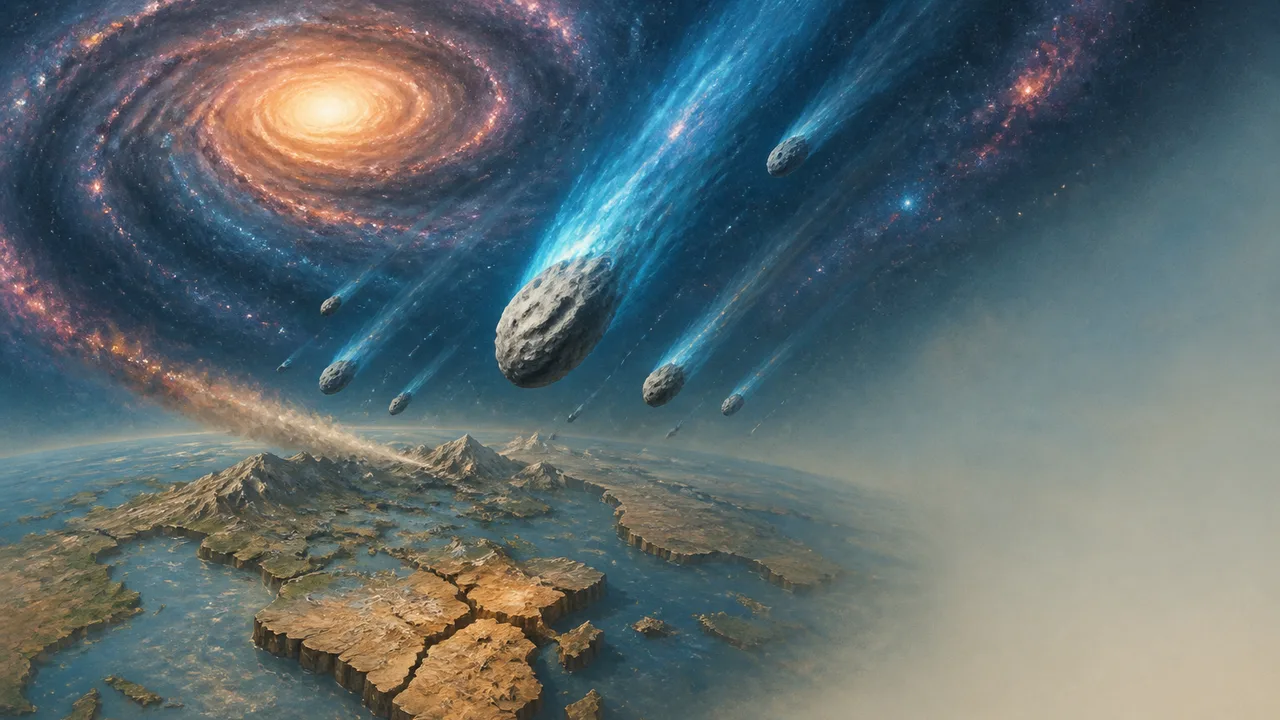
Photo: AI. Iolanthe Fenwick
There's a question about Earth that almost nobody asks, which is itself interesting: why does our planet have continents at all?
Not how plate tectonics works. Not why the continents are shaped the way they are. The deeper, stranger question: why does Earth have substantial landmasses above sea level in the first place, rather than being a smooth, ocean-covered rock — which, statistically speaking, is a more likely outcome for a habitable planet?
A new paper out of Curtin University proposes an answer that reframes the question entirely. According to the researchers, you can't fully explain Earth's continents by looking at Earth alone. You have to look at the galaxy.
The Standard Story, and Why It's Incomplete
The conventional account of continental formation goes something like this: the young Earth's surface didn't cool uniformly. Plumes of heat from the interior pushed against the crust irregularly, remelting sections of it. Lighter chemical elements floated upward, eventually accumulating into the thick, buoyant slabs we now call continental crust. Over billions of years, those slabs drifted, collided, and arranged themselves into the geography we know.
It's a plausible story, and most geologists still believe some version of it. But it has a gap: it treats continent formation as an essentially internal process, driven by Earth's own chemistry and thermal history, without a strong account of timing. If the process is random and gradual, why do the geological records suggest it happened in pulses?
That's the puzzle the Curtin team found their way into. They analyzed a global dataset of isotopes in ancient crystals — zircons, essentially, which are among the oldest solid materials on Earth and act as chemical clocks. What they found was that sudden changes in the isotope record, interpreted as episodes of fresh crust production, recur on a roughly 190-million-year cycle.
That number rang a bell. It's approximately how long it takes for the solar system to cross one of the Milky Way's spiral arms.
The Galaxy Gets Involved
The Sun doesn't travel through the Milky Way in a simple circle. It oscillates — bobbing in and out of the galactic plane while completing its orbit around the galactic center. Each time it passes through a spiral arm, it enters a denser region of the galaxy: more star systems in the neighborhood, heavier clouds of gas, more gravitational perturbation.
The Curtin researchers argue that this gravitational jostling disturbs the Oort Cloud — the vast, diffuse shell of icy bodies that extends to the outer edges of our solar system. A disturbed Oort Cloud rains comets inward. And a spike in comet impacts on young Earth, they suggest, could have locally thinned the crust enough to seed the formation of continental nuclei.
As Hossenfelder summarizes the chain of reasoning in her video: "When Earth passes through the spiral arms, other solar systems and heavy clouds of gas come nearer to our solar system, and that causes more fluctuations of the gravitational field. This disturbs our Oort cloud... As a consequence, Earth gets showered with plenty of comets each time it passes through the spiral arms of the Milky Way. They say that these frequent impacts cause the significant local thinning of the crust of young Earth, which seeded the first continents."
It's a long causal chain, and every link matters. Galactic structure → gravitational perturbation → Oort Cloud disruption → comet impacts → crustal thinning → continental nuclei. Each step is individually plausible. Whether they compound into a coherent explanation is what makes this paper interesting and contested at the same time.
What the Evidence Actually Shows
Hossenfelder, who covered the paper in a recent video, doesn't pretend the case is airtight. She notes that if you look closely at the correlation between the spiral arm crossing interval and the isotope anomalies, it's imprecise — the timing doesn't line up cleanly enough to be compelling on its own. She awards the paper an eight out of ten on what she calls her "meter," which in context reads as: interesting enough to take seriously, not strong enough to treat as settled.
That's an honest position. Correlation studies in deep time are genuinely hard. The spiral arm crossing interval itself is an estimate, not a precisely measured value. And isotope records in ancient zircons, while remarkable, are noisy data — geological processes other than crust production can alter them. The researchers have identified a pattern that rhymes with a known astronomical cycle. Whether the rhyme is causal or coincidental requires more than a single dataset to determine.
What the study doesn't have, yet, is a mechanism demonstrated in detail. The Oort Cloud hypothesis for comet delivery is well-established in other contexts — it's part of mainstream planetary science. But quantifying how much galactic gravitational variation at spiral arm crossings would translate into how many Earth-bound comets, and whether that flux would be sufficient to thin crust at continental scales, involves modeling that the paper apparently doesn't fully work through.
Why This Question Matters Beyond Earth
The stakes of getting this right extend well past geological history. Hossenfelder puts it plainly: "If you want to estimate the chance of this happening on other planets, you first need to know how likely the pleasant mix of water and land on our planet is."
That framing connects directly to a simulation study on exoplanet surface diversity — published in the Land/Ocean Surface Diversity on Earth-like (Exo)planets: Implications for Habitability dataset presented at the 2022 European Planetary Science Congress — which found that Earth's particular balance of land and water is genuinely rare among modeled habitable planets. Most simulated Earth-like worlds ended up either predominantly land or predominantly ocean. The Earth-like split we actually have appears to be an outlier.
If the Curtin hypothesis holds, that rarity gets a new explanation — and a new layer of contingency. Our continents might not just be a product of Earth's internal geology. They might be a product of where in the galaxy our solar system happened to orbit, and how that orbit perturbed the debris on our doorstep billions of years ago.
Which makes the question of habitable planets elsewhere considerably more complicated. It's not enough for a planet to be in the right zone around the right kind of star. Its host star might need to have the right kind of galactic neighborhood, too.
"In the past years, we've seen an increasing number of studies that investigate how the conditions on Earth might have been shaped by supernovae going off in our vicinity or rogue planets coming close to our solar system," Hossenfelder notes. "Estate agents would call this a vibrant neighborhood."
What to Make of It
The Curtin study is not a discovery in the sense of something confirmed. It's a hypothesis with supporting evidence — a well-reasoned idea that clears the bar for serious engagement but not for textbook inclusion. The correlation is real enough to be worth investigating. The mechanism is suggestive rather than demonstrated. The 190-million-year recurrence in the isotope record is a genuine finding; its cause remains open.
That's not a reason to dismiss it. It's a reason to ask what it would take to confirm or rule it out. Better constraint of the spiral arm crossing interval. Independent datasets of crustal production timing from different geological methods. Detailed modeling of Oort Cloud disruption rates at various galactic densities. These are tractable research questions. This paper has given scientists something to aim at.
What I find genuinely worth sitting with is the deeper implication — that Earth's surface, the terrain that made complex land life possible and that we've been building civilizations on for the entirety of recorded history, might trace its origin to where the solar system was in its galactic orbit four billion years ago. The continents we stand on as evidence of planetary stability might be, at root, a record of cosmic disturbance.
If that's true, then understanding what makes a planet livable requires us to zoom out much further than we assumed. Not just to the star. Not just to the solar system. All the way to the architecture of the galaxy itself.
More Like This
Could Life on Earth Have Arrived via Asteroids?
Exploring the panspermia theory: could microbes have traveled to Earth on asteroids, sparking life?

Physicists Just Caught Virtual Particles Becoming Real
New experiment at Brookhaven Lab allegedly proves virtual particles exist—challenging how we understand empty space and quantum reality itself.
Do DMT Entities Point to Alien Consciousness?
Cognitive scientist Donald Hoffman claims DMT entities may be real alien minds. The math is real. Whether it proves anything about consciousness is a different question.
Curiosity at Sol 4948: Reading Mars Like a Genome
Curiosity Rover hit Sol 4948 in Gale Crater. What its mineralogy tells us about Mars' chemical autobiography—and why that question is getting urgent.
One Mathematical Operation to Rule Them All: The EML Paradox
A Polish mathematician claims all math operations can collapse into one function. It's elegant, it's correct, and it reveals something strange about simplicity.
3I/ATLAS: An Interstellar Comet Older Than the Sun
James Webb observations of interstellar comet 3I/ATLAS reveal unusual deuterium and carbon isotope ratios that may point to an origin 10–12 billion years old.

Avi Loeb on Methane, Microbes, and Interstellar Objects
Avi Loeb tells Brian Keating that JWST methane data from 3I/ATLAS is puzzling enough to warrant a microbe hypothesis—and explains why a dark comet might be Soviet.
Pluto's Planet Status Debate, Explained
A 10-year-old's letter to NASA reignited Pluto's planet debate. Here's what the science actually says—and why the answer is messier than you'd expect.