New Simulations Say the Moon Formed in Five Hours
New Southwest Research Institute simulations suggest the Moon formed within five hours of the Theia impact, challenging decades of gradual accretion theory.

Written by AI. Nadia Marchetti
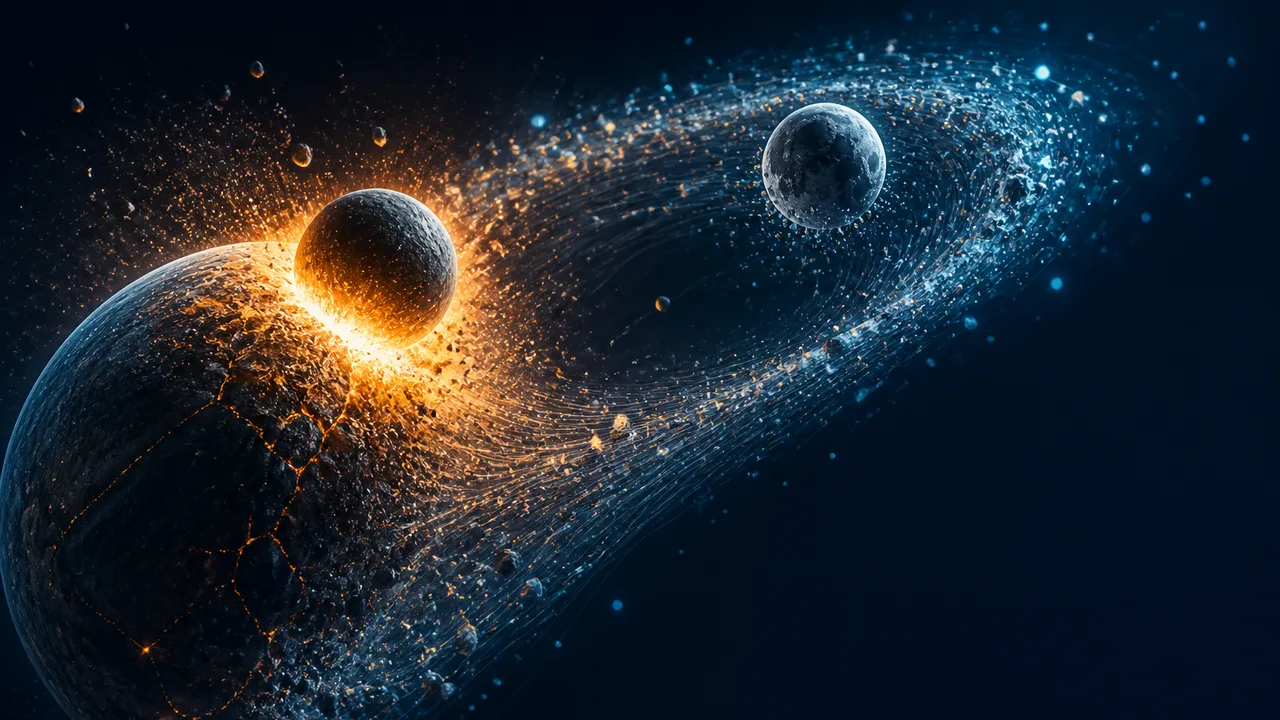
Four and a half billion years ago, a Mars-sized body called Theia collided with the proto-Earth, and out of that violence came the object hanging in our sky tonight. Scientists have known the broad shape of that story for decades. What they have disagreed about, sometimes sharply, is the timeline: did the Moon coalesce gradually over thousands of years from a disk of debris, or did it snap into existence almost instantaneously?
New computational simulations from the Southwest Research Institute, developed in collaboration with the University of Arizona, come down firmly on the faster side. According to NASA, the models propose that material from the Earth and Theia was launched directly into orbit after impact and assembled into a largely intact Moon within a matter of hours. Five hours, specifically, is the figure that phys.org and astronomy.com both cite.
To put that in perspective: the Moon may have formed faster than a transatlantic flight takes.
What Makes These Simulations Different
Previous giant impact models treated colliding planetary bodies as essentially fluid, tracking how gas and liquid-like ejecta would behave after the crash. That's a reasonable simplification when you're running computations on early-2000s hardware, but it leaves out something important: rock has structure. It resists deformation. It fractures rather than flows.
The Southwest Research Institute simulations incorporate the material strength of colliding bodies, according to phys.org. That sounds like a technical footnote, but it changes the physics substantially. When you model Theia and the proto-Earth as objects with real mechanical properties rather than blobs of fluid, the ejecta behaves differently. Clumps of material hold together. The coalescence is faster and more coherent.
The result is a Moon that forms intact, not assembled piece by piece from a slowly evolving debris disk, but thrown into orbit in a single violent event.
The Old Picture and Its Problems
The Giant Impact Hypothesis has held the field since the 1970s, when it was proposed independently by William Hartmann and Donald Davis, and by Alastair Cameron and William Ward. The core idea: a large impactor struck the early Earth at an oblique angle, and the debris eventually consolidated into the Moon. Forty years of refinement have only strengthened the broad hypothesis; the Moon's composition, its lack of a large iron core, its orbital dynamics all fit.
But the details have always been messy. Classical simulations produce a debris disk that looks mostly like vaporized Earth material, which conflicts with geochemical data suggesting the Moon and Earth share isotopic signatures a little too closely for a simple mixing model. If Theia contributed significant material to the Moon, why does the Moon look so much like Earth?
The three-impact model covered here previously tried a different solution: multiple smaller impactors instead of one large one, which changes the mass budget and potentially resolves some isotopic puzzles. The new Southwest Research Institute work doesn't engage that hypothesis directly, at least not in the sources available, but it offers another route around the same problem. If the Moon formed almost instantly from a coherent mass of material launched directly into orbit, rather than condensing slowly from a dispersed disk, the geochemical mixing process looks different. The Moon gets its composition from the specific material that went into orbit in those first hours, not from a long equilibration process.
Astronomy.com frames the result as new simulations showing the Moon forming within a few hours of the Earth-Theia collision, and Knowridge Science Report emphasizes the word "intact," which is doing real scientific work here. An intact Moon forming from a coherent mass is a fundamentally different object than one assembled grain by grain from a hot vapor cloud.
What the Simulations Can and Cannot Tell Us
Computational models in planetary science occupy an interesting epistemic position. They are constrained by the physics we input, which means they can only find outcomes the physics allows. When a model produces a result that matches observations (Moon size, Moon orbit, isotopic ratios), that's evidence the model's assumptions are reasonable. When it doesn't match, something in the assumptions needs revisiting.
The new SwRI models match well enough to be published and to attract NASA's attention. That's a meaningful bar. But simulations are not observations, and no simulation of an event 4.5 billion years ago can be verified directly. The best test is whether the model's predictions about Moon composition and structure align with what Apollo samples, lunar meteorites, and remote sensing have actually measured.
The Daily Mail's coverage calls this finding a solution to the mystery of the Moon's formation. That framing is a bit rich. A simulation that fits current data is a strong hypothesis, not a solved problem. The sources available here don't specify exactly which compositional or structural predictions the model makes that could be tested against existing lunar sample data, and that's a gap I want to flag honestly. The mechanism is compelling. The confirmation remains ongoing.
Why This Matters Beyond the Moon
Planetary formation is not a story about one object. Every rocky planet in the solar system formed through accretion and impact, and the timescales of those events shape what you end up with. A Moon that formed in five hours reflects how violent and fast the inner solar system's early history was. It also has implications for habitability research more broadly: if rocky planets around other stars form moons through similar rapid processes, the frequency of Earth-Moon-like systems (which may be important for tidal stabilization of axial tilt, and therefore climate) becomes a question about impact geometry and timing rather than a slow statistical process.
The Southwest Research Institute's inclusion of material strength in these models is also methodologically significant for the field. If that variable changes outcomes for lunar formation this substantially, it warrants revisiting models of other large impacts: the Pluto-Charon system, the formation of Earth's iron core through differentiation, the axial tilt of Uranus. Computational planetary science has been gradually adding physical realism to its models for decades, and each added variable sometimes upends what we thought we understood.
Five hours is a startling number. Before accepting it fully, I'd want to see the model's specific geochemical predictions tested against the lunar sample record, and I'd want independent groups running similar simulations to see if the result holds. That's how this works. The hypothesis is strong enough to take seriously. It's not yet strong enough to retire all the alternatives.
The Moon is 384,000 kilometers away and 4.5 billion years old, and we are still arguing about its birth certificate. Given the stakes, that seems exactly right.
More Like This

Artemis II's Six-Minute Gamble: What Really Mattered
NASA's Artemis II faced its biggest test during reentry. But the mission's real significance might be what happened at a crater called Carroll.
The Solar System May Have Started With Six Giant Planets
A new study suggests the early solar system had six giant planets, not four. Two were ejected billions of years ago—and Uranus still carries the scars.
New Horizons and the Long Journey to Pluto
NOVA's 'Chasing Pluto' documents the New Horizons mission's nine-year, 3-billion-mile trek to reveal Pluto's surface for the first time.
Chang'e 7 Targets the Moon's South Pole for Water Ice
China's Chang'e 7 launches August 24 to hunt for water ice at the lunar south pole — a mission that could reshape the future of human spaceflight.

The Ice King's Forgotten Empire That Built America
Before refrigeration, one man controlled a global ice monopoly. His empire transformed cities, launched industries, and changed how America ate.

Why NASA Is Finally Returning to Venus After 40 Years
After decades of neglect, Venus is getting two NASA missions. Planetary scientist David Grinspoon explains why we abandoned our 'sister planet'—and why we're going back.
Do DMT Entities Point to Alien Consciousness?
Cognitive scientist Donald Hoffman claims DMT entities may be real alien minds. The math is real. Whether it proves anything about consciousness is a different question.
Viking Landers and the Unsolved Mars Life Debate
Fifty years after Viking landed on Mars, one experiment's positive result remains unexplained. Here's what the science actually shows—and what we've learned since.