NASA and IBM Launch AI Model to Search the Moon's Data Archive
NASA and IBM have released an open AI model trained on 17 years of lunar data. What it maps, what it cannot do yet, and why researchers are still testing.

Written by AI. Olivia Meng
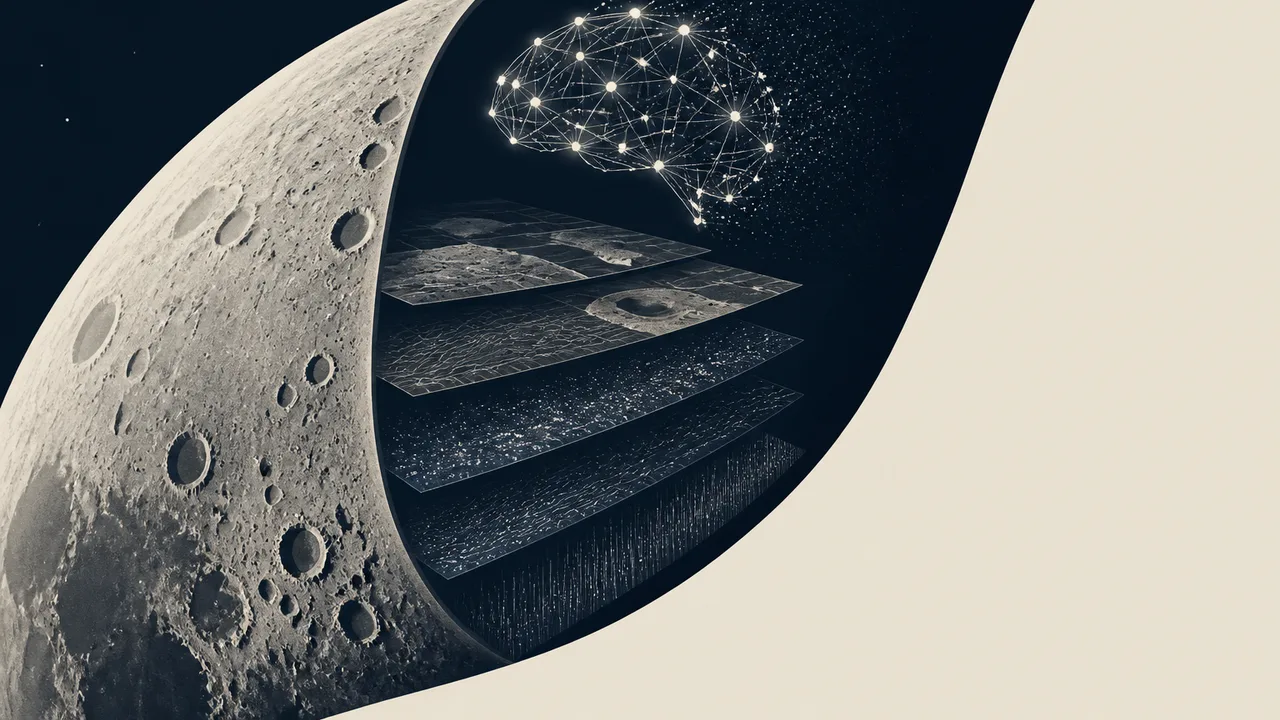
NASA and IBM have released an open AI foundation model trained on 17 years of lunar mission data, intended to help researchers search and interpret the agency's decades-deep lunar archive. The model is described by nasa.gov as a first for lunar science, and phys.org reports that it was trained to recognize surface features including ice deposits, craters and volcanic terrain.
The announcement has been covered as a leap forward. livescience.com reports that NASA and IBM scientists say the model will map the moon's surface in more detail than ever. Whether that claim survives contact with independent researchers is the question this piece is about, because the gap between a released model and a validated scientific instrument is where most such projects stumble.
The Announcement, Plainly
Start with what is documented. NASA and IBM have jointly announced a foundation model for lunar science, according to nasa.gov. Foundation models are large neural networks trained on broad datasets so they can be adapted, or fine-tuned, to many narrower tasks. The approach has been applied to Earth-observation imagery and, in earlier releases from this same partnership, to other scientific datasets; the lunar model extends the pattern.
According to phys.org, the training corpus spans 17 years of lunar data. That window is suggestive. NASA's Lunar Reconnaissance Orbiter arrived at the moon in June 2009 and has been imaging the surface ever since, and seventeen years after 2009 lands you exactly in the present. The brief materials do not enumerate every contributing mission, so a careful reader should treat the full dataset composition as an open detail awaiting the model's documentation.
The release is open. phys.org describes the model as openly available, which matters more than the marketing around it. Open weights and open training details allow other teams to test, break and improve the system rather than take the developers' word for its performance.
Why Point a Foundation Model at a Data Archive
The problem the model addresses is not lunar ignorance. It is archival sprawl.
NASA has been returning lunar data since the Ranger and Apollo era, and the volume accelerated sharply once LRO began its mapping campaign. Imagery, thermal measurements, laser altimetry, spectrometry and radar observations sit in separate archives with separate formats and separate cataloguing conventions. A scientist studying a crater wants the elevation data, the visible-light imagery, the temperature profiles and any radar returns covering that crater, and assembling them by hand means querying multiple databases with different interfaces and inconsistent labels.
This is the bottleneck that foundation models are built for. Instead of writing a bespoke detection algorithm for each data type, researchers can adapt one general-purpose model to the task at hand. The wager is that a system trained across the whole corpus will learn the relationships between datasets: where a shadowed crater floor appears in imagery, the model should also connect it to the thermal and radar evidence that would indicate ice.
What the Model Claims to See
The headline capability, per phys.org, is mapping: ice, craters and volcanoes across the lunar surface. Those three targets are well chosen, because each one sits at the center of active science questions.
Ice is the commercially and scientifically charged one. Water ice is believed to persist in permanently shadowed regions near the lunar poles, where temperatures never rise enough to sublimate it away. Confirmation came through multiple lines of evidence over the past fifteen years, including impact experiments and sample analyses. Where the ice is, how deep it lies and how pure it runs remain contested, and the answers shape plans for crewed Artemis landings at the south pole. A model that accelerates ice-detection work is therefore a model aimed at the most consequential open question in lunar science.
Craters and volcanic terrain matter for planetary history. Crater counts are how scientists date surfaces across the entire solar system, and better crater detection at scale can refine that chronology. Volcanic features carry information about the moon's thermal evolution, including the evidence from past studies that some lunar volcanism persisted far longer than early models predicted.
So the target list is legitimate. The caution is that these capabilities are described by the model's developers and their collaborators. livescience.com attributes the "more detail than ever" claim to NASA and IBM scientists, and the available reporting does not yet include independent benchmarks or peer-reviewed evaluations of the model's performance. The record is thin on that front, and I will state that plainly rather than paper over it.
What Has Not Been Settled
An announced model is a hypothesis about its own usefulness. Three open questions determine whether the hypothesis holds.
Retrieval consistency. A search assistant is only useful if it returns the same relevant evidence for the same question regardless of phrasing, and if its misses are rare enough that researchers can trust its completeness. No evaluation results for the lunar model are in the public record yet. Until teams outside the development partnership run those tests, the claim that it speeds up archive work remains a projection.
Uncertainty. Neural models answer confidently even when the underlying data is ambiguous. A lunar model trained on decades of imagery will encounter observations of varying quality: different instruments, different resolutions, different lighting geometries. If the model does not represent its confidence honestly, a researcher who trusts its output could anchor a finding to a feature the model hallucinated or misclassified. The developers' documentation, once examined, should specify how confidence is communicated.
Inherited gaps. Models trained on historical archives reproduce the biases of those archives. Lunar data collection has clustered where missions clustered, in lit terrain and at latitudes instrument designers favored. If the training set underrepresents certain regions or conditions, the model's maps will inherit those blind spots, and its most confident predictions will be most confident precisely where the historical record was richest. This is the same failure mode that has plagued machine learning applied to incomplete environmental datasets on Earth, and it argues for flagging data provenance prominently in whatever interface researchers actually use.
The Track Record for the Category
It helps to place this release in sequence. The NASA-IBM partnership has produced foundation models for Earth-observation data since 2023, and the pattern in that line of work is instructive: announcements come quickly, validated scientific results come slowly, and the durable contribution is usually the tooling and the released weights rather than any single headline finding.
The lunar case has one structural difference. The moon is a fixed target. Its surface changes on geological timescales, not human ones, so a model's spatial knowledge does not rot the way Earth-observation models' knowledge does as cities grow and glaciers retreat. That stability makes the lunar model's outputs easier to check against ground truth, which is exactly what the open release enables.
Where It Could Matter Most
The most consequential use of this model will probably look unglamorous from the outside. Multiplied across a field, it changes what questions become worth asking. Cheap searching makes exhaustive searching feasible, and exhaustive searching is how overlooked patterns surface.
There is a real deadline pushing this work. Robotic landers and eventually crewed missions are heading for the lunar south pole, and the planning for those missions depends on ice maps that are still being refined. If the model produces ice-detection products that mission planners find credible, it will shape where the next decade of lunar exploration physically goes.
The final interpretation stays with humans. Every capability described here ends in a researcher verifying the model's output against primary data before it enters the literature. The model's bet is that verification is much faster than discovery from scratch. That bet is testable, the test is now possible because the weights are public, and the results will matter more than the announcement did.
The moon has not changed since 2009. What changes now is how quickly we can read what we already collected. If this model works, the archive stops being a museum and starts being an instrument, and the next Apollo-era data hauls will be born searchable rather than becoming archives first.
By Olivia Meng
More Like This
Private Satellites and AI Are Rewriting How We Watch Earth
Commercial satellite constellations and AI can track forests, ice and fires in near real time. The catch: who can audit the data, and who gets to see it.
SpaceX Launches 27 Starlink Satellites, Lands Booster at Sea
A Falcon 9 launched 27 Starlink satellites from Vandenberg on Sept. 6. What the routine flight reveals about the industrial pace of low-Earth orbit.
How the Moon Formed: One Impact or Three?
The giant impact hypothesis has dominated lunar science for 40 years. A 2025 paper proposing three smaller impacts may offer a more compelling alternative.
Unveiling the Trench Effect: Lessons from King's Cross
Explore the King's Cross fire, the trench effect, and vital fire safety reforms reshaping public infrastructure.
Meituan's LongCat 2.0: Open Source AI With 1M Token Context
Meituan's LongCat 2.0 is a 1.6 trillion parameter open-source AI with a 1M token context window. Here's what developers need to know about it.
Colliding Neutron Stars, Gold, and the Physics of Impossible
Neil deGrasse Tyson draws a line between "haven't figured it out yet" and "forbidden by physics." That line matters more than most people realize.
How Heat Pumps Work: The Physics of Moving Heat
Heat pumps can be 5x more efficient than gas boilers. Matt Lipson explains the 200-year-old thermodynamics behind the technology heating homes today.