How Lunar Surveillance Found McGetchin's New Crater
NASA's McGetchin crater shows how 17 years of lunar change detection can reconstruct impacts and guide debate over engineered craters on the lunar surface.

Written by AI. Nadia Marchetti
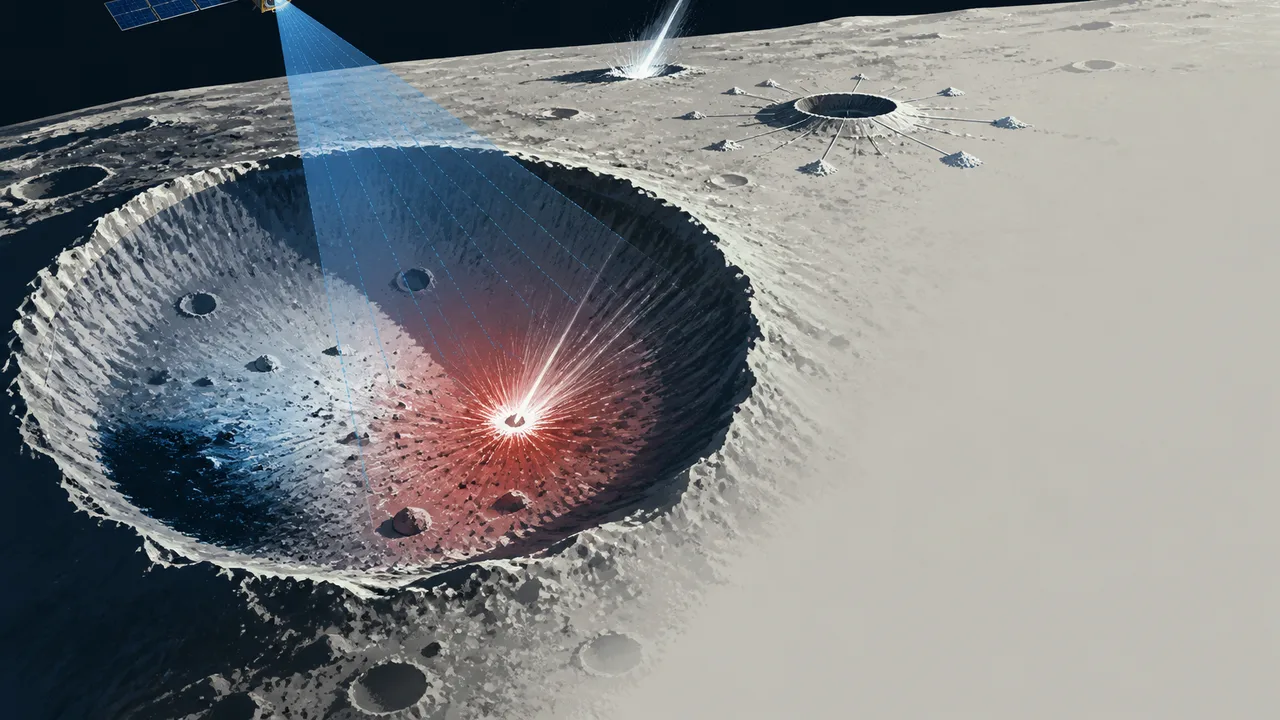
Robert Wagner found McGetchin crater on October 24, 2025, while comparing global maps made by NASA’s Lunar Reconnaissance Orbiter. The impact had apparently occurred more than a year earlier, sometime between April 11 and May 22, 2024.
That delay sounds like a surveillance failure until you look at what Wagner was asking the images to do. Lighting changes manufacture false alarms, and most fresh impact scars are tiny. Finding a new hole among the Moon’s overlapping craters is less like noticing a broken window and more like comparing two warehouses full of gray confetti.
McGetchin defeated the camouflage. At 728 feet wide and 141 feet deep, it produced an ejecta pattern stretching across hundreds of pixels. NASA describes it as the largest newly formed crater yet identified in the solar system, although it is nowhere near the largest lunar crater overall. The ancient South Pole-Aitken Basin is about 1,550 miles across, as Engadget’s account of the announcement points out.
The superlative is fun. The monitoring system behind it is more useful.
Seventeen Years Turned Photographs into a Time Machine
The Lunar Reconnaissance Orbiter has spent more than 17 years measuring lunar topography, composition, temperature and radiation with seven instruments. CNET reports that it scans the full lunar surface every 14 days. Thousands of passes have produced maps detailed enough to identify fresh craters, landslides, landers, faults and possible signs of lava tubes.
That history changed what a lunar image can establish. A single photograph shows what occupies a location. A long, consistently collected sequence can reveal when something appeared, how far its effects spread and which features changed together. McGetchin was therefore observed as an event with a bounded formation window, even though nobody watched the collision happen.
The search still needed human judgment. During periodic global searches, researchers compare newer maps with older ones and look for changes wider than 150 feet. Wagner stacked hundreds of wide-angle frames so unchanged ground appeared gray while differences appeared bright or dark. Shadows and lighting shifts generated hundreds of false signals. Fresh impacts usually emerged as small bright points with fuzzy halos; McGetchin’s debris pattern covered hundreds of pixels.
Researchers then directed the orbiter’s Narrow-Angle Camera, capable of resolving about 3 feet per pixel, toward the site. A close pass on December 5, 2025, supplied the measurements of the crater and its disturbed surroundings. This sequence, broad detection followed by targeted inspection, is described in NASA’s mission announcement.
The method matters because discovery statistics depend on what the instrument can see and what analysts choose to search for. LRO researchers have identified at least 1,000 new impact craters and recorded about 100,000 other surface changes associated with impacts or their debris. Scientists estimate that impacts capable of producing roughly 30-foot craters occur about 140 times per year across the Moon, while microscopic projectiles create many more holes beyond orbital resolution, according to EarthSky’s edited version of the NASA release.
Those numbers describe an observed and modelled slice of lunar activity. They do not provide a complete census. A crater below the resolution limit still exists, even if it never enters the catalogue. The Moon is an instrumented experiment with a detection threshold, false alarms and gaps between observation and review. Welcome to science, where even a world without weather can make paperwork.
The Cold Mark Around the Hole
McGetchin became more intriguing when the Diviner thermal instrument examined it after dark. Researchers found a cold region roughly 4 miles wide, about 16 degrees Fahrenheit cooler at night than nearby terrain. Their explanation is physical rather than exotic: the impact loosened and churned the regolith, lowering its density and its ability to retain heat after sunset.
The crater itself is only part of the altered ground. The thermal signature indicates that the collision reorganized material across an area far beyond the rim, with possible consequences for how rover wheels interact with the surface.
Researchers also compared newly formed craters wider than 66 feet. Reporting on the second study says every fresh crater larger than 98 feet in that comparison showed the cooling effect, with larger craters associated with larger cold regions. That cross-crater result makes McGetchin more than an isolated curiosity: its thermal halo appears to be an unusually large example of a recurring process.
The comparison has limits. A threshold observed in one study should not yet become a universal engineering rule. Crater size, impactor composition, impact angle and local geology could influence the outcome, and the reporting does not supply the study’s sample size or full error analysis. McGetchin offers a strong natural experiment because researchers possess before-and-after observations, but one spectacular crater cannot represent every patch of lunar ground.
Should Missions Make Craters Deliberately?
David Paige, a coauthor of the thermal study, has suggested that future lunar missions could use impacts to “garden the regolith,” churning sediment and bringing buried material toward the surface for research or resource extraction.
The strongest case follows directly from McGetchin. An impact creates excavation and redistribution in one event. Orbital cameras can map the visible disturbance, while thermal observations can trace changes in density beyond the obvious crater. If a mission could control an impactor’s mass, speed and destination, it might expose subsurface material and then monitor the result as a designed experiment.
McGetchin also supplies the caution label. Its cold zone reached roughly 4 miles across, vastly wider than its 728-foot cavity. Deliberate crater-making would therefore require planners to treat the surrounding regolith as part of the experiment. How far would ejecta travel? Could an impact threaten nearby hardware, change rover routes or mix the target material with the impactor? The current findings establish neither an operational technique nor a safety standard.
A natural collision and an engineered one also answer different questions. McGetchin arrived with an uncertain identity, described as an asteroid or comet roughly as large as a three- to six-story building. Researchers inferred its effects after the fact. A designed impact could carry known properties and instruments, producing cleaner experimental constraints, but it would lack McGetchin’s scale unless a mission accepted a correspondingly larger disturbance.
The “once in a century” description needs similar restraint. Researchers quoted crater-production models estimating one McGetchin-scale event every 132 years on the Moon. That is a statistical interval, not an appointment on a lunar calendar. Rare events can cluster, and a 17-year observing record remains short beside a century-scale estimate.
McGetchin’s discovery does not show that researchers can watch every lunar impact as it happens. It shows something subtler and more powerful: repeated observations can reconstruct an unwitnessed event, test its effects against other fresh craters and turn a new scar into a proposal for future experiments.
Wagner began with hundreds of false alarms and a patch that refused to look gray. The next crater may be found the same way, unless a future mission puts it there on purpose.
More Like This
Triton's Strange Orbit and the Ice Giants' Secrets
Triton's retrograde orbit, nitrogen geysers, and the chaotic magnetic fields of Uranus and Neptune reveal how little we understand our own solar system.
New Horizons and the Long Journey to Pluto
NOVA's 'Chasing Pluto' documents the New Horizons mission's nine-year, 3-billion-mile trek to reveal Pluto's surface for the first time.
Who Owns the Moon? Law, Science and the Race for Lunar Resources
The 1967 Outer Space Treaty bars owning the Moon, but mining, safety zones and science reserves are forcing hard questions about who gets to use it.

NASA and IBM Launch AI Model to Search the Moon's Data Archive
NASA and IBM have released an open AI model trained on 17 years of lunar data. What it maps, what it cannot do yet, and why researchers are still testing.
Einstein vs Quantum Mechanics: The EPR Paradox Explained
Physicist Jim Al-Khalili unpacks the EPR paradox—Einstein's 1935 challenge to quantum mechanics that inadvertently gave us the concept of entanglement.

Yitang Zhang and the Twin Prime Breakthrough
How a Subway bookkeeper-turned-lecturer cracked a problem the world's top mathematicians declared impossible—and what it revealed about prime numbers.