Who Owns the Moon? Law, Science and the Race for Lunar Resources
The 1967 Outer Space Treaty bars owning the Moon, but mining, safety zones and science reserves are forcing hard questions about who gets to use it.

Written by AI. Mei Zhang
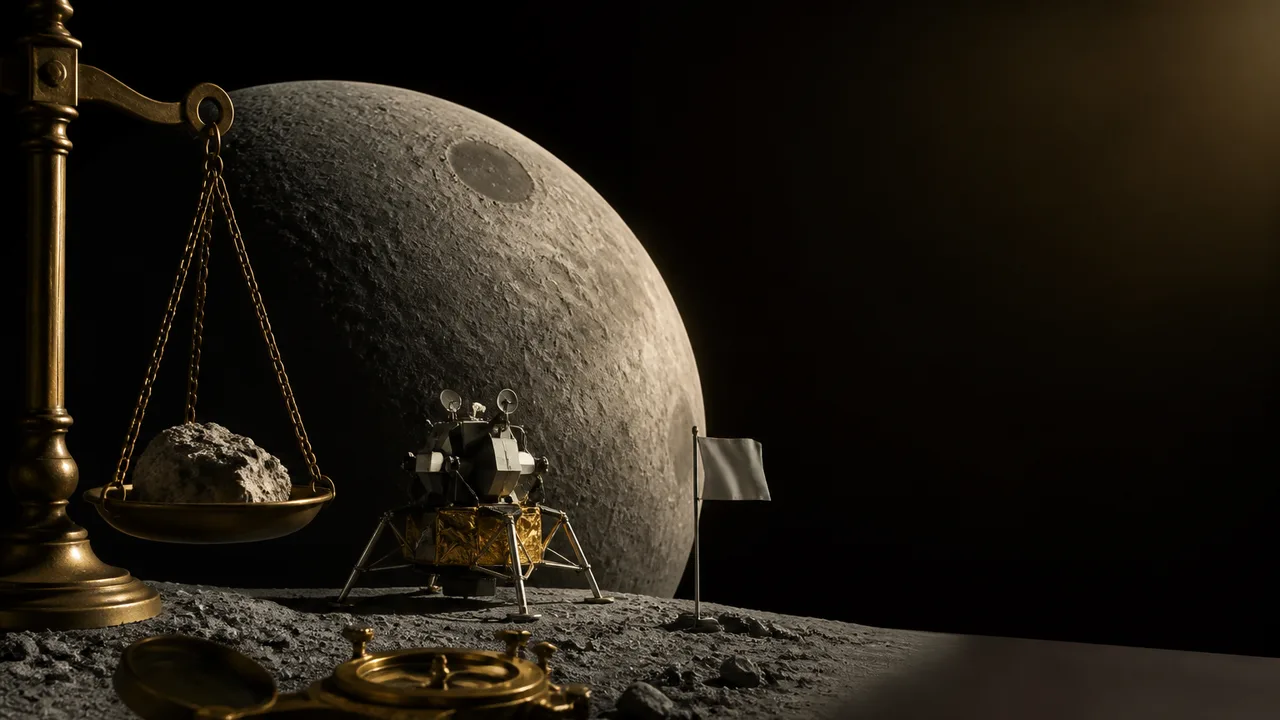
The 1967 Outer Space Treaty has governed the Moon for nearly six decades, and its core rule still holds: no nation can claim lunar territory. What the treaty never anticipated, according to a recent episode of This Week in Space covered by space.com, is a lunar economy. The episode frames lunar ownership through the history of capitalism, asking how commercial activity might shape humanity's next phase beyond Earth. That framing puts the question where it belongs: at the intersection of science, law and economics, with resource extraction, landing sites, infrastructure and scientific access all in play.
The Legal Baseline, and Its Gaps
The treaty's "non-appropriation" principle is the anchor. As a research article in ScienceDirect explains, resource activities are developing within existing international space law rather than in a legal vacuum. States can't own the Moon, but they remain responsible for their nationals' activities there, and those activities can proceed under authorization and supervision.
That distinction drives everything. The Congressional Research Service has outlined how U.S. law and international rules intersect around "resource utilization," including the 2015 Commercial Space Launch Competitiveness Act, which gives U.S. companies rights to materials they extract from asteroids or celestial bodies. You can take the water ice; you still can't plant a flag on the crater.
The tension is obvious. Extraction requires presence, presence requires infrastructure, and infrastructure requires some claim to a location. Nobody has violated the treaty yet. Lots of plans are skirting its edges.
Safety Zones and the Artemis Accords
The U.S.-led Artemis Accords, signed by a growing list of nations since 2020, try to fill the gap. NASA's primary text defines the Accords' approach to "safety zones": areas around lunar operations where other parties commit to coordination and to avoiding harmful interference.
Critics, including Russia and China, have argued safety zones could function as appropriations in disguise. Defenders point out the zones are supposed to be scoped to the hazard, not the ambition, and that notification and transparency obligations accompany them. Both readings are legally plausible, which is exactly why the wording will matter more as operations scale up.
Should Scientists Get Reserves?
One proposal gaining attention sidesteps ownership entirely. Coverage from phys.org and Universe Today describes calls for lunar research reserves, protected areas where radio-quiet zones and pristine regolith sites would be off-limits to development. EarthSky highlights the far side specifically: it's the only place in the inner solar system shielded from Earth's radio noise, and one well-placed transmitter or mining operation could compromise radio astronomy and cosmology experiments for everyone.
The reserves idea borrows from Antarctica, where scientific protections coexist with territorial claims suspended by treaty. Whether that model transfers is an open question. Antarctica has no extractive industry under its treaty; the Moon is being priced for water ice, oxygen and rare metals right now.
The Uncomfortable History Angle
The This Week in Space episode's capitalism lens, per space.com, is doing real work here. Colonial extraction has a documented pattern: resources claimed first, governance negotiated later, local and scientific interests losing to whichever actor arrived with infrastructure. The strongest counterargument is that the Outer Space Treaty was written precisely to prevent a repeat, and that unlike the age of sail, every launch is visible to every observer on Earth. Transparency is cheap in space. Enforcement is the hard part.
Non-signatories to the Accords, notably China and Russia with their own ILRS lunar base program, would write different rules. Any regime that excludes the two other biggest lunar actors will govern only part of the Moon.
What to Watch
Three developments will tell us more than any podcast debate. First, whether the Artemis program's initial landings establish de facto precedent around coordination and notification. Second, whether the research-reserve proposal gains formal traction in UN bodies or stays an appeal to goodwill. Third, whether extraction contracts, like those for lunar water, start specifying exclusive access to terrain rather than just the resource.
That last one is the tell. Water rights on Earth have a long history of becoming land rights. If lunar contracts follow the pattern, the Outer Space Treaty's core promise will be tested not by flags but by wellheads.
The Moon belongs to no one. The question the next decade will answer is whether that can survive being useful to someone.
More Like This
Unraveling the Golden Ratio's Mathematical Magic
Explore how the golden ratio's unique irrationality connects math, nature, and fractals.
Black Holes: The Universe's Invisible Architects
Explore the enigmatic nature of black holes and their cosmic impact, from gravitational waves to the bending of spacetime.

Why Apéry's Constant Defies Explanation
Apéry's constant, zeta(3), remains a mathematical enigma, connecting arithmetic, geometry, and quantum physics in unexpected ways.

Anil Menon Reaches the ISS on His First Spaceflight
NASA astronaut Anil Menon launched to the ISS on July 14 aboard Soyuz MS-29. His eight-month mission raises questions about what space cooperation looks like next.
Shungite: Ancient Rock with Modern Potential
Explore the ancient origins and modern applications of Shungite, a unique carbon-rich rock with potential in tech and construction.
Earth Microbes May Survive on the Moon's South Pole
NASA research finds common Earth microbes could survive in shadowed lunar south pole regions—raising urgent questions about contamination and planetary protection.

Pancreatic Cancer Treatments That Could Change Everything
NALIRIFOX, daraxonrasib, and a personalized mRNA vaccine are reshaping pancreatic cancer treatment. Here's what the breakthroughs mean—and who can actually access them.

Ancient Egyptian Princesses Were Trained Weapon Users
New skeletal analysis of five Middle Kingdom mummies reveals ancient Egyptian princesses used bows and daggers — and a bias that buried that fact for decades.