How Mieza Became Aristotle and Alexander's School
New finds at Mieza strengthen its identification as Aristotle's school, while revealing how Philip II used education to cultivate Macedonia's royal elite.

Written by AI. Helen Papadopoulos
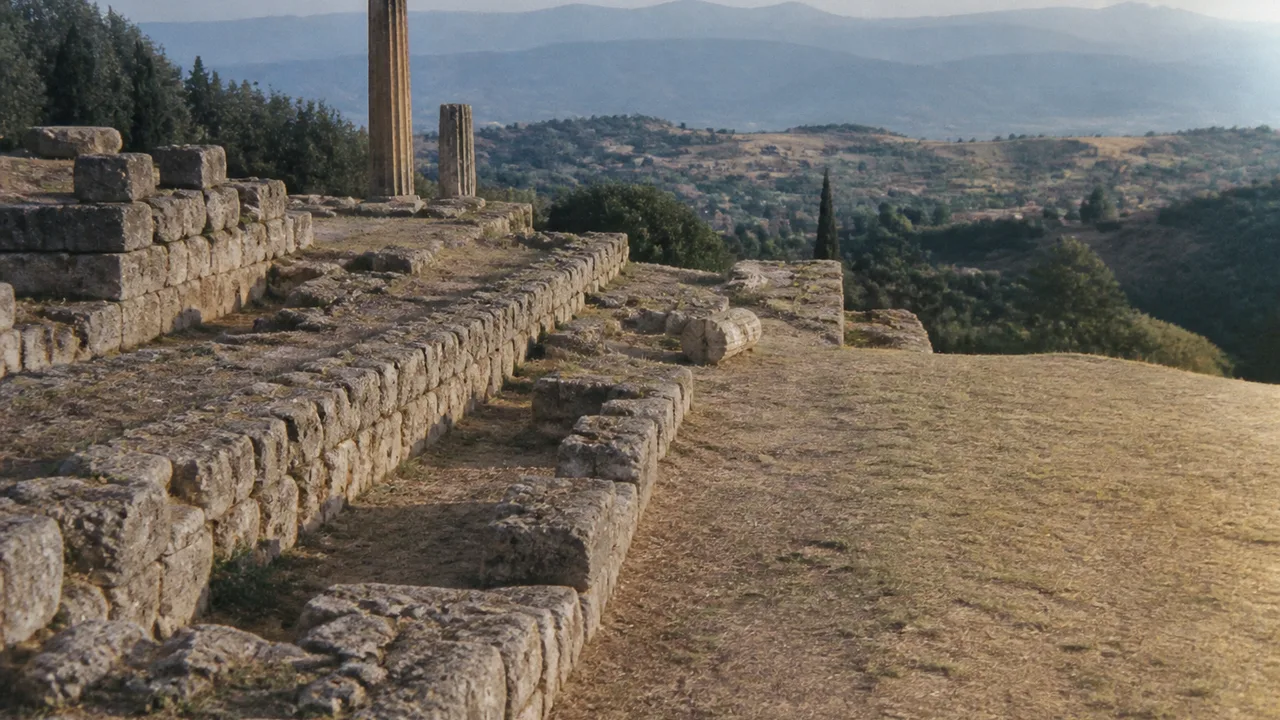
Archaeologists at ancient Mieza in northern Greece have uncovered a fourth-century BC complex containing teaching space, athletic facilities, banquet rooms and four writing styluses. The finds strengthen the identification of the site with the school where Aristotle taught the young Alexander of Macedon, although they do not provide the archaeological equivalent of a class register.
The excavated complex includes two banquet halls, a stadium, a sporting arena, a roofed porch and a lecture hall furnished with stone desks. Mosaics and columns adorned the buildings, while raised platforms in the dining rooms held nearly a dozen couches. Coins, ceramics and four styluses were also found. Its decoration resembles the Macedonian royal palace at Aigai, where Philip II and Alexander lived.
This was education with a palace budget. By placing intellectual instruction beside exercise and formal dining, the architecture suggests an institution designed to form an elite cohort rather than a room reserved for one precocious teenager and his philosopher. It is plausible that a prince and his companions followed a routine encompassing lectures, athletics and meals, but the layout alone cannot establish their timetable or prove that the banquet rooms had an educational function.
That interpretation also explains why the identification depends on the whole site. Four styluses indicate writing, but they cannot identify their users. Stone desks indicate instruction, but many pupils could have occupied them. Decoration resembling Aigai suggests wealthy patronage, but it does not spell out the patron's name. Location, date, function and status become persuasive when read together.
How Ruins Acquire Famous Names
The argument begins with Plutarch, who lived roughly four centuries after Alexander. In his Life of Alexander, he says Philip summoned Aristotle and rewarded him lavishly, restoring the philosopher's native Stagira after having destroyed it. Philip then assigned the sanctuary of the Nymphs near Mieza for the group's “studies and exercises.” Plutarch adds that visitors in his own day were shown Aristotle's stone seats and shaded walks.
The wording offers a topographical checklist: Mieza, a sanctuary connected with the Nymphs, places for study and exercise, stone seating and shaded walks. The excavated complex stands at Mieza, dates to the appropriate century and combines the activities Plutarch associates with Aristotle's pupils. Its costly finish fits the proposal of royal sponsorship.
Historian Miltiades Hatzopoulos considers the identification likely, but told Live Science that the excavator had not yet published a paper presenting the relevant archaeological testimony. The archaeological case has therefore not yet been fully presented in a scholarly paper for testing. A fourth-century elite gymnasium could in principle have served other Macedonian pupils.
Plutarch supplies another reason for care. At the opening of the Life of Alexander, he announces that he is writing “not Histories, but Lives.” His aim was a moral portrait assembled from revealing actions, sayings and anecdotes, rather than an archaeological inventory. His account works best here as a later geographical tradition tested against physical remains. The stones can check the story; they need not kneel before it.
The ancient wording also leaves room for development over time. Plutarch says Philip “assigned” a sanctuary, while the current interpretation attributes an opulent educational complex to royal funding. A sanctuary could receive new buildings, or an educational establishment could grow around an existing sacred landscape. Text and architecture may describe different phases of the same institution.
Philip's Curriculum of Power
Aristotle was called to Macedonia in 343 BC, according to the history preserved with the site. Read as a political arrangement, Philip's bargain with him appears to join intellectual prestige to royal coercive power. Plutarch's account describes a king who had destroyed Stagira, then restored it, returned exiles and formerly enslaved citizens, and summoned its most famous philosopher to teach his son. Describing this arrangement as an elite teaching post is an inference from the status of the patron and pupils, rather than a title preserved in the ancient text.
That arrangement illuminates education at Mieza as an instrument of monarchy. Philip was investing in Alexander and the children of Macedonian nobles, the people being formed for life close to royal authority. The school joined two projects. Aristotle taught a prince; Philip assembled other elite pupils around that prince.
The physical setting sharpens the point. The 30-acre gymnasium included a palaestra, stadium, arcades and a covered running track described as 200 meters long. The latest excavation added a teaching area with stone desks and adjacent mosaic-floored banquet halls. Literacy, athletics and formal dining occupied one planned environment.
The layout permits a cautious inference about institutional purpose. Physical training could cultivate endurance and competitive display; lectures and writing could cultivate intellectual skills. If the banquet rooms formed part of the pupils' routine, their placement suggests that participation in elite dining customs belonged beside those other forms of training. On that reading, Mieza offered a curriculum in belonging, teaching Macedonian noblemen how their social rank was expressed through thought, movement and communal dining.
No surviving stylus can reveal whether Aristotle's politics influenced an order Alexander later issued in Asia. The buildings support a narrower conclusion: Macedonian royal education brought intellectual and bodily training into an environment structured by wealth and hierarchy. A straight line from a philosophy lesson to an empire would give Aristotle too much power and Alexander too convenient an alibi.
Alexander's subsequent career nevertheless gives Mieza's design a severe retrospective charge. Its best-known pupil became a king and conqueror, while the institution served other elite Macedonian youths. The surviving evidence supports that social composition without proving that the school operated as a training academy for the officials of Alexander's later empire.
Mieza also resists the old habit of presenting Alexander's education as the ignition point of something called “Western civilization,” with Asia reduced to scenery awaiting conquest. The complex belonged to a Macedonian monarchy and served a privileged minority. Its grandeur records where Philip directed resources and whom he considered worthy of intellectual, physical and social cultivation.
What Changed After 1964
The connection between Mieza and Aristotle's school predates the latest excavation. Archaeologist Photis Michael Petsas rediscovered the site in 1964 and identified its mid-fourth-century stoa with the Nymphaeum described in ancient texts. That earlier argument rested chiefly on topography, chronology, architecture and literary comparison.
Excavations begun at the wider complex in 2024 have broadened that case. Petsas had a suitably dated covered walkway near Mieza and a text mentioning shaded walks and stone seats. Archaeologists now have a larger functional assemblage: spaces for teaching, athletics and dining, architectural parallels with Aigai, and implements used for writing.
The comparison between 1964 and the present excavation shows how archaeological identifications mature. The first stage matched a place and structure to a literary description. The second examines an institution through its component parts and activities. These are complementary categories of evidence, although both still depend partly on the same late tradition preserved by Plutarch.
Royal decoration supplies another strand. The mosaics at Mieza resemble those at Philip's palace in Aigai, a comparison researchers have used to associate the gymnasium with his reign. Similar decoration cannot identify an individual pupil, but it helps connect the complex's chronology and social status to the Macedonian court.
Ancient archaeology rarely produces a marble label reading “Alexander studied here.” At Mieza, the persuasive object is the arrangement itself: desks beside running grounds, banquet couches beneath palace-like decoration, and four small tools for writing inside a landscape remembered for centuries as Aristotle's classroom.
More Like This

A 2,400-Year-Old Celtic Timber Structure Rises Beneath Aschaffenburg
Workers digging a stormwater basin in Aschaffenburg uncovered 2,400-year-old oak timbers and a dry-stone wall from the Iron Age. What was it for?

The Sunken Bronze Age City Beneath Naxos
The ancient city of Grota lies partly submerged off Naxos. A new History Time video traces its extraordinary story from Neolithic origins to Bronze Age collapse.

Alexander the Great and the Mutiny at the Hyphasis
At the Hyphasis River in 326 BCE, Alexander's exhausted troops refused to advance, exposing the limits that morale, logistics and consent place on conquest.
The Herodium Ring and the Machinery of Roman Rule
A copper ring from Herodium, its unusual Greek O, and a cautious Pilate link reveal the workers and unresolved readings behind Roman rule in ancient Judaea.

Aristotle: Philosopher, Scientist, and Royal Tutor
From Plato's Academy to Alexander's court, Aristotle built a mind that shaped Western thought. Here's what that biography actually tells us.
Ancient Greece: Democracy, Empire, and Extremes
From Homer's epics to Alexander's conquests, ancient Greece shaped the Western world through democracy, warfare, and cultural fusion. Here's what the evidence shows.
Pliny the Younger's Letters on the Eruption of Vesuvius
Pliny the Younger's two letters to Tacitus remain the only eyewitness account of Vesuvius's eruption in 79 AD — and they still read like dispatches from the end of the world.

How the Square Root of 2 Shook Ancient Greek Mathematics
The Pythagoreans believed whole numbers governed all of reality. One diagonal line—and one brave mathematician—proved them catastrophically wrong.