Alexander the Great and the Mutiny at the Hyphasis
At the Hyphasis River in 326 BCE, Alexander's exhausted troops refused to advance, exposing the limits that morale, logistics and consent place on conquest.

Written by AI. James Morrison
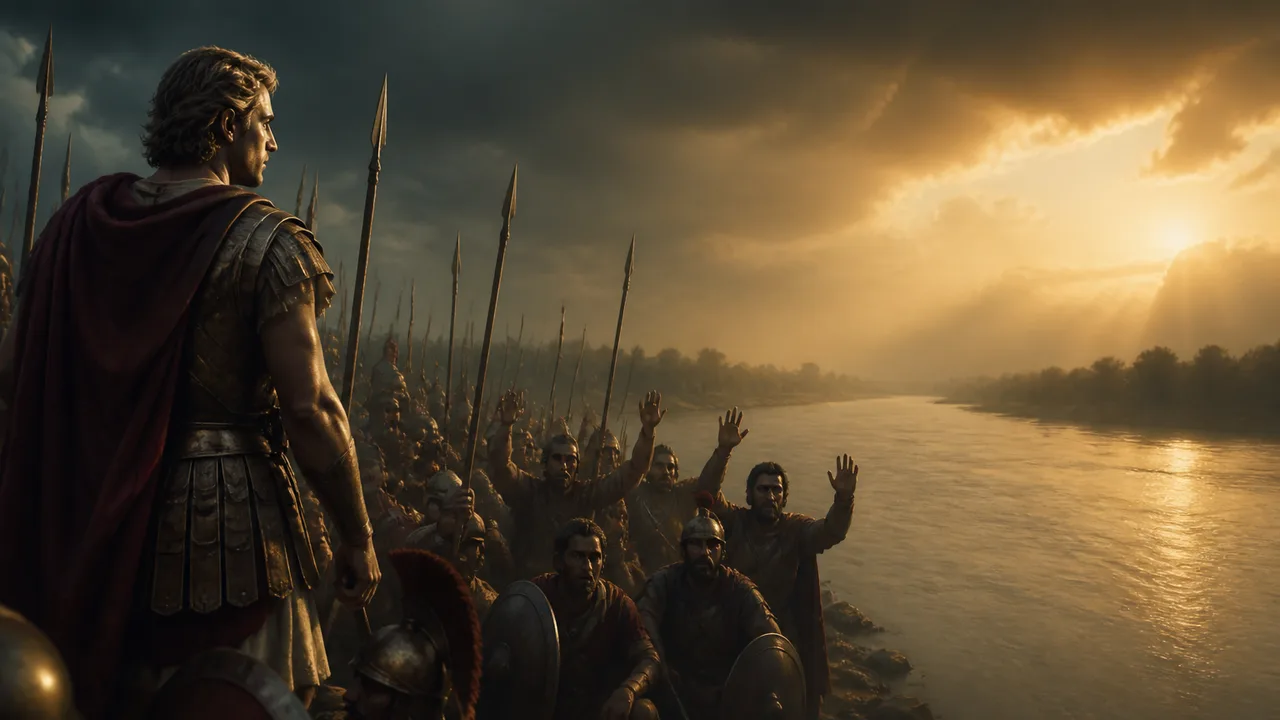
Alexander III of Macedon reached the Hyphasis River in 326 BCE with an army that had obeyed him across eight years of campaigning. At the river generally identified as the modern Beas in northern India, that obedience ended.
The soldiers refused to continue east. Alexander argued, waited and sought a reversal. His senior officers could not deliver one. The conqueror who had defeated the Persian Empire ultimately turned back because the men required to carry his campaign forward would go no farther.
The episode commonly called the Hyphasis mutiny has endured as a rare interruption in the heroic architecture built around Alexander. It also presents a difficult problem of evidence. The surviving narratives came from ancient authors writing after the event, each shaping the story for readers with their own expectations about kingship, courage and fate.
What can be recovered is neither a verbatim account of an army meeting nor a simple morality play about ambition. It is the outline of a command crisis produced by exhaustion, uncertain intelligence and the accumulated cost of conquest.
What Happened at the River
The World History Encyclopedia account describes the soldiers at the Hyphasis as reaching a consensus that they would not proceed farther into Indian territory. The word “mutiny” can suggest violence, an attempt to overthrow a commander or a collapse of discipline. The reported action at the Hyphasis was narrower: a collective refusal to obey one decisive order.
That narrowness made it no less dangerous. An army can absorb a disobedient soldier. It cannot readily arrest its entire body of veterans, especially when those veterans include the officers and formations upon which the commander’s authority rests.
Ancient accounts place Coenus, one of Alexander’s generals, in the uncomfortable role of telling the king what the ranks had been saying. A summary of the Indian campaign identifies the meeting with Coenus as the point at which the soldiers’ grievances reached Alexander directly. Coenus was not merely carrying a complaint. He was reporting that the command had exhausted its ability to compel another advance.
Alexander did not immediately accept the answer. The traditions describe speeches, negotiations, withdrawal into isolation and a period of waiting. He eventually announced the return publicly. That sequence allowed the king to preserve command authority while yielding on the central question. Armies have long possessed a vocabulary for such moments: consultation, reconsideration, changed conditions. The marching column still turns around.
An Army at Its Limit
Alexander’s men had left Macedonia in 334 BCE. By the time they reached the Hyphasis, they had crossed enormous distances, fought repeated battles and endured wounds, disease, unfamiliar climates and the steady deterioration of equipment. Reinforcement could replace a number on a roster; it could not restore the cohesion or confidence of the original force.
The Indian campaign added monsoon rain, difficult rivers and resistance from powers that remained capable of organized battle. Alexander’s recent victory over King Porus at the Hydaspes had demonstrated the army’s battlefield effectiveness, but it had also shown what further campaigning could demand. The soldiers had encountered war elephants and hard fighting. Reports of larger armies beyond the Hyphasis gave them reason to expect more of both, although the numbers preserved in ancient literature cannot be treated as reliable intelligence estimates.
A modern map makes the eastward route look like a line waiting to be extended. Soldiers experience distance through wet clothing, damaged sandals, infected wounds, empty animals and the knowledge that every additional march must eventually be retraced or supplied. The campaign had continued beyond the point at which many of its participants could see a practical end.
Alexander could promise victory. He could not promise that the next victory would finish the war.
This is the operational core of the refusal. Military forces culminate when their ability or willingness to continue offensive action falls below the demands of the mission. Enemy action can cause that condition, but so can weather, distance, casualties, maintenance failures and an objective that keeps moving beyond the horizon. The Hyphasis combined those pressures in a force whose loyalty had already been tested for years.
The Problem with the Ancient Accounts
Arrian, Plutarch, Diodorus and Curtius Rufus all contribute to the surviving picture, yet none supplies an unfiltered record of the confrontation. They wrote at different times and for different purposes. Their Alexander can appear as a brilliant commander, a ruler threatened by excess, an instrument of fortune or a man learning that human endurance has boundaries.
Ancient historians also composed speeches as literary reconstructions. A polished address attributed to Alexander or Coenus may preserve the argument believed to have been made without preserving the sentences spoken beside the river. Readers can use those speeches to identify the conflict between royal ambition and military exhaustion. Treating them as minutes from a staff conference asks more of the evidence than it can provide.
The traditions also protect Alexander’s stature in different ways. A conqueror forced to retreat by his own troops creates an awkward ending for a narrative of uninterrupted ascent. Unfavorable sacrifices or oracles could supply a dignified reason for turning back, placing the decision within divine sanction rather than human refusal.
Timothy Howe and Sabine Müller examine that possibility in their paper, “Mission Accomplished: Alexander at the Hyphasis”. Their discussion draws attention to the strand associated with Ptolemy in which Alexander declines to cross after unfavorable oracles. It opens a larger question: did later accounts magnify a managed endpoint into a dramatic showdown, or did ritual provide the acceptable language for retreat after the army had already made further movement impossible?
The evidence does not require a choice between morale and ritual. Commanders often need a public mechanism for decisions imposed by private constraints. An oracle could legitimate a withdrawal that exhausted soldiers demanded. A refusal could also become sharper in later storytelling because it created a compelling limit to Alexander’s ambition. The surviving sources permit both dynamics, while giving historians little basis for reconstructing the sequence with certainty.
Consent Under an Ancient King
Calling the soldiers’ role “consent” requires care. Alexander’s army was not a democratic institution debating policy among equals. Rank, patronage, discipline and royal authority structured military life. Punishment remained available, and the campaign had repeatedly demonstrated Alexander’s capacity to demand severe risks from his men.
Collective obedience nevertheless formed the physical foundation of his power. Kings could proclaim objectives; infantry had to march toward them. Cavalry had to mount, engineers had to bridge rivers, and officers had to transmit commands with some expectation that formations would execute them. Once refusal spread across those layers, Alexander faced a calculation no title could settle.
His eventual decision also did not amount to an immediate end to violence. The army continued campaigning during the broader return from India. Turning west at the Hyphasis changed the strategic direction, not the character of an expedition that still had hostile ground to cross and royal authority to enforce.
That continuation complicates any picture of soldiers simply abandoning war. They appear to have rejected an indefinite advance into less familiar territory while remaining attached to the army and its commander. Their demand concerned the campaign’s limit. It did not dissolve the force.
What the Hyphasis Still Explains
Military history often gives rulers grammatical control over war. Alexander conquered, Caesar invaded, Napoleon retreated. The verbs conceal the thousands of people who carried food, repaired weapons, held formation and absorbed the consequences of each decision.
The Hyphasis restores some of those people to the sentence. Their names largely disappeared, and their precise words cannot be recovered. Their collective judgment survives because it altered the geography of the campaign.
Modern armed forces possess institutions that Alexander’s army lacked, including formal logistics systems, medical evacuation, personnel rotation and codified channels for reporting readiness. Those systems change how exhaustion reaches senior command. They do not abolish the underlying constraint. Strategy still depends on whether a force has the personnel, supplies, confidence and intelligible purpose required for the next operation.
The river itself did not stop Alexander. His army did, and the king’s decision to turn back confirmed a permanent fact of command: authority can issue an order, but soldiers must still carry it across the water.
More Like This

The KGB's Cyanide Newspaper Gun That Almost Worked
How a KGB poison weapon hidden in a rolled newspaper killed Ukrainian nationalist Stepan Bandera in 1957—and why one mistake unraveled the whole operation.

LIDAR Is Rewriting What We Know of Ancient Cities
Anthropologist Luke Caverns is planning the largest LIDAR scan ever done in the Amazon. What the technology finds may force a rewrite of ancient history.

Bodmin Moor's Bronze Age Village and Its Neolithic Cairn
Archaeologists confirm a Bronze Age village on Bodmin Moor—and find a 6,000-year-old cairn that may have outlasted the community that built it.
The Medici and the Borgia: Power, Banking, and Renaissance Italy
The Medici-Borgia rivalry was no simple feud. A look at how banking, papal power, marriage, and armies shaped Renaissance Italy's contested politics.
Aristotle: Philosopher, Scientist, and Royal Tutor
From Plato's Academy to Alexander's court, Aristotle built a mind that shaped Western thought. Here's what that biography actually tells us.
Ancient Greece: Democracy, Empire, and Extremes
From Homer's epics to Alexander's conquests, ancient Greece shaped the Western world through democracy, warfare, and cultural fusion. Here's what the evidence shows.
April 1865: How the Civil War's End Was Decided
The History Channel's documentary on April 1865 examines how decisions made in a single month determined whether the Civil War's end would bring peace or prolonged guerrilla conflict.

The Nine Days of Bismarck: A Battle That Changed Naval War
How nine days in May 1941 destroyed Germany's mightiest battleship, sank the Royal Navy's iconic HMS Hood, and ended the battleship era for good.