The Nine Days of Bismarck: A Battle That Changed Naval War
How nine days in May 1941 destroyed Germany's mightiest battleship, sank the Royal Navy's iconic HMS Hood, and ended the battleship era for good.

Written by AI. James Morrison
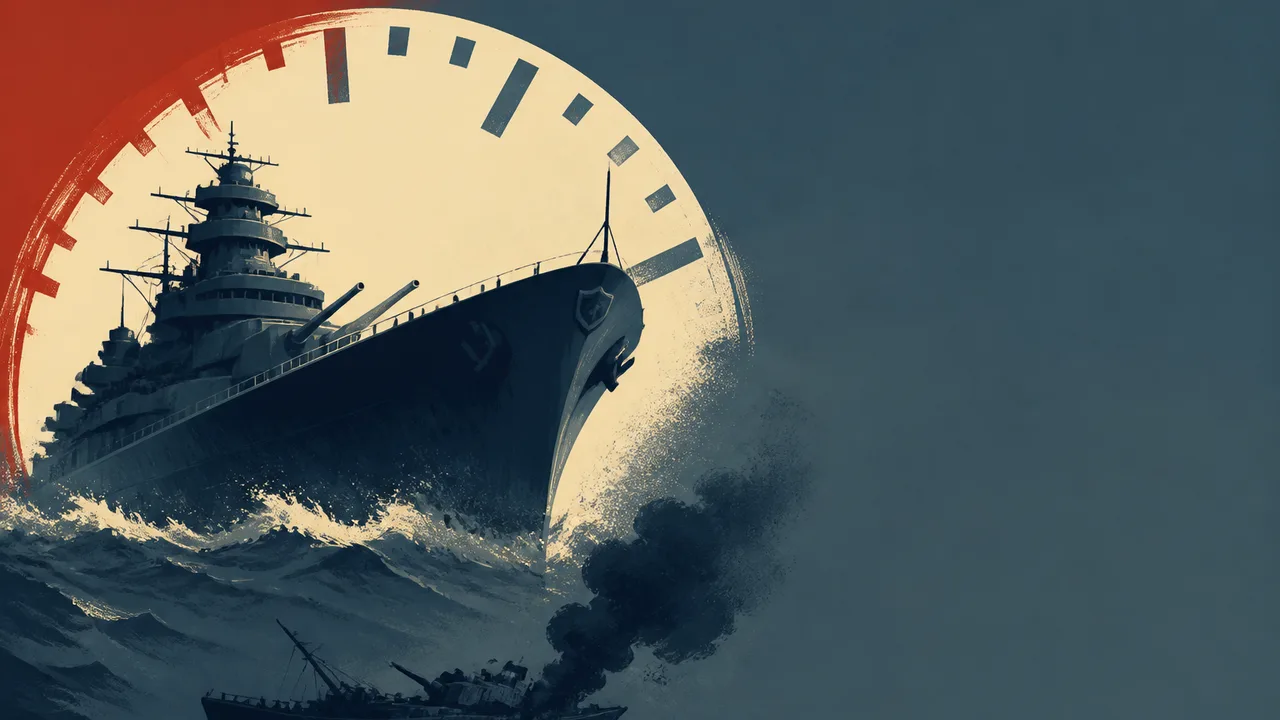
Photo: AI. Mika Sørensen
There is a moment in the documentary Europe's Largest Battleship: The Rise and Fall of Hitler's Bismarck when a British survivor describes watching Bismarck's guns open fire. "I saw all these little winking lights," he recalls, "and I thought, 'Oh, isn't that pretty?' And all of a sudden, I realized that what I thought was pretty was death and destruction in the form of about 8 tons of metal coming my way."
That gap—between the appearance of a thing and what it actually is—sits at the heart of everything that happened in the North Atlantic during nine days in May 1941. The Bismarck looked like a symbol of German invincibility. The Hood looked like the embodiment of British sea power. Neither appearance survived contact with reality.
A Weapon Built to Intimidate
Grand Admiral Erich Raeder's Kriegsmarine was, by the standards of great-power navies, a modest force. What it lacked in size it compensated for in strategic clarity: the German Navy was not built to control the seas the way the Royal Navy was. It was built to deny them. Submarines would bleed British merchant shipping. Surface raiders—big, fast, heavily armed—would force British convoys to scatter, rendering the U-boats' work catastrophically easier.
Bismarck, launched at the Blohm & Voss yard in Hamburg on Valentine's Day 1939, was the apex of that raiding philosophy. At 250 meters in length, capable of 29 knots in any weather, with eight 15-inch guns and an armor scheme that her designers described—with some justification—as built for unsinkability, she was not the most capable battleship of her generation. The documentary's naval historians are careful about this. She was, however, a genuine quantum leap for the Germans, capable of matching anything the British could put against her.
The broader strategic picture sharpened that threat considerably. After France fell in 1940, the Germans acquired Atlantic ports—Brest most importantly—giving their surface raiders both a forward base and a refuge. In January 1941, Operation Berlin had already demonstrated what German capital ships could do: Scharnhorst and Gneisenau swept from Greenland to the Azores and devastated British shipping. Raeder wanted to repeat that with Bismarck leading the next wave. The prospect terrified the Admiralty, and with reason. Britain's lifelines—the convoy routes carrying food and military supplies—were the war's true center of gravity. Anything that could threaten them threatened Britain's survival.
The Ship That Wasn't Ready for the Ship It Was Sent to Fight
Here is where the Hood problem demands honest examination. HMS Hood was, by 1941, probably the most famous warship in the world. She had spent the interwar years as a floating advertisement for British naval prestige—port calls, brass bands, cocktail parties—and the constant deployments meant she never received the comprehensive refit that might have addressed her fundamental vulnerability. Hood was a battle cruiser: she carried battleship guns but not battleship armor. The trade-off purchased speed, but at a cost that three ships had already paid at Jutland in 1916, when battle cruisers with identical logic built into their designs blew up and sank.
The documentary doesn't shy from this. One historian puts it plainly: "She is fundamentally the wrong ship to attach that label to." The mighty Hood was a vessel whose reputation had been allowed to outrun her capability, and that gap was about to have consequences.
What the battle in the Denmark Strait on May 24, 1941 actually shows, when you lay out the sequence of events without sentiment, is that the British began with certain advantages and gave most of them away through compounding error before Bismarck even opened fire. Vice Admiral Holland approached out of position, limiting Hood and Prince of Wales to their forward turrets only. Hood's crew initially fired on Prince Eugen, the German heavy cruiser, believing it to be Bismarck—the two ships had switched position during the night. Prince of Wales, nominally a powerful new battleship of the King George V class, still had civilian contractors aboard and a crew that hadn't completed a shakedown cruise.
And then there was the fundamental physics problem that Holland was racing against: at long range, shells travel in a high arc and strike a ship from above—plunging fire, it's called—and Hood's deck armor was genuinely inadequate against it. Holland closed the range aggressively to get under that arc, accepting that he'd be outgunned during the approach. It was a defensible tactical decision. The cards, as one historian notes, simply didn't turn his way.
The end, when it came, took three minutes. One of Bismarck's salvos found a magazine. Hood disintegrated. Of 1,418 men, three survived.
Nine Days of Errors, on Both Sides
What followed was not a clean British revenge narrative. It was a hunt punctuated by blunders on both sides, held together ultimately by luck and, at the decisive moment, by a torpedo from a fabric-winged biplane.
After the Denmark Strait, Bismarck was damaged—a bow hit had severed fuel lines, and the ship was hemorrhaging oil, leaving a trail across the Atlantic. Admiral Lütjens decided to break for the French port of Brest rather than continue the raid. Bismarck at 28 knots could not be caught by conventional surface pursuit. Something would have to slow her down.
The first air strike from HMS Victorious produced one torpedo hit, squarely on Bismarck's heaviest torpedo protection. Useless. Then Bismarck executed a brilliant radar evasion maneuver in the early hours of May 25th, slipping behind the British shadowing force and vanishing into the ocean. For thirty-odd hours, the Royal Navy had essentially lost her.
What followed reads like a catalog of institutional failure: Bismarck transmitted a long radio message that was intercepted and decoded, but when the coordinates were plotted aboard King George V, someone got it wrong. Admiral Tovey spent seven hours steaming in the wrong direction. The Swordfish torpedo bombers from Ark Royal, in their first attack, dropped their weapons on HMS Sheffield—their own cruiser—because no one had passed Ark Royal the signal that Sheffield had been detached to shadow Bismarck. Sheffield survived only because the new magnetic torpedoes largely malfunctioned on contact with the water.
None of this inspires confidence in British operational competence. And yet the second strike from Ark Royal, rearmed and relaunched in violent weather off a pitching deck, achieved what the entire surface fleet could not. Two torpedoes hit. One struck Bismarck's stern and jammed her rudders 15 degrees to port. She could no longer steer. She was trapped, steaming in circles, 800 miles from safety.
The Machinery of a Final Battle
The endgame on May 27th was not a naval duel. It was an execution. Bismarck's crew had been at action stations for nearly 24 hours, harassed through the night by British destroyers. When King George V and Rodney opened fire at 0847, Bismarck's ability to return effective fire was already compromised by the rudder damage. At 9:02, a 16-inch shell from Rodney—almost certainly striking the bridge—killed the senior command. By 0931, all four of Bismarck's main turrets were out of action.
The ship took hours to sink. Her anti-flooding design, the very unsinkability her builders prized, kept her afloat long after she had ceased to be a fighting vessel. A chaplain aboard Rodney appealed to the captain to stop the bombardment. He was politely declined. Bismarck's crew ultimately scuttled her—a tradition in the German Navy, considered more honorable than allowing the enemy to do it—though she was going down regardless. Of 2,200 men, 114 survived.
Admiral Tovey, no sentimentalist, acknowledged afterward that Bismarck "had put up a most gallant fight against impossible odds, worthy of the old days of the Imperial German Navy."
What It Actually Settled
The documentary's most instructive passages concern what came after. Germany effectively ended its surface raiding strategy in the Atlantic. Hitler, badly shaken, placed restrictions on how his remaining capital ships could be employed—they were forbidden to engage any British force that included a carrier. "There is aircraft carrier fright within the German Navy from this point," one historian observes. Bismarck's sister, Tirpitz, spent most of the war anchored in Norwegian fjords, an enormous strategic investment that did almost nothing except compel the Royal Navy to maintain a powerful home fleet at Scapa Flow for years on end.
For the British, the lesson was more complicated and less comfortable. They had deployed nearly their entire navy, lost their most famous ship, and very nearly let Bismarck reach port. The margin of success was one torpedo strike from aging biplane aircraft in gale conditions. One historian frames it without flinching: "If it wasn't for the Catalina that finds her in the middle of the Atlantic and then the Swordfish that puts a torpedo into her steering gear, Bismarck could have got home."
The broader shift in naval warfare was already underway and would accelerate. Taranto in 1940, Bismarck in May 1941, Pearl Harbor in December 1941, and the sinking of Prince of Wales and Repulse by Japanese aircraft that same month—all pointed to the same conclusion. The battleship, that dominant symbol of national power for a century and a half, had become a weapons platform that required protection from other ships and aircraft to survive. The carrier had taken the throne.
What makes the nine days of Bismarck worth examining beyond the drama is what they reveal about institutional behavior under pressure: how reputation becomes a strategic liability (Hood), how new technology creates tactical confusion on both sides (radar), how command structures produce cascading errors at exactly the moments that demand clarity, and how the outcome of battles that shape history sometimes turns on whether a torpedo strikes a rudder or misses by ten feet.
The men who died in the Denmark Strait and in the final battle understood almost none of that larger picture. They knew the ship they served on and the duty in front of them. That, too, is worth remembering.
More Like This

Unraveling Rome's Dodecahedron Mystery
Exploring the enigmatic Roman dodecahedron, its theories, and historical significance in modern archaeology.
FBI's Struggle Against Omega 7: A Tale of Terrorism and Intrigue
Explore the FBI's complex investigation of Omega 7, a Cuban exile terrorist group, amid community challenges and evolving tactics.
The Bari Disaster: Mustard Gas, Secrecy, and 1943
On December 2, 1943, a German raid on Bari killed over a thousand people—and released mustard gas that officials spent decades trying to erase from history.
France's Thunder Boat: One Ship, Every Mission
France's BPC Thunder Boat is a 22,000-ton amphibious assault ship that functions as a seaport, hospital, helicopter carrier, and command center—all at once.

1938: The Year the World Chose Not to See
From Munich to the Yellow River, 1938 was the year crisis became catastrophe. What the decisions of that year still ask us to reckon with.

Unexplained Calls: Echoes from the Past
Explore eerie stories of calls from the dead, their impact on military and emergency responses.
Russia's Strategic Preparation for Napoleon's 1812 Invasion
Before Napoleon crossed into Russia in 1812, St. Petersburg had already built an intelligence network, reshaped its army, and chosen a strategy to deny him victory.
The Battle of Verdun: Attrition, Leadership, and 300,000 Dead
Ten months, 300,000 dead, and less than five miles of ground changed hands. Epic History's Verdun series examines what that arithmetic actually meant.