April 1865: How the Civil War's End Was Decided
The History Channel's documentary on April 1865 examines how decisions made in a single month determined whether the Civil War's end would bring peace or prolonged guerrilla conflict.

Written by AI. James Morrison
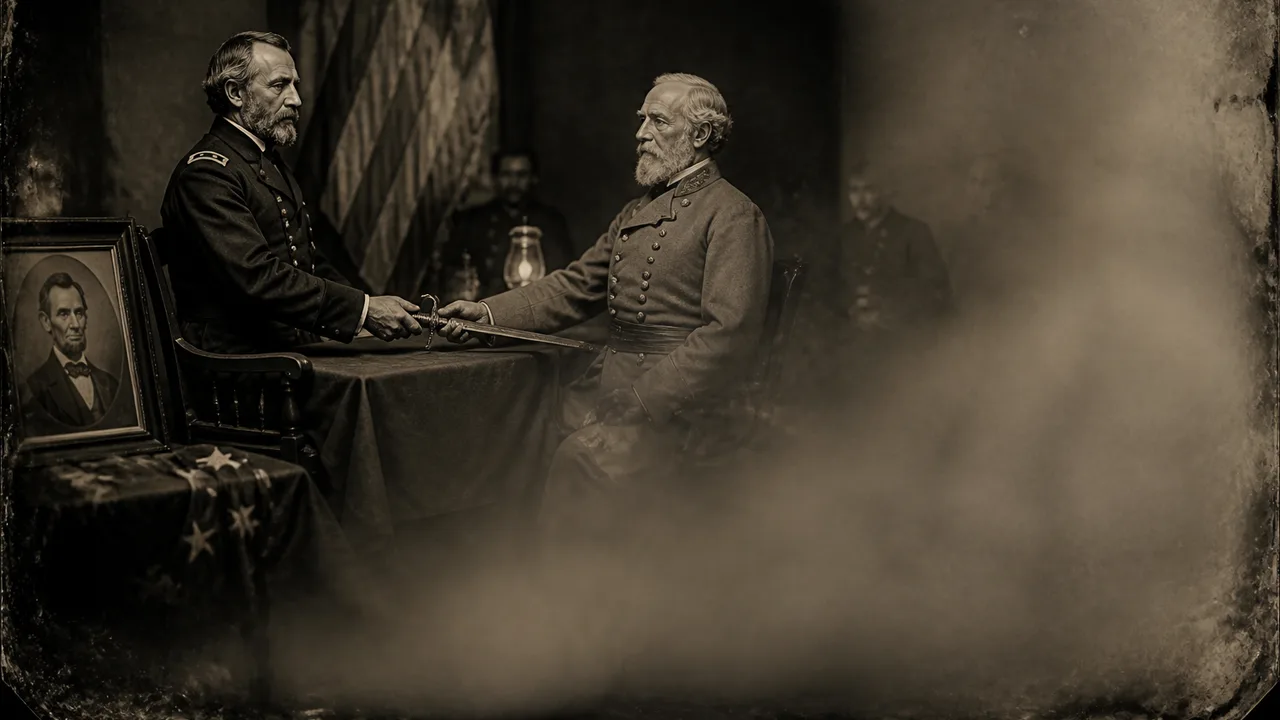
Photo: AI. Otieno Okello
Wars are studied for how they start, occasionally for how they're fought, and almost never for how they end. The History Channel's documentary special April 1865, based on Jay Winik's bestselling account of the Civil War's final weeks, makes a forceful case that this is precisely backwards. The ending, the film argues, was the whole thing—and it nearly went a very different way.
That argument is harder to dismiss than it sounds.
By the first of April 1865, more than 620,000 American soldiers were dead. Grant had been grinding Lee's Army of Northern Virginia into the dirt outside Petersburg, Virginia for nine months. Sherman had left a scorched corridor from Atlanta to the sea. The Confederacy was militarily finished. And yet, as the documentary carefully establishes, military defeat and political resolution are not the same animal. The South still had men in the field—175,000 under arms when Lee surrendered at Appomattox on April 9th—and its president, Jefferson Davis, was not only undefeated but actively calling for guerrilla warfare, urging citizens to take to the countryside and keep fighting.
This is the fork in the road the documentary asks us to really look at. One path leads to something resembling Appomattox. The other leads to what the film calls "the Vietnamization of America"—a phrase that lands with particular weight given what the country lived through a century later.
The Weight of a Decision
The most arresting sequence in the documentary isn't the surrender ceremony itself. It's the Palm Sunday council of war the morning before, when Lee's brilliant 29-year-old chief of artillery, Brigadier General E. Porter Alexander, laid out the guerrilla option plainly: disperse the army into the mountains, fight from cover, make the Union's occupation ungovernable. Alexander wasn't speaking from fantasy. Partisan warfare had worked in the American Revolution. Lee's own father, Lighthorse Harry Lee, had been a partisan commander against the British. Jefferson Davis had just issued a proclamation calling for exactly this kind of resistance.
Lee said no. His reasoning, as the documentary reconstructs it, was not sentiment but strategic calculation: protracted guerrilla war would destroy not just the South, but whatever remained of the American nation. He reportedly told his staff, "I'd rather die a thousand deaths than do that"—and then added the sentence we hear far less often: "It is our duty to live."
The film is at its most analytically useful here, because it holds the question open rather than closing it too quickly. Lee's decision was consequential. It was also not inevitable, and the documentary earns credit for not pretending otherwise.
Grant's Unscripted Generosity
The terms Grant offered at Appomattox were, by the standards of civil wars across history, extraordinary. Lee's soldiers would sign paroles—pledges not to take up arms again—and go home. Officers kept their sidearms. Men who owned horses could keep them for the spring planting. No imprisonment, no trials, no public humiliation beyond the fact of defeat itself. Grant ordered his troops to silence their celebrations when Lee rode away.
This was not standard operating procedure for victors. The documentary draws the comparison explicitly: most civil wars end in more civil war. Rwanda. Cambodia. Bosnia. Grant was essentially offering amnesty to an entire enemy army on his own authority, guided only by a conversation with Lincoln aboard the steamer River Queen days earlier.
"Grant is enacting the tender peace that Lincoln has called for," the documentary observes. "He's basically giving amnesty to the entire Army of Northern Virginia. This is historically unusual to say the least."
The irony the film doesn't quite force but allows the viewer to feel: Grant, the relentless general who had wept after the Wilderness and kept attacking anyway, turns out to have the softest peace terms in the room. The men who had fought the hardest were the least interested in punishment.
Sherman's Overreach and Its Aftermath
The documentary's most genuinely complicated episode involves William Tecumseh Sherman—the man who burned his way through Georgia—negotiating a surrender agreement with Confederate General Joseph Johnston in North Carolina that was so generous it shocked Washington. Sherman offered Johnston's army not just the terms Grant gave Lee, but effectively a restoration of the political and legal status quo ante: Confederate state governments preserved, property rights intact, full political amnesty.
Washington killed the agreement immediately. Secretary of War Edwin Stanton accused Sherman of exceeding his authority. Some feared a military coup. The terms were renegotiated to match those at Appomattox.
The documentary is honest about the complexity here. Sherman's terms were politically indefensible—they said nothing about the four million people who had just been freed from slavery, treating emancipation as the war's only irreversible outcome while leaving everything else essentially unchanged. The cabinet wasn't wrong to reject them. But Sherman's instinct—that a generous peace was the only durable peace—was the same instinct Lincoln had expressed and Grant had acted on. The difference was Sherman went further than his authority allowed, and did so in the days immediately following Lincoln's assassination, when the political temperature in Washington had swung hard toward punishment.
Lincoln's murder is the pivot point the film keeps returning to, and rightly so. His death handed ammunition to Radical Republicans who had always thought his reconciliation policy was dangerously naive. It brought to power Andrew Johnson, whom Lincoln had chosen as a unity candidate and who turned out to be neither Lincoln's peer nor a reliable vehicle for his vision. And it injected into every subsequent decision the raw fury of a traumatized nation looking for someone to make pay.
The Question the Documentary Raises Without Answering
The History Channel special, at its best, is asking something that doesn't have a clean answer: did the magnanimous peace of 1865 actually produce a good outcome?
The men in the documentary—historians, military analysts—speak movingly about the roads not taken, the guerrilla war that didn't happen, the American experiment that survived. Lee's postwar interview with a Northern journalist, in which he spoke of "we" and "the country" meaning the United States rather than the Confederacy, is presented as a kind of grace note. One historian quotes Lee's own reflection: "I surrendered as much to Lincoln's goodness as I did to Grant's armies."
That is a remarkable thing for a defeated general to say. It is also worth sitting with what followed: Reconstruction was gutted, the promise of Black citizenship was systematically dismantled over the following decades, and the men who fought for the Confederacy were largely permitted to return to political and social power in the South. The "tender peace" Lincoln envisioned was merciful to former Confederates in ways that were not merciful to the people they had enslaved.
The documentary, rooted in Winik's thesis about a saved nation, is understandably more focused on the bullets dodged than on the long reckoning with what the peace actually delivered. That's a fair choice for a ninety-minute film with a specific argument to make. But the tension is present in the material if you're looking for it—in Sherman's silence about the freedmen, in the Radical Republicans' frustrated insistence that something more structural was required, in the treason indictment of Lee that Grant had to personally threaten to resign over to kill.
April 1865 was the month that prevented one catastrophe. Whether it planted the seeds of another is the question American history has been arguing about ever since.
More Like This
The KGB's Cyanide Newspaper Gun That Almost Worked
How a KGB poison weapon hidden in a rolled newspaper killed Ukrainian nationalist Stepan Bandera in 1957—and why one mistake unraveled the whole operation.
FBI's Struggle Against Omega 7: A Tale of Terrorism and Intrigue
Explore the FBI's complex investigation of Omega 7, a Cuban exile terrorist group, amid community challenges and evolving tactics.

Unveiling Rome's Gladiator Underworld
Explore the hidden world beneath ancient Rome's arenas, unveiling gladiator training, underground tunnels, and cultural practices.
The Bari Disaster: Mustard Gas, Secrecy, and 1943
On December 2, 1943, a German raid on Bari killed over a thousand people—and released mustard gas that officials spent decades trying to erase from history.
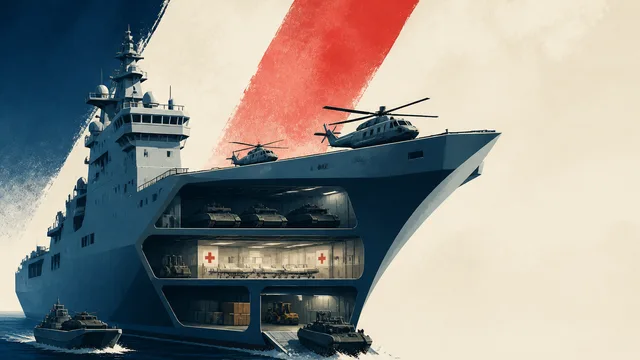
France's Thunder Boat: One Ship, Every Mission
France's BPC Thunder Boat is a 22,000-ton amphibious assault ship that functions as a seaport, hospital, helicopter carrier, and command center—all at once.
Did the Valar Abandon Middle-earth?
The Valar all but vanish by the Third Age. Robert from In Deep Geek argues that's not absence—it's a handoff. Here's what the text actually supports.
The Nine Days of Bismarck: A Battle That Changed Naval War
How nine days in May 1941 destroyed Germany's mightiest battleship, sank the Royal Navy's iconic HMS Hood, and ended the battleship era for good.
Russia's Strategic Preparation for Napoleon's 1812 Invasion
Before Napoleon crossed into Russia in 1812, St. Petersburg had already built an intelligence network, reshaped its army, and chosen a strategy to deny him victory.