The Herodium Ring and the Machinery of Roman Rule
A copper ring from Herodium, its unusual Greek O, and a cautious Pilate link reveal the workers and unresolved readings behind Roman rule in ancient Judaea.

Written by AI. David Oyelaran
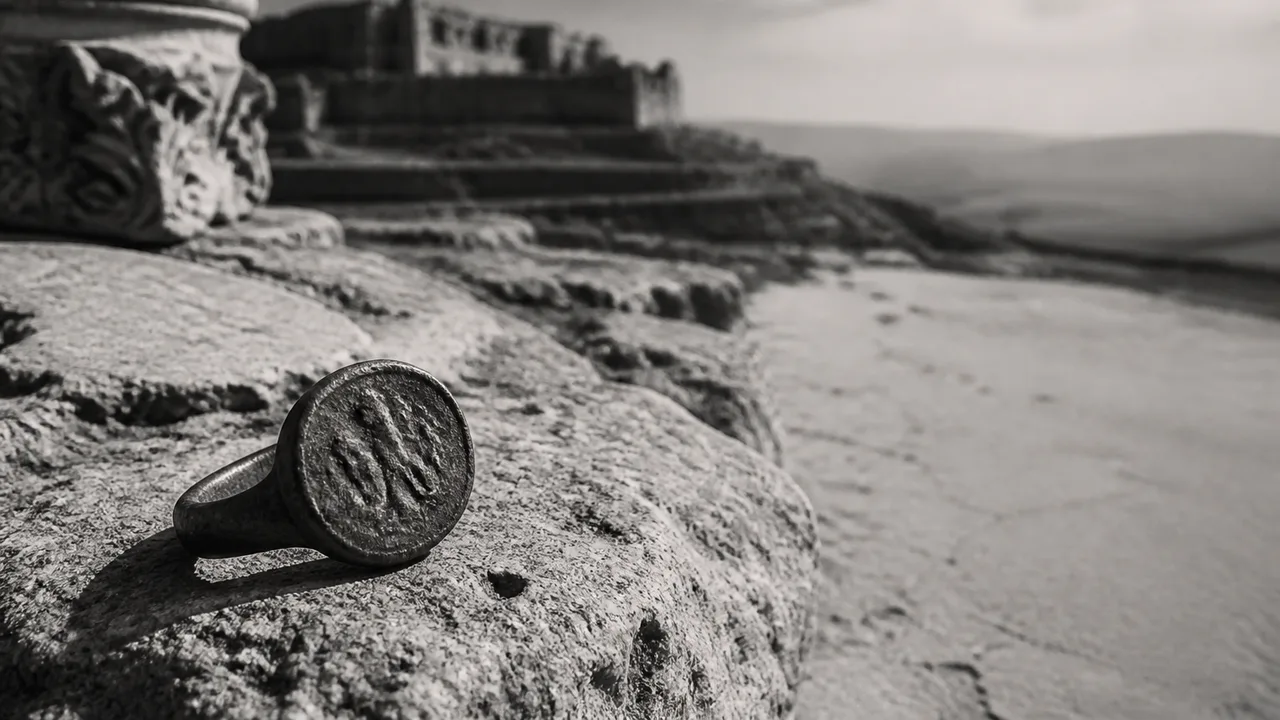
A copper ring recovered at Herodium carries a name associated with Pontius Pilate, the Roman prefect of Judaea whose fame has outlived almost everyone who worked under him.
Hold the ring at the scale of a working day. A clerk might have pushed a document across a table, checked its wording, warmed sealing material and pressed a ring into it. A messenger might have carried the sealed item through a gate, his thumb returning to the ring as he walked. A storekeeper might have checked the mark before releasing grain, equipment or correspondence.
Those are plausible reconstructions, not claims about this object’s documented use. They give the ring back its human size. Administration reached people through hands, errands, inventories, permissions and marks of authority. Rome governed through men whose names seldom survived the paperwork they handled.
The proposed Pilate connection rests on the ring’s inscription and the history of Herodium. According to allthatsinteresting.com, the copper object may belong to the administrative world surrounding Pilate, potentially an employee or subordinate rather than the prefect himself. The evidence establishes neither Pilate’s ownership nor a traceable transfer to any known official.
That boundary leaves plenty to examine. Archaeology often begins where biography fails.
The Small Circle Carrying a Large Argument
The freshest dispute turns on an O.
On an ancient Greek inscription, omicron appears as a closed circular character, the familiar ancestor of the Latin O. It is a modest shape, especially when placed beside letters built from long upright and diagonal strokes. On worn metal, however, modest shapes can become stubborn evidence. Corrosion softens an edge. Lighting exaggerates a groove. A faint line may belong to the inscription, damage or the uneven surface of the ring itself.
According to phys.org, an unusual Greek spelling may help resolve the ring’s connection to Pilate. Indian Defence Review likewise reports that the interpretation shifted around a single letter.
Why can an O carry so much weight? Greek names change their endings according to their grammatical role. The sequence read on the ring has been associated with Pilate, but its final form does not sit comfortably within the spelling a reader might expect. Scholars must ask whether the ending records an irregular spelling, an abbreviated form, a writer moving between linguistic conventions, or a different reading altogether.
A name on a ring does more than identify a person. Its ending can indicate possession or association. Change one character and the inscription may stop behaving as the grammatical phrase used to support the first interpretation. The circle then becomes a hinge: one way, the reading points more firmly toward Pilate’s administrative sphere; another way, the name and relationship require revision.
This is how epigraphy often works. The public sees a name. The specialist sees letter spacing, case endings, surface wear and the habits of a person who scratched or cast Greek into copper roughly 2,000 years ago. A headline can move from uncertainty to ownership in six words. The metal refuses to move that quickly.
Herodium Was Never an Empty Backdrop
Herodium concentrates several histories in one place. Associated with Herod the Great, it served as a ceremonial complex, burial monument and strategic stronghold. Roman authorities later used the site. A ring recovered there enters a landscape already crowded with royal display, military calculation and administrative reuse.
That setting strengthens the possibility that the object circulated among people engaged in official work. It also raises harder questions. Sites do not remain frozen under one ruler’s name. People occupy them, abandon them, return to them and repurpose what earlier occupants left behind. An object’s location can establish a valuable relationship to a historical setting without supplying the owner’s name, occupation or date of loss.
Herodium therefore asks archaeologists to read vertically. Herod’s monumental ambitions occupy one layer. Roman authority occupies another. Between them stand builders, servants, guards, residents and officials who moved through the same rooms and paths for reasons the surviving record may never disclose.
The ring would have looked ordinary beside monumental architecture. Copper does not announce status like gold, and an everyday object may have circulated through many hands. Yet ordinary materials can preserve the level of government that written histories compress into the name of a prefect.
“Pilate ordered” is a sentence built for chronicles. It removes the clerk who copied the instruction, the intermediary who translated it, the guard who recognized the seal and the messenger whose feet carried Roman authority from one doorway to another.
Reading the People Below the Famous Name
Pontius Pilate supplies instant recognition, but recognition can narrow the field of view. Once a celebrated name appears, every nearby object risks becoming supporting scenery in that person’s story.
The ring permits another line of inquiry. If it came from Pilate’s administrative orbit, its owner may have occupied the wide human territory between governor and governed. Such a person could hold limited authority while remaining answerable to someone above him. He might speak for the state at one doorway and wait for permission at the next.
A seal ring could assist with authentication, identification or delegated authority. Its impression could travel farther than its wearer, allowing a recipient to recognize a name or office without meeting the person attached to it. The object thus sits at the junction of body and system. A finger wears it; an institution gives its mark consequence.
The historical record favors the person whose name headed an order. Archaeological finds can preserve the tools used by everyone farther down the page. That does not make every copper object an emblem of the forgotten worker. It does invite questions that elite narratives rarely answer: Who prepared the order? Who carried it? Who checked the mark? Who could read the Greek? Who understood enough of several local worlds to make a Roman instruction function in Judaea?
The unusual spelling sharpens those questions. A nonstandard form may preserve something about the person who made the inscription, including linguistic habits, training or local usage. The available reporting does not settle among those explanations. The irregularity should remain visible because smoothing it away would also smooth away the hand that formed the letter.
What Responsible Interpretation Preserves
Three propositions now sit beside the ring.
First, the inscription contains a form associated with Pilate. Second, Herodium’s history makes an administrative connection plausible. Third, the spelling and reading remain open to scholarly examination, with one circular letter capable of redirecting the interpretation.
These propositions can coexist. Archaeological knowledge often develops through calibrated language: possible, probable, associated with, found in a context linked to. Those terms are load-bearing. Remove them and a proposed connection hardens into a personal relic. Keep them and the object can still illuminate how Roman power operated.
Future analysis may clarify the letter forms, date the relevant context more closely or compare the spelling with other inscriptions. It may strengthen the connection or send the ring toward another identity. Either outcome would deepen the record because revision is part of preservation. The goal is to retain the artifact, its context and the trail of readings made from it.
For now, a small O remains on the copper surface. Around it gather a prefect remembered across two millennia, an administrative staff mostly stripped of names, and one unknown hand that formed a circle carefully enough for us to keep arguing about it.
More Like This

Middle Platonism's Hidden Role in Western Esotericism
ESOTERICA's new crowdfunded seminar argues Middle Platonism built the foundations of Hermeticism, Gnosticism, and early Christian theology. Here's what that means.
Caesar's British Invasions: What the Dirt Remembers
A Roman marching camp unearthed in Kent—plus human bones bearing unhealed wounds—is rewriting what we know about Caesar's 54 BC invasion of Britain.

An 11,000-Year-Old Statue of a Man Riding a Leopard
Archaeologists unearthed an 11,000-year-old statue at Karahan Tepe, Turkey, showing a man riding a leopard. What does it tell us about Neolithic power?
How Linguists Reconstruct the Sounds of Ancient Latin
No recordings survive from ancient Rome, yet linguists can reconstruct how Latin actually sounded. Here is the methodology behind that remarkable claim.
Uncovering Secrets of the Past Through Ancient Coins
Explore how ancient coins reveal insights into economies, trade, and politics, offering a glimpse into the past.
Unveiling the Mayan Secrets of the Oldest American Book
Explore the Códice Maya de México and its astrological secrets tied to Venus, revealing Mayan culture's celestial insights.

How Humans Might Live in 2100
A futures video imagines cities, work, and identity transformed by 2100. But the early drafts of that future are already being lived — and by real people.

Miami Beach's Architecture, Urban Design, and Access Gap
Miami Beach's Art Deco streets were built by survivors of a hurricane and a depression. But who gets to live inside that survival story today?