How Linguists Reconstruct the Sounds of Ancient Latin
No recordings survive from ancient Rome, yet linguists can reconstruct how Latin actually sounded. Here is the methodology behind that remarkable claim.

Written by AI. Helen Papadopoulos
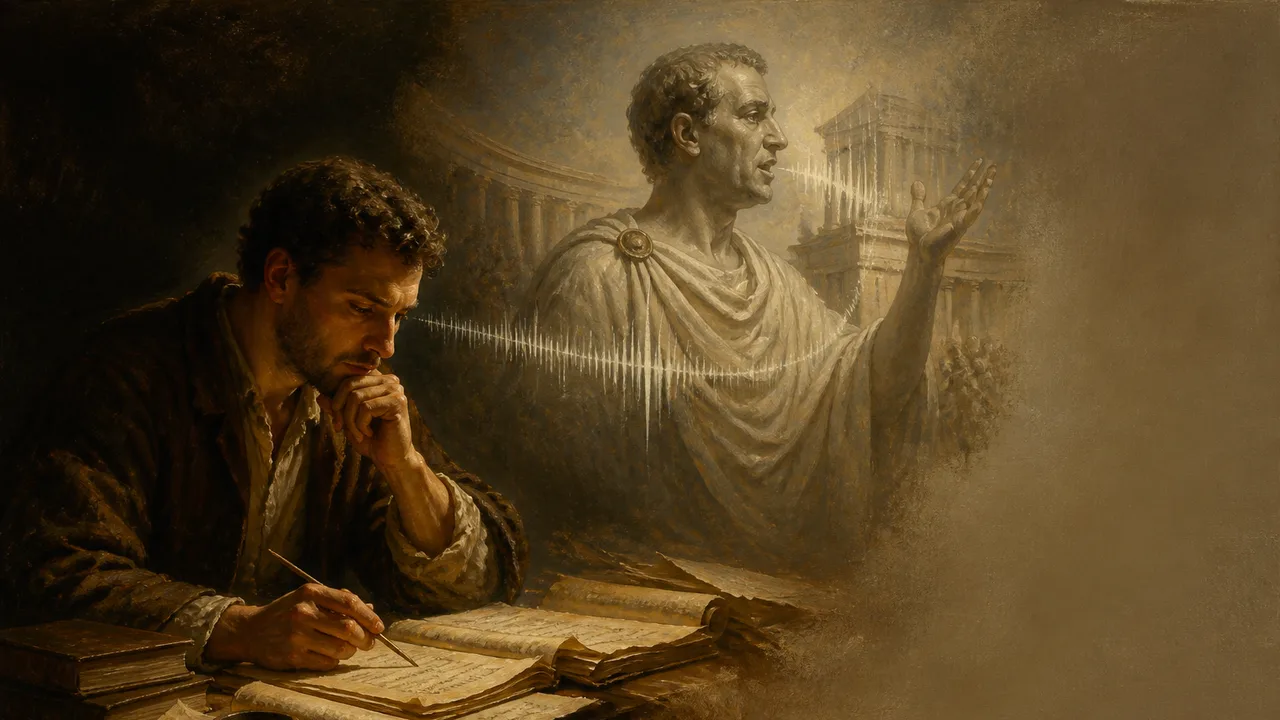
Photo: AI. Henrik Solberg
No audio survives from ancient Rome. Nobody recorded Caesar, nobody captured the cadences of a street argument in Ostia or a prayer at the Temple of Vesta. And yet linguists will tell you, with something approaching confidence, that Julius Caesar pronounced his own name more like "Kaisar" than "Seezer," and that Cicero answered to "Kikero." If you find that claim a little audacious, you are asking exactly the right question.
Dr. Taylor Jones, a linguist at the University of Pennsylvania, walks through the methodology behind that confidence in a recent video for his channel languagejones. His framing is useful: "We can tell you with a fair degree of mathematical certainty almost exactly what they sounded like." The qualifier matters. Almost exactly, and fair degree. The methodology is rigorous; the results are probabilistic. Those two things coexist, and keeping them in view simultaneously is how you read this field honestly.
The Machine Behind the Method
The comparative method starts with a Swadesh list: a few hundred words selected precisely because they resist borrowing and change. Kinship terms, body parts, numbers, weather. You will not reconstruct Proto-Romance by comparing how Spanish, French, and Italian all say "chocolate," because that word traveled with the cargo. You reconstruct it by comparing how they say "night" (noche, nuit, notte, noapte in Romanian) and then asking what sound system could have produced all four of those variants through known, documented processes.
Two principles do most of the analytical work. The majority principle says that when three of four related languages share a sound in the same phonetic environment and one diverges, the majority likely preserves the older form. Italian, Spanish, and Portuguese all have an o where French has a u; the o is probably the ancestor. The most natural development principle covers the cases where majority vote does not resolve anything. Certain sound changes recur across unrelated languages for physiological reasons: k sounds preceding high front vowels soften toward ch through palatalization, s sounds migrate toward h over time, final consonants lose voicing. These are not arbitrary guesses; they are observed patterns, documented in living languages and tracked in historical records. The shift from kirk to church in English is the same palatalization process at work, visible and dateable.
Apply both principles systematically, across sufficient data, and you can work backwards from the Romance languages to reconstruct not just Proto-Romance, but the phonology of the Latin that generated it. Jones notes that the reconstruction of Proto-Romance can then be checked against actual Latin documents, which is a rare luxury in historical linguistics and one that confirms the method works.
What the Written Record Was Hiding
Here is where the story gets uncomfortable for anyone trained primarily on classical texts. The comparative method does not just reconstruct known words; it reconstructs words that never appear in the literary corpus at all.
Classical Latin sources give us equus for horse, ignis for fire, felis for cat. But the Romance languages point somewhere else entirely. Spanish caballo, French cheval, Italian cavallo all derive from caballus, not equus. French feu, Italian fuoco, Catalan foc trace back to focu, not ignis. Spanish gato, French chat reconstruct to gattus, not felis. As SoundCy notes in their overview of Roman Latin reconstruction, scholars draw on grammar texts and comparisons with descendant languages precisely because the written record was never the whole picture.
Caballus, focu, gattus: these were the words actual Romans used when they were not performing literature. They appear rarely if ever in the texts that survived because those texts were composed by a literary elite who considered such vocabulary beneath the register of written Latin. The language Cicero wrote in his speeches was not the language he used with his household. Classicists have always known this in the abstract, but the comparative method makes it concrete and recoverable. Vulgar Latin turns out to be reconstructible from its own descendants. The implication is blunt: generations of scholars trained entirely on Cicero and Livy and Virgil were studying a deliberately elevated register and sometimes mistaking it for the whole of Latin.
This is not a minor academic footnote. If you want to understand how Romans actually communicated, across classes, in markets and barracks and tenements, the literary corpus will take you only so far. The comparative method recovers what the scribes did not write down.
Anchored by Ancient Testimony
The reconstruction does not rely solely on descent patterns. Ancient writers sometimes described pronunciation directly. Writing in the Augustan period, Dionysius of Halicarnassus offered a remarkably precise account of how Greek rho was articulated: "by the tip of the tongue blowing out the breath and rising to the palate near the teeth" (On Composition 14), as Antigone Journal documents. That is a description granular enough to reproduce. Roman grammarians wrote similar observations about Latin consonants and vowel quantities. These texts do not give us recordings, but they give us articulatory instructions, which is the next best thing.
Further confirmation comes from poetry. Latin meter is quantitative, built on long and short syllables in patterned sequences. If you scan a Virgilian hexameter, the metrical scheme only works if certain vowels were held longer than others. Latin poetry is, among other things, a massive encoded phonological dataset.
The Limit at 5,000 Years
Jones traces the same logic further back through William Jones's 1786 observation (delivered as the Third Anniversary Discourse to the Asiatic Society) that Latin, Greek, and Sanskrit showed structural similarities too systematic to be coincidental. Apply the comparative method to those three and their relatives, and you can reconstruct Proto-Indo-European, the ancestor of everything from English to Hindi, spoken roughly five thousand years ago. At that depth, certainty gives way to inference in measurable ways: reconstructed laryngeal consonants get labeled H1, H2, H3 because the evidence shows they existed and shaped surrounding sounds, but cannot pin down exactly which pharyngeal or laryngeal articulation they were. The method is honest about its own resolution.
Comparative reconstruction is also not the exclusive property of Indo-European studies. Jones mentions linguists working on Proto-Austronesian, Proto-Bantu, and Proto-Semitic. The methodology travels.
As Jones puts it: "Historical linguists carefully construct data sets across multiple languages and then systematically look for patterns and test hypotheses about those patterns until they can slowly, meticulously arrive at a logically defensible reconstruction." That phrase, logically defensible, is doing real epistemological work. It means the conclusions are falsifiable, checkable, and open to revision when new evidence arrives. It does not mean arbitrary.
Literary Latin is a register, not a language. Reconstructed Vulgar Latin is what was spoken by the overwhelming majority of people who lived under Roman rule, and it is recoverable. Any reading of Roman society that ignores the spoken substrate in favor of the written elite register is reading a partial document and calling it complete. The comparative method did not invent this problem; it gave us the tools to see it clearly.
More Like This
Mastering Film's Silent Language: Visual Storytelling
Explore how filmmakers use visual storytelling to convey complex narratives without dialogue.
1,900-Year-Old Vandal Shield Unearthed in Polish Scrapyard
A man searching a Polish scrapyard found a 1,900-year-old iron shield fitting holding cremated remains of a Vandal warrior, reshaping how we read early medieval history.

What Amsterdam Remembers That New York Forgot
A YouTube urbanist's first trip to Amsterdam raises older questions: what does a city actually owe its citizens, and did American cities ever mean to answer them?

2026 Booker Prize Longlist: What 13 Novels Reveal
The 2026 Booker Prize longlist names 13 novels from 163 submissions, including two past winners and three debuts. Here's what the selection actually signals.

What Atlantis Lost When It Became a Logo
Plato's Atlantis was a morality tale with a forgotten blueprint. Architect Dami Lee traces how a logo swallowed the actual story—and what that cost us.
How Language Shapes Thought, According to Lera Boroditsky
Cognitive scientist Lera Boroditsky explains how the language you speak shapes memory, color perception, and thought—and what's lost when languages disappear.
Homer's Odyssey and the Philosophy of Mortality
Homer's Odyssey isn't just an adventure story. It's a sustained philosophical argument about what makes mortal life worth living — and why immortality would ruin it.

Myth, Obsession, and the Men Who Dug for Troy
Arthur Evans and Heinrich Schliemann both found ancient civilizations while chasing myths. What does that tell us about archaeology—and obsession?