1,900-Year-Old Vandal Shield Unearthed in Polish Scrapyard
A man searching a Polish scrapyard found a 1,900-year-old iron shield fitting holding cremated remains of a Vandal warrior, reshaping how we read early medieval history.

Written by AI. Harold "Harry" Goodman
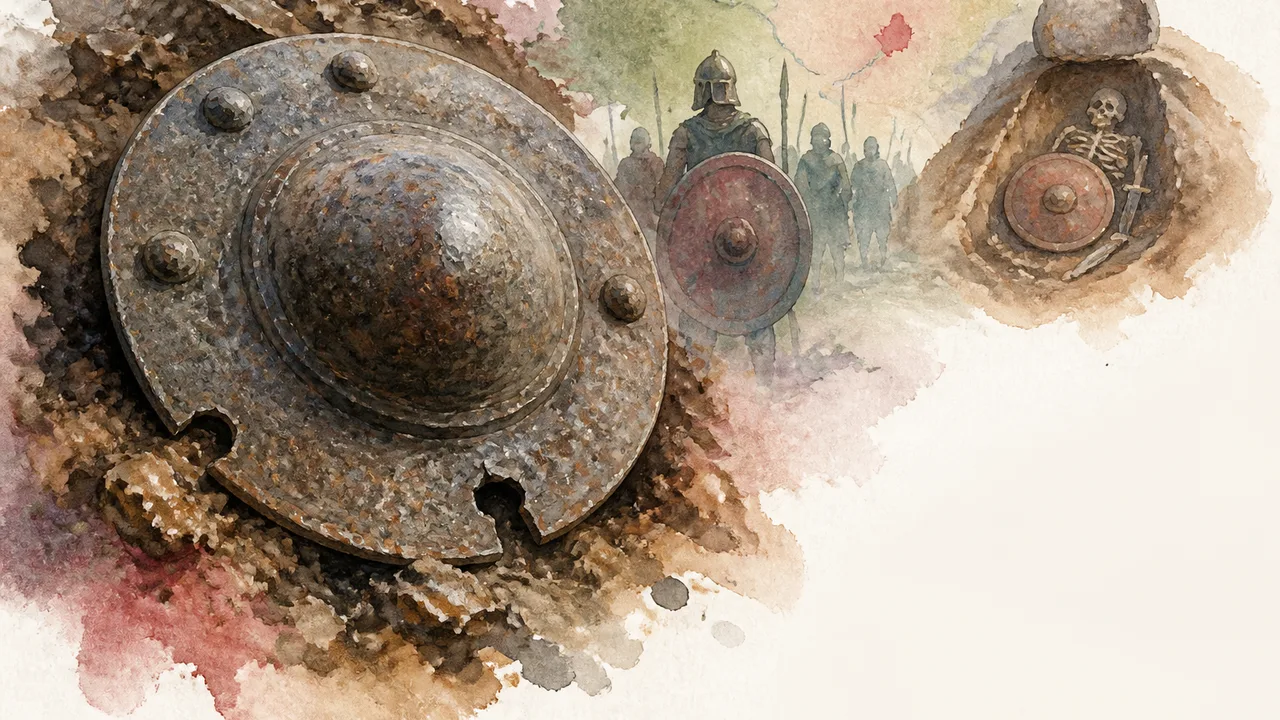
A man rummaging through a scrapyard in Poland pulled out a corroded iron object and, without knowing it yet, held roughly 1,900 years of burial custom in his hands. According to All That's Interesting, the artifact is an iron shield fitting dating to the second century C.E., believed to belong to a Vandal warrior, and it was cremated alongside its owner before ending up in the soil of what is now Poland.
The object itself is not dramatic to look at. A shield fitting is hardware, the kind of reinforcing ironwork that keeps a wooden shield from splitting under the force of a sword stroke. Strip away the wood over two millennia of burial, and what you have left is the metal skeleton of an act of war and an act of mourning.
What the Object Is, and What It Carries
The cremation detail is the piece that pulls at me. Placing a warrior's weapons on the pyre with him was standard practice across several Germanic cultures of the Roman-period centuries, the so-called Przeworsk culture that archaeologists associate with proto-Vandal populations in what is now Poland and western Ukraine. The shield was not deposited in the grave as an afterthought. It was put into the fire.
Live Science reports that the shield fitting was found holding cremated remains, which means this is not simply a piece of lost equipment but a container for a person. The ironwork and the ash arrived in the archaeological record together.
The scrapyard location is the minor mystery the sources don't fully resolve. How the object moved from a second-century burial context into a modern Polish junkyard is not explained in the reporting available. Scrap dealers in Poland and elsewhere have long been inadvertent custodians of antiquity; metal detectorists and salvage workers turn up Roman-period material with some regularity in the territories that once marked the frontier zones between the Roman Empire and the Germanic confederations beyond the Danube and Rhine. The object likely passed through multiple hands before anyone recognized what it was.
Who the Vandals Were Before the Sacking
The word "vandal" carries roughly a thousand years of bad press. The historical Vandals sacked Rome in 455 C.E., and the event lodged so firmly in the European cultural imagination that their name became a common noun for wanton destruction. That reputation has a way of reaching backward through time, coloring how we read every piece of Vandal material culture, as though the shield's owner must have been practicing for something.
He was not, of course. A Vandal warrior of the second century C.E. lived three hundred years before the Sack of Rome. He was a member of a Germanic-speaking tribal confederation occupying territories roughly corresponding to modern Poland, navigating trade routes that connected the Baltic amber coast to the Roman provinces to the south, and maintaining a burial culture that took his weapons seriously enough to burn them with him. The Vandals of this period were in commercial and sometimes military contact with Rome, not yet its destroyers.
The confusion between early Vandal culture and the later migration-period confederacy that swept through North Africa and eventually sacked the city is one of the persistent distortions in popular history of late antiquity. Scholars of the period have pushed back on this conflation for decades. The Encyclopaedia Britannica's entry on the Vandals notes that the tribal group underwent significant political transformation across the migration period, absorbing other peoples and changing its social structure substantially before arriving at Carthage in 429 C.E. The second-century warrior whose remains are mixed with this shield fitting inhabited an entirely different world.
The Archaeology of Przeworsk Culture
The context that makes this find legible is the Przeworsk archaeological culture, named after a site in southeastern Poland and associated broadly with Germanic populations of the first through fourth centuries C.E. Przeworsk burials are characterized by cremation, weapons deposits, and ironwork of consistent enough style that archaeologists can identify the tradition across a wide geographic range. Shield bosses and shield fittings are among the most commonly recovered weapon-associated objects from these burials, because iron survives fire and centuries of soil in ways that wood and leather do not.
Poland's soil has been yielding Przeworsk material for well over a century, and the scholarly literature on it is substantial, though not especially well known outside of Central European archaeological circles. The find reported by All That's Interesting and Live Science fits squarely within an established type: a cremation deposit with associated ironwork, recovered outside of controlled excavation conditions. The scrapyard provenance is unfortunate from a stratigraphic standpoint; context lost to the shovel is context that can never be reconstructed. We know what the object is. We cannot know precisely where it was buried, with what else, or in what relationship to other burials.
That caveat matters for interpretation. A single isolated find relates to manufacture and custom. A burial assemblage tells you about social position, wealth, community. This object arrived stripped of most of that potential information.
What Remains to Be Answered
The reporting from both All That's Interesting and Live Science identifies the artifact as Vandal rather than Przeworsk more broadly. That attribution is plausible given the geographic location and the date range, but Przeworsk material has been associated with several Germanic groups, and the ethnic identification of archaeological cultures is a question historians and archaeologists continue to debate with considerable care. The shield fitting cannot announce its owner's tribal affiliation. The attribution to Vandal culture specifically is an inference from regional and temporal context, and a reasonable one, but it should be held as a probability rather than a certainty.
The remains inside the shield fitting may be the most significant element for future study. If the cremated bone survives in sufficient quantity, isotope analysis could potentially indicate where the individual was raised, what he ate, and whether he was local to the deposition site or had traveled. Ancient DNA extraction from cremated bone is difficult but not impossible under the right preservation conditions. Whether Polish researchers will have the resources and access to pursue that kind of analysis is an open question.
The Scrapyard as Archive
Poland's position at the historical intersection of Roman frontier trade, Germanic migration routes, and centuries of later conflict has made its soil one of the denser archaeological archives in Europe. Objects surface through farming, construction, and, yes, scavenging. The informal recovery network that moves these objects from field to market to collector to museum, or sometimes stops at the market, is a persistent problem for controlled archaeology and a persistent source of material for it simultaneously.
The shield fitting made it to researchers. That is the outcome that allows any of this analysis to proceed. How many similar objects have disappeared into private collections or been melted down in actual scrapyards, unable to announce themselves, is a number no one can estimate with any confidence.
A Vandal warrior was burned with his shield somewhere in what is now Poland around 1,900 years ago. The iron outlasted the wood, the leather, the bone, and probably the name. What it has not outlasted, it turns out, is curiosity.
More Like This

How Swear Words Reveal a Culture's Deepest Fears
Linguist Dr. Taylor Jones traces how profanity shifts across languages and centuries, finding the same cultural logic underneath every culture's worst words.

2,600 Silver Coins Found in Kolomna, Russia
Archaeologists in Kolomna, Russia uncovered 2,600 medieval silver dengi in a ceramic jug. The hoard may trace to a plague victim who never returned.

Thomas Troward's Edinburgh Lectures on Mental Science
Thomas Troward's 1904 Edinburgh Lectures shaped New Thought for generations. A close look at his argument, its craft, and its enduring open questions.
Denmark's Largest Viking Silver Hoard Found in a Garden
A homeowner in Rebild, Denmark unearthed around 700 Viking silver objects dating to the 10th century, the largest such hoard ever found in the country.

An 11,000-Year-Old Statue of a Man Riding a Leopard
Archaeologists unearthed an 11,000-year-old statue at Karahan Tepe, Turkey, showing a man riding a leopard. What does it tell us about Neolithic power?
When Car Enthusiasts Drove Britain to War in 1914
How Britain's Royal Automobile Club Volunteer Force brought private cars to the Western Front in 1914, and what their story reveals about technology and war.
Chapel Head: Time Team Digs the Cambridgeshire Fens
Time Team's "Beacon on the Fens" investigates Chapel Head in Cambridgeshire, uncovering a medieval chapel, Saxon pottery, and layers of prehistoric occupation.

Ken Leechman and the 1966 Winnipeg Gold Heist
How Ken Leechman, the Flying Bandit, masterminded Canada's biggest gold heist at Winnipeg Airport in 1966—and how it all unravelled.