Denmark's Largest Viking Silver Hoard Found in a Garden
A homeowner in Rebild, Denmark unearthed around 700 Viking silver objects dating to the 10th century, the largest such hoard ever found in the country.

Written by AI. Margaret "Maggie" Holloway
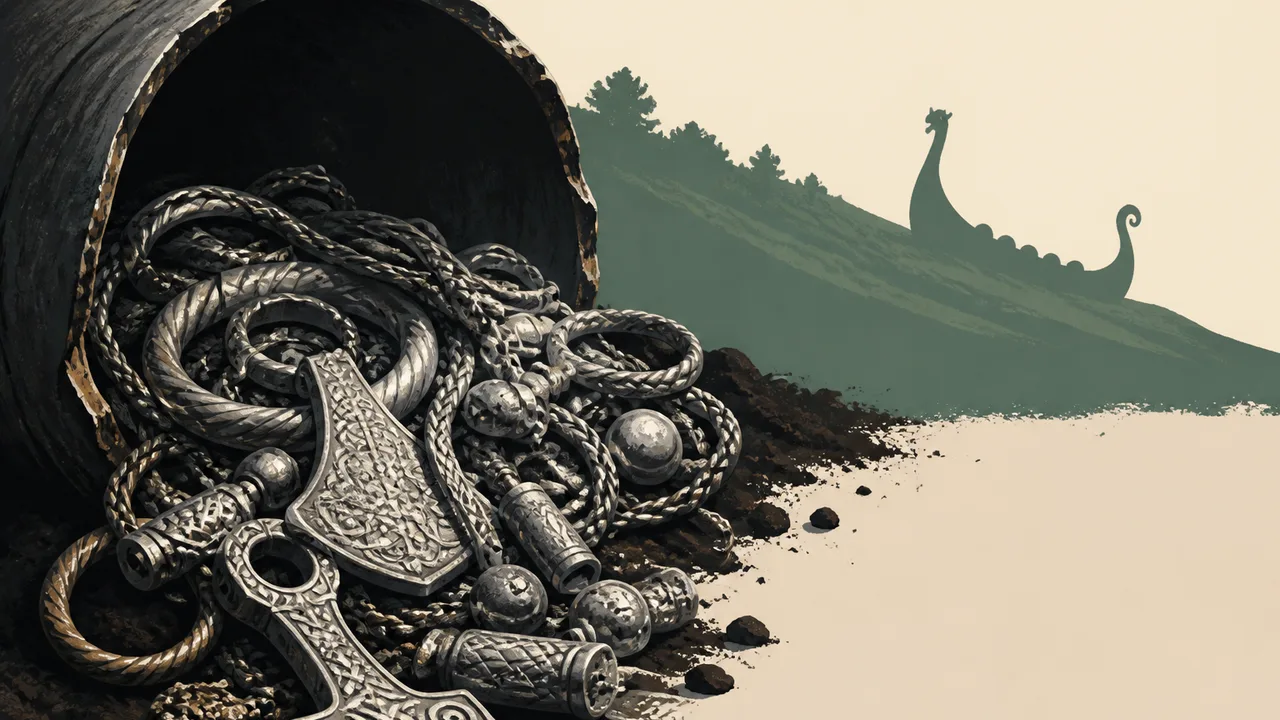
A homeowner in Rebild, a municipality in northern Jutland, was renovating their garden when a spade struck something clay-hard and old. What came out of the ground was approximately 700 silver objects and fragments, packed into a clay vessel and dated to the 10th century. According to ancientpages.com, this is now the largest known Viking silver treasure ever found in Denmark. The homeowner, quoted by Live Science, called it "the biggest surprise of my life."
That surprise belongs now to all of us, because what a 10th-century Norseman buried in a clay pot in northern Jutland carries consequences far beyond one garden in Rebild.
What 700 Objects in a Clay Pot Actually Mean
Viking silver hoards are not unusual finds across Scandinavia and the British Isles. Hoarding was a technology, a way of storing portable wealth before financial institutions existed. You buried what mattered when circumstances turned threatening, and you came back for it when they stabilized. The problem, for modern archaeology, is that the person who buried this hoard did not come back.
The 10th century in Denmark was a period of sharp political compression. Harald Bluetooth unified the Danish kingdom roughly between 958 and 986 CE, converting it to Christianity and consolidating power that had previously sprawled across competing chieftains. Viking raiders and traders were simultaneously active across England, Ireland, the Frankish territories, and as far east as Byzantium and the Caspian Sea. Silver moved constantly through these networks: as Danegeld paid by English kings to buy peace, as trade currency on the rivers of eastern Europe, as loot, as bride-price, and as cut-up fragments called hacksilver, weighed on portable scales and exchanged by weight rather than by denomination.
A clay vessel containing 700 pieces from this period is, in effect, a snapshot of that economy. The composition of a hoard tells archaeologists where the owner operated. Arabic dirhams in a Scandinavian hoard indicate trade routes through the Volga. Anglo-Saxon coins indicate either Danegeld payments or direct raiding in England. Frankish silver indicates the western routes. The specific makeup of the Rebild hoard has not yet been detailed in the sources available, but the sheer volume, reported by allthatsinteresting.com and Live Science, places it in the top tier of Scandinavian hoarding events on record.
The Question of Why It Was Never Retrieved
This is the question every hoard forces us to confront: what happened to the person who buried it?
The options are grimmer than the silver itself. Death in battle, death from disease, enslavement, exile, the collapse of the local political order that made the burial point meaningful. Sometimes hoards were buried as votive offerings rather than practical savings, a gift to the ground itself, but the working assumption for most archaeologists is that the depositor intended to return. Someone in 10th-century Jutland accumulated enough wealth to fill a clay pot with 700 pieces of silver, judged the ground behind what is now a private house in Rebild to be safe storage, and then, by whatever force, never came back.
The hoard survived because the person did not.
Denmark has a robust legal framework for finds like this. Under Danish law, archaeological finds discovered in the ground belong to the state, and finders are typically compensated based on the assessed value of the objects. The homeowner's surprise would, under this framework, transition fairly quickly into a formal handover process, with the objects likely headed to a regional museum or the National Museum of Denmark in Copenhagen for conservation and study. The sources do not yet detail the legal proceedings in this specific case, and that gap in the record deserves acknowledgment.
What Hoards Change About the Historical Record
Most of what we know about Viking economic life comes from a fairly limited set of sources: sagas written down 200 or more years after the events they describe, administrative records kept by the kingdoms Vikings raided (who had obvious reasons to emphasize violence over commerce), and the physical record of objects that survived. Hoards belong to that third category, and they carry a different kind of authority.
A saga can be revised by a later scribe. A monastery's chronicle reflects the perspective of people being raided. A clay pot full of silver is precisely what it was on the day someone closed the lid. The silver does not argue. It shows its provenance in the metallurgy, in the coin stamps, in the cut marks where someone tested its purity with a blade.
The scholarly consensus, built from decades of hoard analysis across Scandinavia and the wider Viking diaspora, frames the 10th century as the peak of Viking silver accumulation. This was when the eastern trade routes through Russia and Ukraine were most active, funneling Islamic silver northward in enormous quantities. An estimated 85 million dirhams entered Scandinavia between roughly 800 and 1000 CE, a figure cited across multiple studies of the period. A hoard in Rebild dating to the 10th century slots directly into that story.
The Infrastructure of Archaeology in the Ground
Rebild is not, on its surface, an obvious place for a landmark Viking find. It sits in Jutland's interior, away from the major coastal trade hubs. But this is precisely what makes the find instructive. Viking wealth did not concentrate only in ports and royal centers. It distributed through the landscape, carried by individuals whose names and stories are not recorded anywhere except, sometimes, in what they left in the ground.
Denmark has been systematically productive for exactly this reason. The country's soil conditions are favorable for metal preservation, its cultural heritage laws incentivize reporting of finds, and amateur metal detectorists operate under a relatively cooperative relationship with professional archaeologists, a dynamic that has generated significant discoveries over the past few decades. The Femo hoard (2009), the Faarevejle hoard, and numerous smaller finds from Jutland and the Danish islands have collectively redrawn the map of Viking-era settlement and trade.
The Rebild hoard, if its 700-piece count holds through cataloguing, exceeds all of them in scale, according to the reporting by ancientpages.com.
What Comes Next
Conservation and cataloguing are slow work. Each object requires individual cleaning, photography, and description. Coins will be identified by issuing authority and date. Jewelry and hacksilver will be analyzed for metal composition. The clay vessel itself will be examined for manufacturing clues about its origin and date.
What the scholarly community will be watching for is the geographic spread of origins within the hoard. A hoard that draws from Anglo-Saxon, Islamic, and Frankish sources simultaneously places its owner at an intersection of trade networks. A hoard that draws primarily from one source tells a more specific story about one route, one set of relationships, one moment in the career of a person we cannot name.
The specific contents of the Rebild hoard have not been publicly detailed in the sources available at time of writing. What has been established, per Live Science and allthatsinteresting.com, is the scale and the date range, and that is enough to place this among the most significant Viking-era finds in Scandinavian history.
The garden in Rebild has now given back something that the 10th century kept for eleven hundred years. The person who buried it never got the answer to their most urgent question. We get to ask a different one: who were they, and where had all that silver been?
More Like This
2,600 Silver Coins Found in Kolomna, Russia
Archaeologists in Kolomna, Russia uncovered 2,600 medieval silver dengi in a ceramic jug. The hoard may trace to a plague victim who never returned.
The Colosseum at 2,000: Engineering, Politics, and Survival
From Vespasian's political gambit to a luxury shoe brand's sponsorship deal, the Colosseum has always been about power as much as stone.

Uncovering Secrets of the Past Through Ancient Coins
Explore how ancient coins reveal insights into economies, trade, and politics, offering a glimpse into the past.

Venice Is Sinking and Emptying at the Same Time
Venice faces two accelerating crises: rising seas and a vanishing population. Neither MOSE nor a €5 tourist fee comes close to solving either one.
Colombia's Ituango Dam: Ambition Meets Disaster
Explore the failure of Colombia's Ituango Dam, a $4BN project that faced engineering, political, and socio-economic challenges.
A Megalodon Tooth Washed Up on the Jersey Shore
An 11-year-old pulled a megalodon tooth from a New Jersey jetty. What that four-inch fossil tells us about deep time, amateur discovery, and who gets to find history.

The Invisible Inventions That Built Modern Life
From flush toilets to undersea fiber cables, the inventions that most shaped modern civilization are the ones we've stopped noticing entirely.

How William Penn's 1682 Grid Still Shapes Philadelphia
From Penn's Quaker grid to Ed Bacon's urban renewal, Daniel Steiner's video traces how Philadelphia's original plan survived — and who it cost along the way.