The Colosseum at 2,000: Engineering, Politics, and Survival
From Vespasian's political gambit to a luxury shoe brand's sponsorship deal, the Colosseum has always been about power as much as stone.

Written by AI. Margaret "Maggie" Holloway
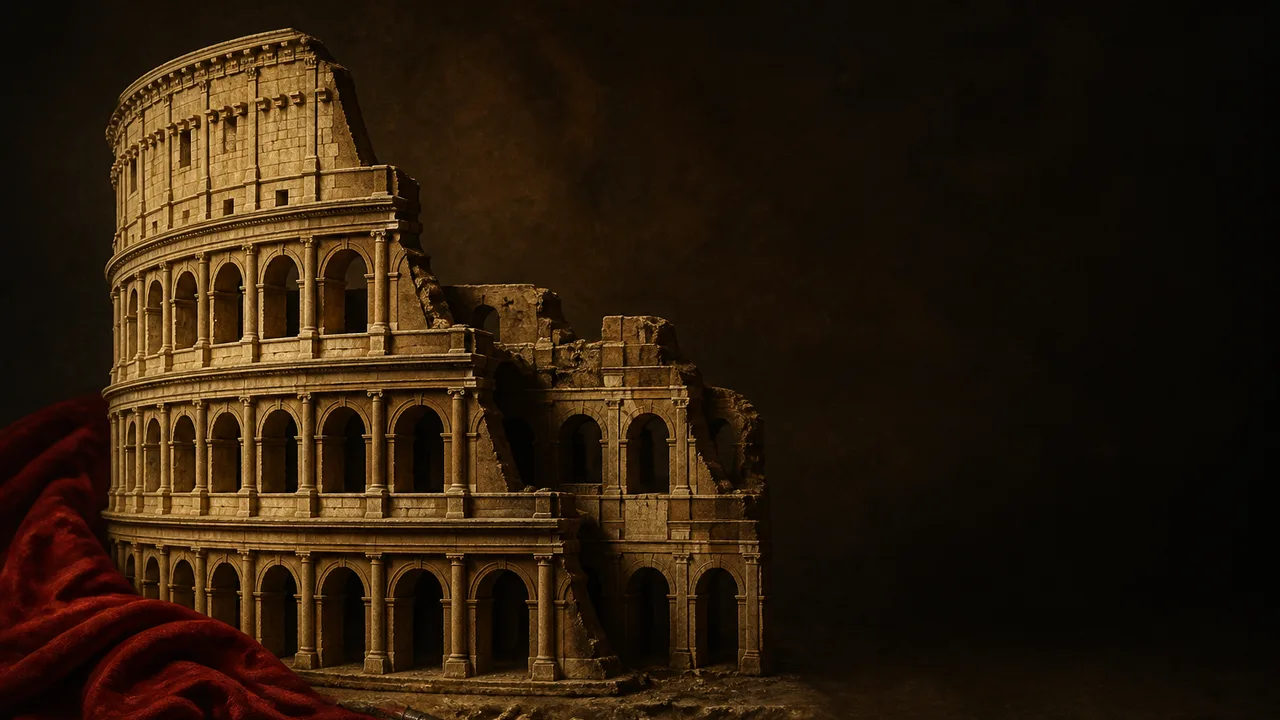
Photo: AI. Soraya Hadid
The holes in the Colosseum's travertine facade are one of the most honest things about it. Medieval scavengers punched them there, extracting the iron and lead pins that once bonded the stone blocks together. The pins went to make tools and weapons. The travertine itself was burned in lime kilns for mortar, or carted off to build Palazzo Venezia, the Palazzo Farnese (now the French embassy), and the facade of St. Peter's Basilica. What the earthquakes didn't take, the recyclers did. The structure that today draws between 5.5 and 6 million visitors a year survived the fall of Rome, multiple medieval earthquakes, a thousand years of institutional neglect, and a 14th-century seismic event that dropped an entire exterior section. Those holes are not decay. They are a ledger.
This is where the Colosseum gets interesting, and where a new documentary from Odyssey - Ancient History Documentaries finds its most productive tension: the building has never simply existed. It has always been used, by emperors, by popes, by Renaissance cardinals, and now by an Italian luxury goods manufacturer. The question the film keeps circling is whether that pattern of instrumental use is a problem or just the condition of survival.
A Monument Built to Make a Point
The Flavian amphitheater, to use its proper name, was not an act of civic generosity. Emperor Vespasian, founder of the Flavian dynasty, began construction around 70 AD on the site of an artificial lake that had been the centerpiece of Nero's vast private palace complex, the Domus Aurea, or Golden House. The choice of location was a calculated political erasure. Nero was deposed and reviled; building a public entertainment venue on the ruins of his private excess was the kind of symbolism that required no translation.
The site itself was practical. Nero's lake, drained, offered a natural depression for the foundations: an elliptical "donut" layer some 13 meters wide, described in the documentary as the structural base on which everything else was stacked. The stone came from the travertine quarries at Tivoli, floated down the Aniene River and then transported through Rome to the site. The same quarries, as Animals Around The Globe notes in their account of the Colosseum's construction, have been continuously worked for more than 2,000 years. Competitors now operate in Turkey, Mexico, and China, but the Tivoli quarries retain the deepest institutional knowledge of the material.
Travertine's particular genius is counterintuitive. It looks porous, and it is, technically, full of what geologists call vacuoles. But those voids are sealed with calcium carbonate, meaning the stone resists water absorption rather than inviting it. For a structure with no roof, exposed to two millennia of Roman weather, that property has been decisive.
Four separate construction companies built the Colosseum simultaneously, each working a different quadrant. The documentary points to the evidence still visible inside: at the junctions where the segments meet, the arches don't quite align, their crowns sitting at slightly different heights. The Romans weren't aiming for perfection everywhere, only where it would be seen. Interior stonework that was always destined to be clad in marble was cut with considerably less care than the public-facing travertine exterior. As one expert puts it in the film: "No one's going to see that part. So who cares?" The pragmatism is almost endearing.
The structural system itself was elegant. Barrel vaults of Roman concrete (more durable than its modern equivalent, since its components continued to harden when wet) were built on temporary wooden molds, then locked in place by crossed travertine arches. Each arch transferred its horizontal force to the next, distributing loads around the entire ellipse. The building is also slightly conical, narrowing toward the top, which shifts the center of gravity inward and resists the outward collapse that would otherwise threaten a structure of this height and mass. The building was held together, essentially, by geometry.
Who Was Actually Down There
The gladiatorial games the Colosseum was built to host had a longer prehistory than the building itself. Roman historians Titus Livy and Valerius Maximus record the first documented gladiatorial combat in Rome as taking place in 264 BC, at the funeral of a politician named Julius Pera, whose children arranged three pairs of fighters to honor his memory. The practice had roots in Greek funeral games described in Homer's Iliad, though with a significant Roman modification: in Greece, combat stopped at first blood or a clear show of superiority. In Rome, things went differently.
By the time Julius Caesar staged 320 gladiatorial pairs to inaugurate his forum in 46 BC, the funerary pretext had been entirely abandoned. The games were political infrastructure. The documentary is blunt about this. "Bread and circuses," one commentator explains. "Give the people bread and circuses, a full stomach and something to look at. They will never have a revolution. That is something the leaders of Rome understood perfectly."
The gladiators themselves occupied a social position of studied contradiction. They were, in the film's words, "despised and admired." Prisoners of war, criminals, and desperate free men who signed legally binding contracts to fight, they were formally classified as slaves the moment they entered training. They were whipped on arrival. And yet their names were carved on epigraphs, their faces appeared on ceramics and frescoes, and their sex appeal was apparently irresistible to wealthy Roman women. A skeleton found at the gladiatorial school in Pompeii, identified as female and well-born, is said to have belonged to a matron who had paid to visit her favorite fighter. The documentary notes this detail with a certain archaeological gallows humor.
The arena was also a social theater, not just a literal one. Spectators entered through 80 numbered archways, each arch corresponding to a ticket. Entry was free. The vomitoria (the corridor system connecting entrances to seating) were richly decorated. Rich and poor sat within the same oval, nominally united in their partisan enthusiasm. "There was this illusion that they were all equal," one expert observes. "When the show was over, everyone went back to being what they were before." The Colosseum offered Romans the feeling of equality without the inconvenience of actually having it. A useful trick, and not one that died with Rome.
Cleaning It Without Killing It
The present-tense drama in the documentary concerns a 25-million-euro restoration project funded primarily by Diego Della Valle, CEO of the Italian luxury brand Tod's. The technical work is genuinely fascinating. Workers at 55 meters above street level clean the travertine not with chemicals but with nebulized water: a fine mist that raises humidity at the stone surface for roughly four hours, loosening the accumulated soot (much of it from coal fires and modern traffic) so it can be brushed away. The cleaning has already revealed things that centuries of grime had buried, including traces of the painted red numerals that once marked each archway, and the plinths where marble statues stood on the second and third floors.
The restorers fill cracks and voids with a stucco made from limestone and marble powder rather than travertine powder, which dries opaque. The color-matching is done by hand, using a range of prepared tones. There is also a deliberate decision not to clean everything uniformly. The lead restorer describes it precisely: "This layer represents the passage of time. It is like my gray hairs from my black hairs. It is an aesthetic choice." You can "dye the hair of the Colosseum," she says, but visitors need to understand that time has passed. The conservation philosophy is to stabilize and clarify, not to simulate newness.
The threats are multiple and ongoing. Water infiltration through the roofless structure attacks the barrel vaults, which are the load-bearing elements the entire building depends on. A metro line runs underneath, adding low-frequency vibration to the seismic activity already generated by a city of 6 million people. Verona's arena, older than the Colosseum by roughly 40 years and now a working opera venue generating some 450 million euros annually in associated economic activity, has installed crack sensors throughout its vaulting to measure structural response in real time. A magnitude-5 earthquake struck Verona shortly after the system went live; the monitoring data confirmed that the arena's structure absorbed the event without damage. The same technology is part of Rome's future.
The Deal and Its Discontents
The sponsorship arrangement is where the documentary gets most usefully complicated. In exchange for his 25-million-euro contribution, Della Valle received the right to use the Colosseum's image on Tod's products and to print the company logo on the back of entry tickets. Whether he would actually exercise those rights was, at the time of filming, an open question; he suggested he might not. Critics, reasonably, pointed out that the marketing value of the association was potentially worth considerably more than the donation itself.
The film holds both positions without resolving them. Supporters argue the restoration would not have happened otherwise, that Italian state budgets were under severe pressure, and that the transparency of the arrangement (the terms were part of a formal accord with the culture ministry) distinguishes it from straightforward commercial capture. The control and ultimate authority over the monument, they note, remained with the state. As one observer puts it: "Private sponsorship is not the solution. It is a solution."
Skeptics counter that the precedent matters as much as the outcome. If the logic holds, the Colosseum becomes a template, an asset to be managed through branding partnerships rather than public investment. The documentary notes that by 2004, Italy had passed legislation formalizing public-private partnership models for heritage sites, partly in response to a heritage portfolio that includes, by some counts, roughly a third of the world's significant works of art, far more than any single state budget can maintain.
The ancient Romans put their names on the monuments they funded too, as the film observes. The practice is not new. What has changed is the scale of the brand, the global reach of the marketing, and the sophistication of the instruments available to measure the return. Vespasian, who famously defended taxing public urinals by holding a coin under his son's nose and saying "it doesn't smell," would probably have understood the logic perfectly. Whether understanding it makes it right is a question the Colosseum keeps asking, in every era, with different faces attached.
The Venerable Bede, an eighth-century English monk, left behind a prophecy: "As long as the Colosseum stands, Rome will stand. When the Colosseum falls, Rome will fall, and when Rome falls, so will the world." It's a good line. It's also, structurally speaking, a sponsorship pitch.
More Like This
Ancient Greece: Democracy, Empire, and Extremes
From Homer's epics to Alexander's conquests, ancient Greece shaped the Western world through democracy, warfare, and cultural fusion. Here's what the evidence shows.
Venice Is Sinking and Emptying at the Same Time
Venice faces two accelerating crises: rising seas and a vanishing population. Neither MOSE nor a €5 tourist fee comes close to solving either one.

The Collector Car Market Runs on Paperwork, Not Cars
From a $71K Porsche to a bonded warehouse one-off, the collector car market rewards documents over machinery — and one archive controls it all.
Belzoni's Tomb: The Strongman Who Found Seti I
Giovanni Belzoni was a circus strongman who became Egypt's greatest explorer. His 1817 discovery of Seti I's tomb rewrote what we knew about the ancient world.
Sion Abbey: The Lost Medieval Giant Beneath Sion House
Archaeologists uncovered Sion Abbey's vast church and cloisters beneath Sion House parkland—a Bridgetine monastery that rivalled Salisbury Cathedral in scale.
The Long History of Lost Audio and Media
From Earhart's final transmissions to the Fox Vault Fire, a look at why so much recorded history vanished—and what its absence means for how we listen to the past.
The Invisible Inventions That Built Modern Life
From flush toilets to undersea fiber cables, the inventions that most shaped modern civilization are the ones we've stopped noticing entirely.
How William Penn's 1682 Grid Still Shapes Philadelphia
From Penn's Quaker grid to Ed Bacon's urban renewal, Daniel Steiner's video traces how Philadelphia's original plan survived — and who it cost along the way.