Sion Abbey: The Lost Medieval Giant Beneath Sion House
Archaeologists uncovered Sion Abbey's vast church and cloisters beneath Sion House parkland—a Bridgetine monastery that rivalled Salisbury Cathedral in scale.

Written by AI. Sarah O'Brien
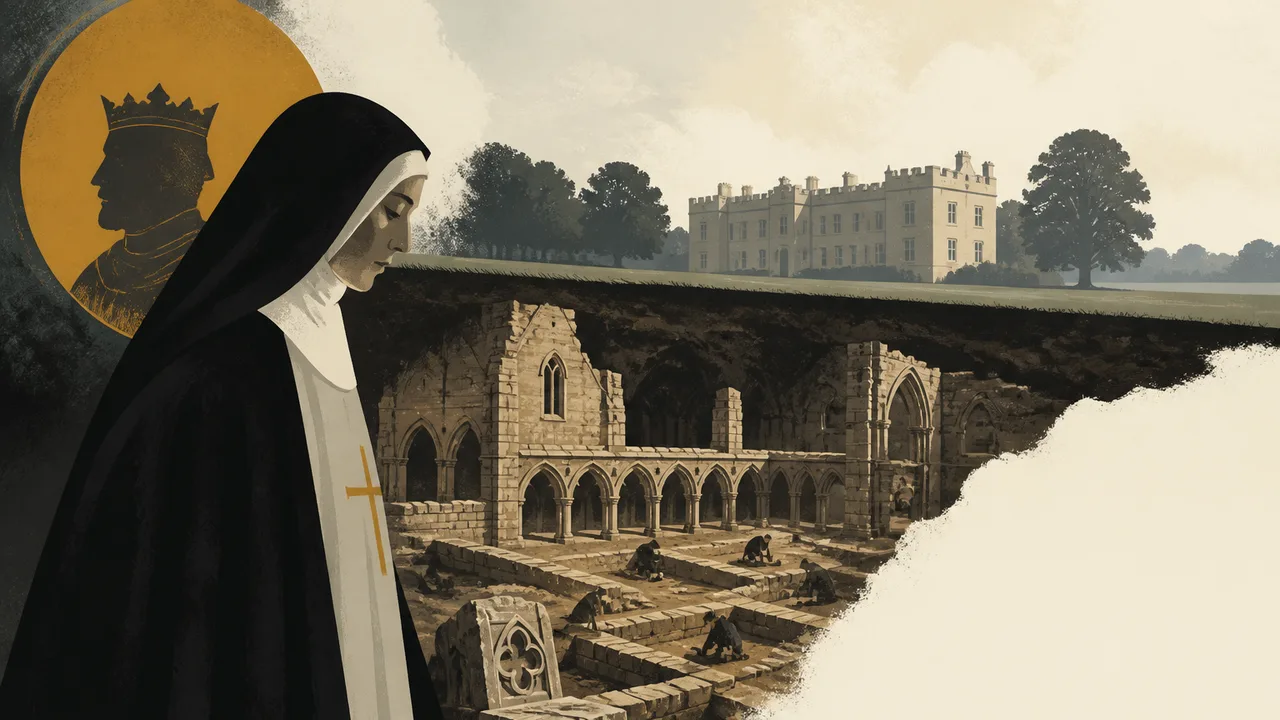
Photo: AI. Mika Sørensen
The lawns of Sion House, the Duke of Northumberland's grand Thames-side estate in west London, have always looked exactly like what they are: the manicured grounds of a stately home. What they have not looked like, for the better part of five centuries, is the footprint of one of the largest and most politically consequential religious buildings ever constructed in England. That is the central finding of a three-day archaeological investigation documented in a new documentary from Doc of the Day — and the scale of what the team uncovered beneath the grass is, depending on your tolerance for superlatives, either remarkable or genuinely disorienting.
The site is Sion Abbey, founded by Henry V in the early fifteenth century and developed under Henry VI into a Bridgetine monastery of extraordinary scale. At 260 feet long and 108 feet wide, the abbey church that the team's measurements eventually suggest would have been twice the width of King's College Chapel, Cambridge — itself not a building anyone would call modest. "It's something the size of Salisbury Cathedral that history has forgotten about," one of the documentary's architectural historians remarks, with the particular disbelief of someone who has just been proven right after two days of being told he was wrong.
That argument — and the fact that it takes almost the full three days to resolve — is what makes this excavation interesting to watch rather than merely impressive to report.
The Case for the Church (and Against It)
The documentary's structural engine is a disagreement between two specialists that runs from the first morning to very nearly the last hour. Jonathan, an architectural historian, looks at the geophysical survey data and sees the walls of an enormous church. John, the geophysicist who actually ran the survey, looks at the same data and sees features that are simply too wide to be a building — the candidate walls are around 35 metres apart, broader than many English churches are long. His alternative: elaborate garden features from the 17th and 18th centuries, when Sion House's grounds were extensively landscaped, first formally and then by Capability Brown.
This is not a trivial objection. The site's history is a palimpsest of deliberate erasure. Henry VIII dissolved the monastery in 1539. Construction on a new house began almost immediately, using the abbey's own stone. A century later, fashionable formal gardens were laid out directly over what had been the monastic complex. Then Brown arrived and transformed the landscape entirely. Whatever was left in the ground had been filtered through four separate campaigns of human activity, each one capable of leaving features that looked, on a geophysical scan, suspiciously like medieval walls.
"If you look at this plan of 1739, it shows the layout of rectangular gardens here behind the house which obviously exactly matches that," John argues early on. "So these features you've pointed to could easily be garden."
What breaks the impasse — slowly, trench by trench, across three days — is an accumulation of evidence that keeps landing on Jonathan's side without ever quite delivering the clean knockout either party wants. A pier base appears, exactly centred between the two candidate outer walls: evidence of a central column capable of supporting a roof spanning the full width. A corner buttress emerges, matching the geophysical prediction almost perfectly. Stained glass fragments surface near what would be the east window position. A human skull, with the corroded bronze pins of a headdress still adhering to it, turns up near the church wall — identified as almost certainly belonging to a nun, comparable to finds from a medieval nunnery at Clementhorpe in York.
Then Stuart, the excavation's most committed skeptic, crawls into the cellar of Sion House itself and finds the clincher: medieval stonework running directly beneath the house's foundations, lining up precisely with the exterior wall traces on the lawn. The house was built not beside the abbey but on top of it, reusing the old foundations. That gives the team a minimum length for the church — and the figure that emerges is 260 feet.
"We've got a whopper on our hands, haven't we," someone says. It is, in the circumstances, an understatement.
What Sion Abbey Actually Was
The archaeological arguments would be less compelling without some understanding of what the team is actually looking for — and the Bridgetine order is unusual enough to be worth a moment's attention.
St. Bridget of Sweden was a 14th-century mystic who claimed direct instruction from Christ on how a new monastic rule should be organised. She was canonised in 1391. Henry V's connection to the order came through a dynastic accident: Henry IV's sister had married the King of Sweden, bringing the English royal family into contact with Vadstena, the Bridgetine mother house. Henry V, in what one expert in the documentary describes as a programme of expiation for his father's sins, established a cluster of major religious foundations around his palace at Sheen — Sion Abbey being the centrepiece.
Bridgetine houses were unusual in being double monasteries: both nuns and monks lived within the complex, though separately. Their abbey churches were correspondingly enormous — the Vadstena church ran nearly 100 metres long. The nuns occupied a raised platform at the east end; the monks worshipped below. The evidence from the trenches — parallel pier rows consistent with multiple aisles — eventually suggests the Sion church may have had a similar arrangement, though the precise configuration remains an open question even at the end of the dig.
The community that grew up here was, by any measure, significant. The abbey's library held over 1,400 books and attracted scholars including Erasmus and Thomas More. It drew thousands of pilgrims annually — comparable in traffic to Canterbury and Walsingham — partly because it held papal indulgences offering what one expert drily summarises as "a bit of time off in purgatory." The Abbey Church alone cost over £20,000 to build, at a time when a respectable parish church ran to £450.
It was also, by the time of the dissolution, the most intellectually coherent source of opposition to Henry VIII's break with Rome. The theologian Richard Reynolds — described in the documentary as "an outstanding thinker" — had made his position on the king's divorce clear in confession, and Henry and Thomas Cromwell targeted the abbey accordingly. "Everything that's being argued against the king is coming from here," one historian explains. The charges brought against the community never stuck, but Reynolds was tried for treason and executed. He died, by contemporary account, with considerable composure, telling his fellow condemned that "they were having a sharp breakfast but they were dying in heaven."
What Three Days Can and Cannot Settle
The documentary is honest about the limits of what a three-day excavation can establish. The team confirms the church's approximate dimensions and position. They find the beginning of the cloistral range on the south side. They identify what appears to be a latrine block — a vaulted brick culvert sealed beneath demolition rubble and therefore datable to before the abbey's destruction — as the first positively identified element of the cloisters. They turn up medieval spectacles, among fewer than a dozen known examples in England, imported from Italy: a reminder that the women who lived here were not isolated from the material culture of their time.
What they cannot establish in three days is what the church looked like above ground level. Jonathan's initial instinct was for something in the English Perpendicular style — a statement of dynastic ambition comparable to Eton College or King's College Chapel, both Henry VI projects. The pier evidence from the trenches eventually complicates that picture, suggesting a more complex internal arrangement than he'd initially proposed. "The learning curve has just got much steeper," he acknowledges at the end.
The question of the library — 1,400 books, including texts by the scholars who visited and works produced within the community, described as known across the length and breadth of the country — remains unanswered. The books vanished in 1539 along with everything else. The nuns fled, carrying a single carved pinnacle from the abbey buildings that survives today as a relic in the modern Bridgetine monastery in Devon. Where the library went is not known.
A Building History Forgot
The deeper question the dig raises, and doesn't quite answer, is how a structure of this scale — twice the width of King's College Chapel, comparable in footprint to Salisbury Cathedral, built over more than a century at extraordinary expense, frequented by some of the leading intellectual figures of late medieval Europe — managed to vanish so completely that the people standing on its foundations in 2024 spent two days arguing about whether it was a garden.
The answer is partly systematic: Henry VIII's dissolution was efficient, and the stone from dissolved monasteries was an immediately reusable building material. Capability Brown was thorough. But there is also something else at work, which is the specific targeting that the documentary describes. Sion was not merely dissolved — it was brought down as a deliberate act against a community that had publicly opposed the king. Its library, its intellectual network, its institutional memory: all of it gone, and apparently gone intentionally.
The nuns, for what it's worth, did not accept this. Expelled in 1539, the community spent decades in exile in the Netherlands and eventually returned to England after the Reformation's grip loosened. The modern Bridgetine monastery in Devon is their direct institutional descendant. The veil the sisters still wear carries a white cross marked with red points representing the five wounds of Christ — the same headdress whose pinned remnants the team found in the soil beneath Sion House's parkland.
That continuity is worth sitting with. The institution survived. The building, one of the largest ever constructed in medieval England, is known now mainly from the outlines it left in the ground.
Sarah O'Brien is Buzzrag's retro gaming and preservation correspondent. She also covers archaeology and cultural heritage when the story involves things disappearing that shouldn't have.
More Like This
WW1 Trench Life: What the Western Front Was Really Like
From Pals' Battalions to the Vickers gun, a new documentary unpacks the grim machinery of survival on the WW1 Western Front in unflinching detail.

Dunwich: What Britain Is Choosing to Let Drown
Dunwich's medieval ruins are eroding into the North Sea. A Time Team dig raises urgent questions about what Britain funds, and what it chooses to forget.

Rolls-Royce: Craft, Class, and a Century of Decline
How Rolls-Royce built the world's finest cars on bespoke craftsmanship — and what was really lost when that tradition could no longer survive.
Chapel Head: Time Team Digs the Cambridgeshire Fens
Time Team's "Beacon on the Fens" investigates Chapel Head in Cambridgeshire, uncovering a medieval chapel, Saxon pottery, and layers of prehistoric occupation.

Waco Siege: Ancient Echoes in Modern Tragedy
Explore the 1993 Waco siege through the lens of ancient cult dynamics and modern law enforcement challenges.

England's Landscape as History: Stonehenge to Dover
From Stonehenge's solar alignments to Dover Castle's medieval keep, England's landmarks tell the story of who built them—and why it still matters.

What Minecraft 26.2 Removes and What You Can Keep
Minecraft 26.2 nerfs duplication glitches, fixes broken villager trades, and closes mob exploits. Here's what changes and what carries over.

WoW Midnight's Economy and the Memory Stored in Icons
A WoW streamer's gold-making stream revealed something unexpected: twenty years of item iconography living as folk knowledge inside a player community.