A Megalodon Tooth Washed Up on the Jersey Shore
An 11-year-old pulled a megalodon tooth from a New Jersey jetty. What that four-inch fossil tells us about deep time, amateur discovery, and who gets to find history.

Written by AI. David Oyelaran
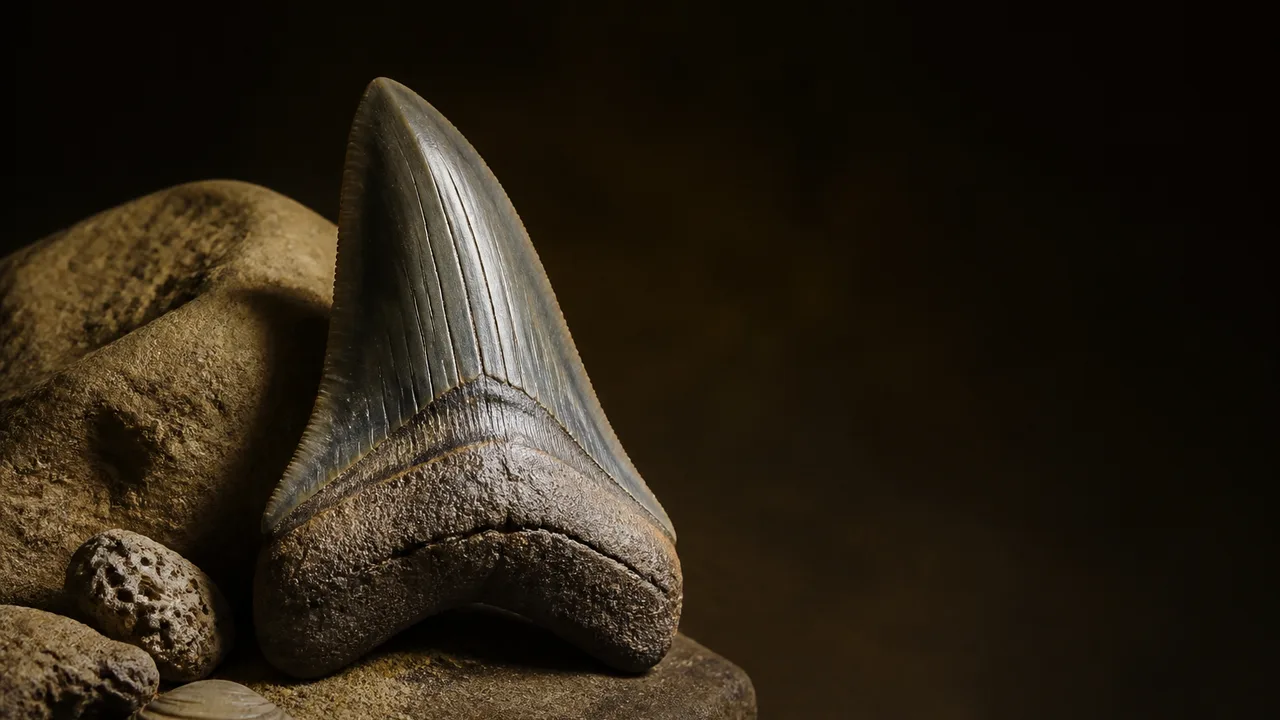
The hand didn't fit. That's the detail that keeps pulling me back into this story.
Michael Bowers was on a routine family vacation in Sea Isle City, New Jersey — the kind of trip where the day's ambition might top out at finding a good sand dollar — when he noticed something wedged inside a narrow gap in a rock jetty near Townsend Inlet. He reached for it. His hand wouldn't fit. So he called over his 11-year-old son, Bo, whose smaller fingers could reach into the rock's opening and pull out what turned out to be a four-inch megalodon tooth, confirmed by the New Jersey State Museum to be millions of years old, according to Fox News.
The image of that — father too big for the gap, son small enough to slip through and retrieve something ancient — feels like it means something, even if I'm careful not to over-read a vacation anecdote into symbolism. Still. There's something in it.
What Bo Actually Found
The tooth is four inches long, which sounds modest until you understand the architecture behind it. Megalodon — formally Otodus megalodon — was among the largest predators ever to exist in Earth's oceans, swimming the seas until approximately 3.5 million years ago. Fossilguy.com, a resource dedicated to megalodon facts and fossil identification, estimates the animal reached lengths of 50 to 60 feet or more — figures that remain actively discussed and refined in the scientific literature, but that give some sense of the scale we're talking about. A four-inch tooth didn't come from something you'd want to share a swim lane with.
What makes megalodon teeth so findable — and so widely distributed across the fossil record — is a feature of shark biology that persists into modern species: sharks shed and replace their teeth continuously throughout their lives. Extinct Atlas, which covers megalodon teeth in detail, explains that this ongoing replacement cycle means a single megalodon could have shed enormous numbers of teeth across its lifetime — a figure that, while inferred rather than directly counted, helps explain why these fossils turn up with some regularity on coastlines, riverbeds, and jetties worldwide. Each shed tooth became a potential future fossil. Bo Bowers found one of them in a rock crevice in New Jersey.
The New Jersey State Museum's confirmation of the find — reported by NBC Philadelphia as at least three million years old — matters beyond the feel-good headline. Institutions don't authenticate every rock a tourist pries off a jetty. The fact that the Museum weighed in suggests the tooth was distinct enough, well-preserved enough, and significant enough to warrant official attention. That's not nothing.
The Accidental Paleontologist Problem
Here's where the story gets more complicated than a heartwarming news cycle typically allows.
The Bowers family wasn't on a fossil hunt. They were looking for shells, according to ABC7 New York. Shell-hunting is a casual, unstructured activity — the kind of thing where you keep your eyes soft and your expectations lower. What Bo found was not a shell. It was a relic from a creature that preceded human existence by millions of years, surfaced by wave action and coastal erosion onto a jetty where a kid with small enough hands happened to reach in at the right moment.
This is how a significant portion of paleontological discovery actually works. Not in a laboratory, not with a research grant, but with a family on vacation, a gap in a rock, and a child whose curiosity outpaced his father's reach. Amateur finds like this one have long complicated the professional paleontology community's relationship with public fossil hunting — a tension worth naming plainly, even if this particular story doesn't resolve it.
On one side: discoveries like Bo's demonstrate that important specimens exist in places and conditions that formal research expeditions rarely encounter. The Jersey Shore is not a mapped dig site. No university has a megalodon fieldwork grant for Sea Isle City jetties. Without the Bowers family's accidental eyes, this tooth might have stayed wedged in that rock indefinitely, or been washed back into the surf.
On the other: amateur recovery of significant specimens, without documentation of precise location, depth, and geological context, can strip a fossil of the scientific information that makes it most valuable. A tooth pulled from a specific sediment layer at a documented depth tells paleontologists something about when and how it was deposited. A tooth pried from a vacation jetty is still a remarkable object — but some of its story has already been lost in the extraction.
The Bowers case sits somewhere in the middle. They reached out. The New Jersey State Museum authenticated the find. That's a better outcome than most, and it reflects something worth honoring: a family that treated a remarkable discovery with appropriate seriousness rather than just posting it and moving on.
Why the Jersey Shore Keeps Giving
This isn't the first megalodon tooth found on the New Jersey coast, and it won't be the last. The geology of the Mid-Atlantic shoreline — sediment composition, wave energy, active erosion — creates conditions where ancient marine fossils surface with some regularity. The Bowers tooth was found near Townsend Inlet in Sea Isle City, as MSN reported, an area where tidal movement around jetty structures stirs and redistributes material constantly.
Coastal erosion, which is accelerating along the Atlantic seaboard, is part of the mechanism here. As shorelines shift and jetties are battered by storm surge, sediment layers that have been stable for millennia get opened up. Things that were buried surface. The irony is not small: the same forces that threaten coastal communities and reshape beach geography are also, incidentally, placing prehistoric objects within reach of an 11-year-old on a shell-hunting trip.
The Telegraph notes that the family was digging through rocks when the discovery happened — an active, physical engagement with the landscape rather than a passive stroll. That distinction matters. Bo wasn't walking along a pristine shoreline and spotting something glinting in the sand. He was in the rocks, working, curious. His father's hand was already in there before his.
What Gets Preserved and Who Does the Finding
All That's Interesting covered the story with an eye toward the Cape May region's broader fossil history, contextualizing the Bowers find within a coastline that has produced significant prehistoric material before. That framing is worth holding onto, because it shifts the story from "lucky kid finds cool thing" toward something more structurally interesting: certain landscapes are, quietly and without announcement, active sites of paleontological emergence.
Most of those landscapes are not being systematically monitored. Most of what surfaces there is found — or missed, or misidentified, or quietly pocketed — by ordinary people. The professional fossil record is, to an underappreciated degree, shaped by who happens to be walking on which beach on which afternoon, and whether they knew what they were looking at, and whether they told anyone.
Bo Bowers, eleven years old, knew enough to know he'd found something. His father knew enough to reach out. The New Jersey State Museum knew enough to confirm it.
That chain of knowing — across generations, across institutions, between a vacation and a museum — is exactly how oral history works, too. You need someone present enough to notice. You need someone willing to tell. And you need a system ready to receive what's offered before it gets washed back into the sea.
More Like This

Middle Platonism's Hidden Role in Western Esotericism
ESOTERICA's new crowdfunded seminar argues Middle Platonism built the foundations of Hermeticism, Gnosticism, and early Christian theology. Here's what that means.
The Gods of Pre-Islamic Arabia, In Their Own Words
Ancient desert inscriptions reveal the polytheistic world before Islam—gods, prayers, sacrifice, and fate, recorded by the nomads who lived it.
Ghost DNA Found in All Humans From Unknown Ancestors
New genetic research has detected an unidentified 'ghost' population in the DNA of every living human — a people with no name, no bones, and no recorded history.
A 1.27-Billion-Year-Old Mars Meteorite Changes Everything
A dark green Martian rock found in Algeria in 2019 just filled a 1.8-billion-year blank in Mars's geological record — and it came from a region no one knew existed.

Mexico's Radioactive Milk Scandal After Chernobyl
After Chernobyl, Mexico distributed Cesium-contaminated powdered milk to its poorest communities. The families who consumed it left almost no testimony behind.
Scotland's Carved Stone Balls: A Neolithic Mystery
Nearly 500 carved stone balls have been found across Scotland. Archaeologists still don't know what they were for. Here's where the theories stand.

Cicero and the Fall of the Roman Republic
Marcus Tullius Cicero defended Rome's Republic with words alone—and paid with his life. A look at history's most consequential orator and his impossible political moment.

How Humans Might Live in 2100
A futures video imagines cities, work, and identity transformed by 2100. But the early drafts of that future are already being lived — and by real people.