Scotland's Carved Stone Balls: A Neolithic Mystery
Nearly 500 carved stone balls have been found across Scotland. Archaeologists still don't know what they were for. Here's where the theories stand.

Written by AI. Sarah O'Brien
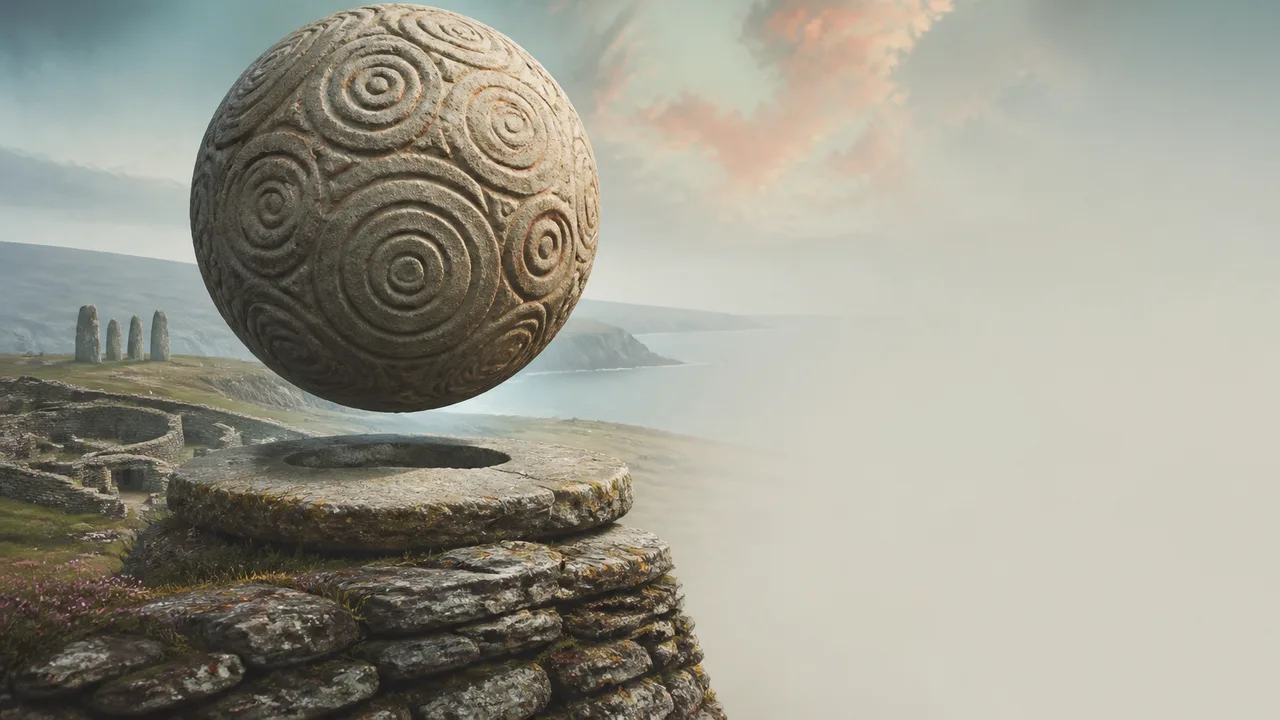
Photo: AI. Iolanthe Fenwick
In 1860, farmworkers cutting a drain at Drimelochit near the Scottish town of Towie pulled something unexpected from the earth: a stone ball roughly the size of a tennis ball, weighing just over 500 grams, decorated with four knobs — three of them carved with intricate geometric patterns, the fourth left blank. The farmer, James Kesson, gave it to a local minister. It eventually reached the National Museum of Antiquities in Scotland, where it was dated to approximately 5,000 years ago. It became known as the Towie Ball.
It was not alone. Not remotely.
Close to 500 carved stone balls have now been found across Scotland, concentrated in Aberdeenshire and Orkney but distributed widely enough that around 37 have turned up in the Highlands — most thought to have been imported from elsewhere, possibly Aberdeenshire. They're made from sandstone, granite, and other local stone. They're roughly uniform in size but wildly varied in decoration: most have around six knobs, though examples range from three upward. Some are elaborately carved. Some are plain. A few, like the balls recovered from Skara Brae in Orkney, have sharper, more pointed projections than the rounded bosses typical elsewhere — enough of a stylistic difference that researchers treat them as a regional variant.
Nobody knows what any of them were for.
That's not false modesty or rhetorical throat-clearing. After decades of scholarly attention, the carved stone balls remain genuinely unresolved — an artifact class with no clear functional parallels, no written record to consult (Neolithic peoples didn't write), and no obvious signs of use-wear that might settle the question. What we have instead is a pile of competing theories, each with something going for it and something that doesn't quite hold.
The Neolithic context
Understanding why the balls matter requires a brief stop at what "Neolithic" actually means. According to Scotland History, the Neolithic period in Scotland dates to roughly 4000–2500 BCE — the era when human communities shifted from hunter-gathering to settled farming, began building permanent structures, and started leaving the kind of durable material record that archaeologists can actually work with.
The physical legacy of that period in Scotland is remarkable. Skara Brae in Orkney — where several carved stone balls were found — is one of the world's best-preserved Neolithic villages, occupied from around 3180 BCE to 2500 BCE before its inhabitants abandoned it for reasons that remain unknown. Its stone houses are connected by covered passages and still contain stone furniture. Nearby, Maeshowe is a chambered tomb engineered so that sunlight floods the interior precisely at the winter solstice. The Ring of Brodgar, a stone circle comparable to Stonehenge, dates to around 2000 BCE. Kilmartin Glen on Scotland's west coast spans over five thousand years of occupation, containing carved rocks, burial cairns, and stone circles including Temple Wood, which Historic Environment Scotland records as having seen use from the Neolithic period through the Bronze Age — a span approaching two millennia.
These weren't people scratching out a subsistence existence. They were building monuments aligned to celestial events, trading materials across long distances, and clearly investing significant effort in objects that went beyond the purely practical. The carved stone balls fit that pattern. They don't fit any obvious utilitarian one.
The theories, and why none of them fully land
The weapons hypothesis surfaces first in most discussions, partly because some of the Orkney balls' pointed projections do look aggressive. The grooves between the knobs, on this reading, are where a leather strap or rope would be fastened to create some kind of handheld or thrown weapon. The problem is the absence of damage. If these things were used in combat or hunting, you'd expect dings, fractures, impact marks. The balls are largely pristine. Archaeologist Dorothy Marshall, who conducted an extensive study of the balls in the 1970s, was unpersuaded: "When one appreciates the skill and time which has been used in the fashioning of these balls, it does not seem possible that the owner would have risked their loss or damage in war or chase."
That's a reasonable objection, though it carries an implicit assumption — that the Neolithic makers valued these objects in ways legible to us. Maybe they did. Maybe they didn't.
The weighing-system theory founders on the lack of standardization. If these were weights for scales, you'd expect much tighter uniformity in size and mass. There isn't. The fishing-net-weight theory handles the grooves adequately — they'd work fine for tying rope — but runs into the same decorative problem that plagues most practical explanations: who spends hours carving elaborate patterns into something you're planning to drop to the bottom of the sea?
Science writer Lynne Kelly has proposed something more interesting, drawing on Australian Aboriginal cultures and their use of physical objects as mnemonic devices. On this reading, the carvings aren't decorative — they're functional memory aids, prompts for oral storytelling or ritual recitation. It's a theory that takes the decorative variation seriously rather than treating it as a puzzle to explain away.
The speaking-stone hypothesis — that whoever held the ball held the floor at communal gatherings — is similarly plausible and similarly unprovable. Marshall entertained it. Other cultures used speaking sticks for the same purpose. Joe Scott's video notes that the balls' deposition context is suggestive: many have been found in recesses or boxes within ancient homes, which fits a ceremonial object more naturally than a tool or weapon.
Then there's the "mason's portfolio" theory — that craftspeople carried these balls as demonstrations of their skill in working stone, essentially a physical resume. The logic is appealing. The Towie Ball's carvings, Scott notes in his video, share stylistic features with decorative work found at Newgrange in Ireland, which would imply the people who made them were moving across significant distances, carrying objects that advertised their capabilities.
And then there are the outliers. Someone on the Above Top Secret forum proposed that the balls represent pollen grains — and even provided microscopic images side by side as evidence — while acknowledging in the same post the fairly significant problem that Neolithic people had no way to see microscopic pollen. It's the kind of theory that says more about human pattern-recognition than about Stone Age Scotland.
What the variation actually tells us
The most honest thing that can be said about the carved stone balls is that their variation might be the point — or at least a data point we're not using well enough.
The balls from Skara Brae look different from those in Aberdeenshire. Some balls appear to have been decorated by multiple hands, with different sections worked at different times. The distribution pattern — concentrated in certain regions, with evidence of long-distance movement to others — suggests these weren't casual objects knocked out by anyone with a spare afternoon. They circulated. They traveled.
That's a significant detail, and it complicates the simpler theories. A fishing weight doesn't get imported across Scotland. A good-luck charm buried under your house might. A status symbol, a memory device, a ceremonial speaking object — those travel with people and with meaning.
Scott leans toward the good-luck-charm or protective-talisman interpretation, partly because of the burial context, and draws a comparison to the Venus figurines found across Eurasia — objects of clear ritual significance, made with evident care, used in ways we can only guess at but whose importance is legible from the effort invested in them.
The comparison is apt, and not just because it's tidy. The same interpretive problem applies to both artifact classes. We have the objects. We have the context. We don't have the people who made them or anything they wrote about why. Archaeologist Dorothy Marshall's decades-old study remains the foundational scholarly work on the balls. The field hasn't exactly been overwhelmed with follow-up.
Nearly five hundred carved stone balls, scattered across one country, made during a period when human civilization was simultaneously doing something similar — reaching for complexity, making things that didn't need to be beautiful but were — and we still can't say with confidence what they were for.
That's not a failure of archaeology. That's what 5,000 years of silence actually looks like.
More Like This
California's Channel Islands Hold 13,000 Years of History
From pygmy mammoths to the Lone Woman of San Nicolas, California's Channel Islands preserve one of North America's deepest human records — if we bother to look.

Unraveling Rome's Dodecahedron Mystery
Exploring the enigmatic Roman dodecahedron, its theories, and historical significance in modern archaeology.
Digging for King John's Palace at Clipstone
Time Team excavates Clipstone, Nottinghamshire, hunting for King John's lost royal palace on the edge of Sherwood Forest. Here's what they found.
The Gods of Pre-Islamic Arabia, In Their Own Words
Ancient desert inscriptions reveal the polytheistic world before Islam—gods, prayers, sacrifice, and fate, recorded by the nomads who lived it.

Myth, Obsession, and the Men Who Dug for Troy
Arthur Evans and Heinrich Schliemann both found ancient civilizations while chasing myths. What does that tell us about archaeology—and obsession?

Rolls-Royce: Craft, Class, and a Century of Decline
How Rolls-Royce built the world's finest cars on bespoke craftsmanship — and what was really lost when that tradition could no longer survive.

Fallout Season 3 Is Filming, and the Franchise Has Come Far
Walton Goggins confirms Fallout Season 3 is filming. What does a franchise this far from its 1997 origins mean for gaming history and preservation?

Sony Bets on AI as Core Game Development Strategy
Sony's leadership has formally positioned AI as foundational to its game development future. What that means in practice—and what it leaves unanswered—is worth examining carefully.