Battle of the Coral Sea: How Carriers Rewrote Naval War
In May 1942, the Battle of the Coral Sea changed naval warfare forever. Here's what that first carrier battle actually meant — and why it still matters.

Written by AI. David Oyelaran
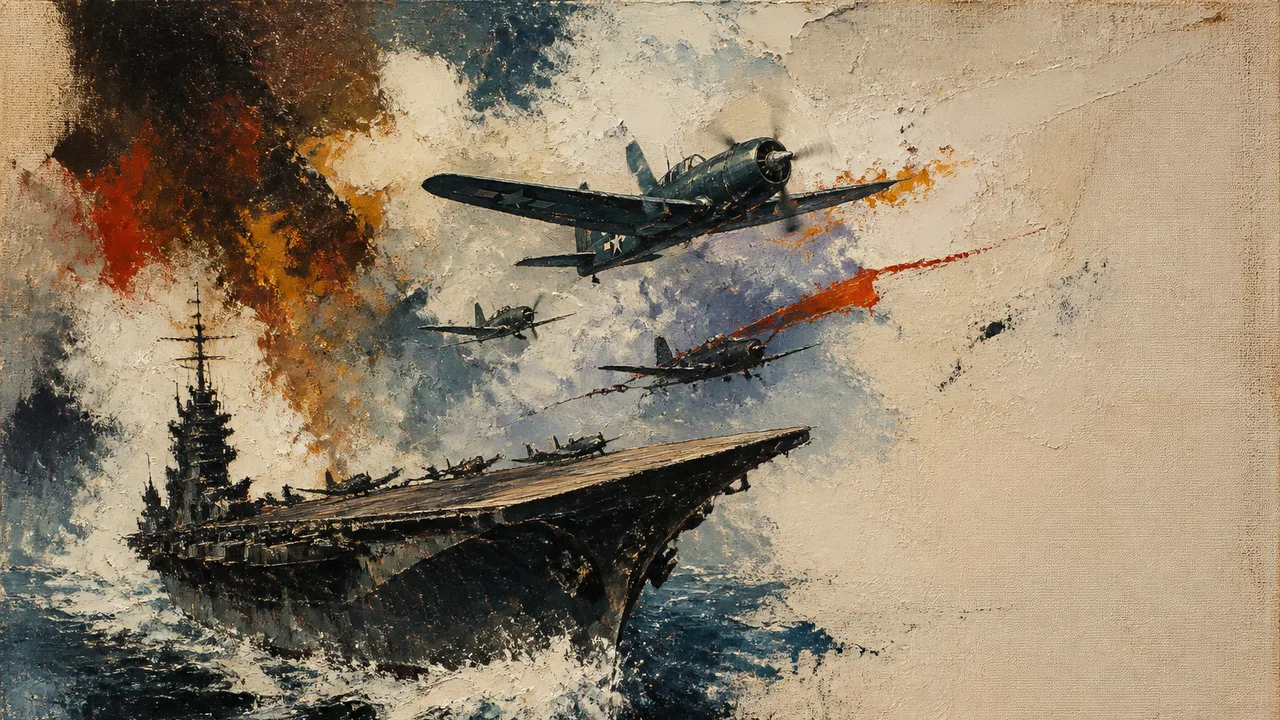
There is something almost philosophically strange about the Battle of the Coral Sea. Two naval forces spent four days trying to destroy each other — and never once laid eyes on each other. No ship fired at another ship. No captain peered through binoculars at an enemy hull on the horizon. Instead, they sent planes. The planes did the killing, and the sailors on both sides only learned what had happened when the aircraft came back — or didn't.
That was May 1942. It was, as Wikipedia's account of the battle puts it, "the first naval engagement in history in which the participating ships never sighted or fired directly at each other." The Naval History and Heritage Command echoes this exactly. What happened in those waters between Australia, New Guinea, and the Solomon Islands wasn't just a battle. It was a proof of concept — for a new kind of war.
The Setup: Japan Moves South
To understand the Coral Sea, you need to understand what Japan was trying to do in the spring of 1942. The attack on Pearl Harbor had badly damaged U.S. battleship strength, but Japan's strategic ambitions hadn't slowed. By April 1942, as The National Interest reports, Japan was moving to isolate Australia by seizing strategic locations in the Pacific — a chain of control that would sever Allied supply lines and extend the defensive perimeter of the empire.
The target was Port Moresby, on the southern coast of Papua New Guinea. If Japan took it, Australia was exposed in a way that couldn't be easily reversed. The World History Encyclopedia notes that the Japanese navy hoped to occupy eastern Papua and the Solomons as part of this broader push. What they hadn't fully accounted for was that the Americans were listening.
U.S. codebreakers had been working their way into Japanese communications, and the intelligence picture, while imperfect, gave Admiral Chester Nimitz enough to position carriers in the Coral Sea ahead of the Japanese fleet. The interception that followed wasn't lucky. It was the first major demonstration of how intelligence and air power, combined, could stop a superior conventional force cold.
The Battle Itself: Four Days of Blind Combat
The fighting ran from May 4 to May 8, 1942. Both sides groped for each other using aircraft as their primary sensors and weapons. What happened across those four days tells you something about how bewildering this new form of combat was — even to the people executing it.
Early on, American aircraft attacked the Japanese light carrier Shōhō, sinking it. The loss was significant, both materially and symbolically: it was the first Japanese carrier sunk in the war. The World History Encyclopedia documents this as part of the broader exchange in which both sides scored hits and absorbed punishment. Japan damaged the U.S. carrier Yorktown and sank the Lexington — one of the largest carriers in the U.S. fleet at the time. By the numbers, Japan could argue a tactical win.
But Japan failed to take Port Moresby. The invasion force turned back. And that, as SOFREP frames it, is where the strategic ledger diverges sharply from the tactical one. "The future of naval combat was in the sky," SOFREP observes, and the Coral Sea was where that future announced itself — loudly, with fire and wreckage spread across hundreds of miles of open ocean.
What the Battle Actually Changed
The historiography here is interesting, because the Coral Sea tends to get overshadowed. A month later came Midway, which destroyed four Japanese carriers in four days and is rightly remembered as one of the most decisive naval engagements in history. The Coral Sea sits in Midway's shadow, and the National WWII Museum acknowledges this plainly: "The Battle of Coral Sea has often been overshadowed by the events a month later at Midway. Yet it stands on its own as a very important contest."
The museum is right, and it's worth saying why. The Coral Sea didn't just happen before Midway — it made Midway possible in a specific way. The carrier Yorktown, damaged in the Coral Sea, was repaired in a frantic 72-hour dockyard sprint and showed up at Midway to deliver the strikes that turned the battle. Japanese carriers Shōkaku and Zuikaku — both present at the Coral Sea — were either damaged or depleted enough that they couldn't participate at Midway. The Coral Sea subtracted firepower from the Japanese side of the decisive engagement before that engagement even began.
There's also the conceptual shift the battle codified. Before May 1942, aircraft carriers were understood as powerful but still somewhat auxiliary to the battleship — the gun-armed dreadnought that had been the king of naval combat since the late 19th century. The Coral Sea confirmed that this hierarchy was obsolete. Range was the new advantage. A carrier could project lethal force across distances that made the gun irrelevant. SOFREP captures it cleanly: both sides "launch[ed] strikes from hundreds of miles away without ever firing a shot at each other."
That sentence should sit with you for a moment. Naval doctrine had been built around the idea that you had to close distance to destroy an enemy. The Coral Sea — and aircraft carriers generally — inverted that logic entirely. Distance became a feature, not a problem to overcome.
The Intelligence Dimension
One thread that deserves more attention than it typically gets is what the Coral Sea revealed about the role of signals intelligence in modern warfare. The Americans weren't in those waters by accident. They were there because cryptanalysts had broken enough of the Japanese naval code — called JN-25 — to anticipate the operation. This wasn't perfect intelligence; there were gaps and errors throughout the engagement. But it was enough.
The pattern here matters beyond WWII. The Coral Sea is an early, clear example of a recurring dynamic: technological superiority in weapons means little if your adversary knows where you're going and you don't know where they are. Information asymmetry doesn't just help — at the operational level, it can be the difference between a failed invasion and a successful one. Japan had more combat experience with carrier warfare at this point in the war. The Americans had better intelligence. The strategic outcome favored intelligence.
The Record and Its Silences
I want to note something about the historical record here, because it's relevant to how we understand battles like this. The Coral Sea is documented extensively in naval archives — ship logs, after-action reports, the records of commands on both sides. What those records capture is movement, firepower, tactical decisions, and outcomes.
What they don't fully capture is the experience of the men aboard those ships: the wait while the planes were gone, the not-knowing, the sound of an air attack without any way to shoot back at another ship. The oral history of the Coral Sea — the sailor's-eye account — is thinner than the strategic analysis. Most of what we have comes through the institutional record, which is thorough but filtered. The voices of enlisted men, the experience of sailors on Japanese vessels — these are harder to recover at this distance.
That's not a criticism of the historians who've done serious work here. It's an honest acknowledgment that the history of this battle, like most military history, has been written more from the bridge than from the deck.
Why It Still Matters
The Coral Sea matters in 2025 for reasons that go beyond its place in WWII chronology. The questions it raised — about range, about air power, about the relationship between intelligence and kinetic capability — remain structurally unresolved in how modern navies think about conflict. Carrier groups are still the centerpiece of U.S. naval power projection. The arguments about their vulnerability — to missiles, to drones, to the kind of over-the-horizon precision strike that carrier aviation pioneered in 1942 — are arguments the Coral Sea opened.
The battle didn't just shift the balance in the Pacific. It asked a question about how war gets fought when visibility is removed from the equation entirely. Commanders making decisions based on information they can't personally verify, against an enemy they cannot see, with weapons operating far beyond their direct control.
That question has only gotten more complicated in the eighty-odd years since.
— David Oyelaran, Oral History & Documentary Correspondent, Buzzrag
More Like This

Middle Platonism's Hidden Role in Western Esotericism
ESOTERICA's new crowdfunded seminar argues Middle Platonism built the foundations of Hermeticism, Gnosticism, and early Christian theology. Here's what that means.
Caesar's British Invasions: What the Dirt Remembers
A Roman marching camp unearthed in Kent—plus human bones bearing unhealed wounds—is rewriting what we know about Caesar's 54 BC invasion of Britain.
Rogue Waves: The Ocean Phenomenon Science Got Wrong
For centuries, scientists dismissed rogue waves as sailor myth. Then one hit a North Sea oil platform and rewrote everything we thought we knew about the ocean.
The Nine Days of Bismarck: A Battle That Changed Naval War
How nine days in May 1941 destroyed Germany's mightiest battleship, sank the Royal Navy's iconic HMS Hood, and ended the battleship era for good.

The Gods of Pre-Islamic Arabia, In Their Own Words
Ancient desert inscriptions reveal the polytheistic world before Islam—gods, prayers, sacrifice, and fate, recorded by the nomads who lived it.
Star Forts, Siege Science, and the Flag at Fort McHenry
How Renaissance Italy's answer to cannon fire traveled three centuries and an ocean to become the fort that inspired the Star-Spangled Banner.
Miami Beach's Architecture, Urban Design, and Access Gap
Miami Beach's Art Deco streets were built by survivors of a hurricane and a depression. But who gets to live inside that survival story today?
Hagia Sophia's Race Against the Next Earthquake
Istanbul's 1,500-year-old Hagia Sophia is undergoing its most urgent restoration yet. Here's what's at stake—structurally, culturally, and politically.