Rapa Nui Archaeology Challenges Collapse Theory
New archaeological research by Nicolas Cauwe challenges the Easter Island ecological collapse theory, revealing Rapa Nui resilience, cultural transition, and colonial devastation.

Written by AI. David Oyelaran
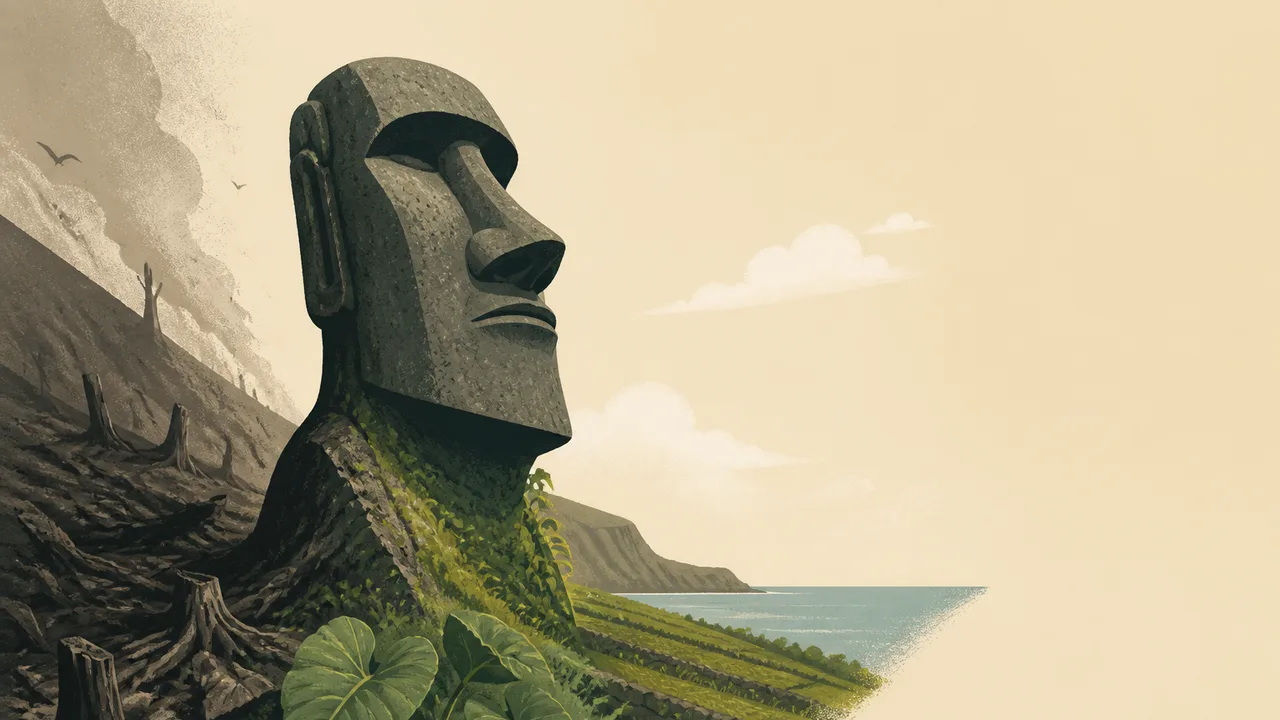
Photo: AI. Mika Sørensen
The story most of us learned about Easter Island is almost too neat to be true. A people carve enormous stone statues, deforest their island in the process, descend into famine and war, and obliterate themselves — leaving only the enigmatic moai as a monument to human shortsightedness. It became, in the hands of popular science writers and environmentalists, a parable for our times: look what they did to their island; look what we are doing to our planet.
The problem with a story that tidy is that it tends to say more about the storytellers than the people being described.
For fifteen years, Belgian archaeologist Nicolas Cauwe has been on Easter Island doing what parable-makers rarely bother with: looking at the actual evidence. The documentary Easter Island: What Archaeology Reveals About the Rapa Nui, recently released on SLICE Full Doc, follows Cauwe through fieldwork at farming villages, obsidian artifact collections, and the volcanic quarry of Rano Raraku. What he's found doesn't demolish the old narrative so much as dismantle it piece by piece, returning a more complicated and ultimately more respectful picture of the Rapa Nui people.
The fields they weren't supposed to have
The ecological suicide theory — the name alone signals its conclusions — holds that the Rapa Nui deforested their island so thoroughly that agriculture became impossible, triggering famine in the 17th century. Cauwe's excavations found something inconvenient: evidence of intense farming during that exact period.
Walking through what looks, to an untrained eye, like a rocky wasteland, Cauwe explains that the stones aren't obstacles. They're the technology.
"Basalt absorbs heat well," he says in the documentary, "and the first advantage is it prevents thermal shocks between day and night temperatures. The stones maintain a more constant temperature and above all help concentrate moisture. Morning dew will be captured and will remain concentrated at the plant's base."
The Rapa Nui had developed lithic mulching — deliberately concentrating stones across their fields — as a way to compensate for the loss of forest cover. The stones regulated temperature, trapped dew, and replaced the erosion-control function that trees had previously provided. Pollen analysis from the soil identified what grew there: sweet potatoes, yams, bananas. High-calorie, nutritionally dense crops, thriving in stony fields that look, at first glance, like nothing could grow there at all.
This reframes deforestation entirely. It was real — no one disputes that — but the Rapa Nui appear to have responded to it with agricultural ingenuity rather than spiraling collapse.
The skeletal evidence supports this. Caroline Polet, a researcher at the Institute of Natural Sciences in Brussels who collaborated with Cauwe, studied dozens of skulls from Easter Island, specifically looking for dental hypoplasia — the enamel growth arrest lines that form when a person experiences malnutrition during childhood. "The conclusion of the research," Polet states, "is that from the skeletal standpoint, we have no evidence of a malnutrition disaster or catastrophic famine on Easter Island." The rates she observed were comparable to other Polynesian island populations — unremarkable, in the precise way that disproves a catastrophe.
The weapons that weren't weapons
The next plank of the ecological suicide argument is tribal warfare — the idea that resource competition drove the Rapa Nui into fratricidal conflict. The main material evidence for this has long been the mataha: obsidian objects in Easter Island's archaeological museum, classified since the late 19th century as spearheads.
Cauwe re-examined them. And the more he looked, the stranger the classification seemed. Some objects have the shape you'd expect from a projectile point. Others are wide, asymmetrical, with the sharpened edge on the side — a genuinely puzzling design for anything you'd want to throw at someone.
Microscopic use-wear analysis told the story. "We found that most objects were used to scrape and not to throw," Cauwe explains. The marks left by repetitive scraping are physically distinct from those left by impact. Most of the mataha were tools — for woodworking, for farming, for daily material life. "That doesn't mean that there were no weapons," Cauwe is careful to add, "but the importance of weapons on Easter Island has been exaggerated."
That's a significant concession built into a significant correction. He's not claiming the Rapa Nui were pacifists. He's saying the evidentiary basis for a civilization-ending war has been overstated, partly because early researchers brought assumptions that shaped their classifications.
What the fallen moai actually tell us
The fallen statues are perhaps the most visually compelling piece of evidence for the collapse narrative — hundreds of moai lying flat along the island's shores, which archaeologists in the 20th century found toppled and face-down. The story wrote itself: warring tribes knocking over each other's ancestral protectors.
But Cauwe studied moai carved from tuff, a notably fragile volcanic rock. If these statues had been violently toppled, the physics would have left debris. Broken noses. Shattered foreheads. "Their forehead is intact," he notes, "yet it's the first thing that touched the ground. So, a shock would have destroyed the forehead. There would be moai pieces, which is not the case. They were laid down whole."
Whole. Carefully. Face-down. And then covered.
"The goal at some point was to stop the roll of these monuments," Cauwe says, "but with respect because they were the ancestors. So, they laid them face down carefully and then enclosed them."
This shifts the entire interpretive frame. These weren't acts of desecration by enemies. They were acts of ritual closure by the Rapa Nui themselves.
A quarry sealed by choice
The Rano Raraku volcano — the quarry where all moai were carved before being transported to the coasts — adds the most texture to Cauwe's reinterpretation. On its slopes sit dozens of moai that appear abandoned mid-production. Some have barely carved bodies. Others are positioned against cliff walls, impossible to extract without destroying. For a long time, archaeologists read these as evidence of sudden catastrophe: workers downed tools and fled.
Cauwe reads them differently. The tuff at the base of buried statues retains its original yellow color, with no weathering — meaning they were buried immediately after being carved, not abandoned and gradually covered by erosion. "They were carved with this in mind," he concludes. "We will bury them here."
Carbon dating, according to Wikipedia's documentation of Easter Island archaeology, places the shift in moai production practices at the late 17th century. What Cauwe identifies is a deliberate act of closure. The Rapa Nui were placing a tapu — a taboo — on their old practices. Giant moai that could never be transported blocked extraction of new tuff. Buried statues formed physical barriers at the quarry's base. Unfinished figures occupied cliff faces that could not be cleared without destroying sacred human forms.
"They did everything to close off this quarry," Cauwe says. "So, they sealed off the possibility to exploit the volcano anymore. And at this time on Easter Island, values were changing."
What replaced the ancestor cult was the god Makemake — a deity whose carved representations began appearing across the island at exactly this transitional period. The shift from three-dimensional moai to two-dimensional rock engravings of Makemake wasn't artistic decline. It was the visual record of a society actively reorganizing its spiritual life.
Where the collapse actually came from
None of this means Easter Island's story ends well. It doesn't. But Cauwe places the catastrophe where the historical record actually locates it: external contact, not internal ecological failure.
European ships began arriving in the 18th century. Early encounters were relatively contained. The 19th century was different. Peruvian slave raids devastated the island's population. Introduced diseases followed. "This ending," Cauwe says plainly, "isn't caused by deforestation or land management. It's caused by an encounter with the outside world which was extremely painful."
The distinction matters morally as well as historically. A civilization that destroyed itself through environmental mismanagement is a cautionary tale about human nature. A civilization that was destroyed by external colonialism and forced labor is a story about power, exploitation, and whose history gets written — and how.
Cauwe's closing reflection cuts through: "We're often wrong creating lessons from history as lessons from history often place our current values into the past and we interpret the past from that angle which doesn't help us much." The ecological collapse parable was always at least partly a projection — a 20th-century environmental anxiety retrofitted onto a Pacific island people who couldn't speak back.
The Rapa Nui adapted. They farmed stone fields. They changed their gods. They rebuilt after catastrophe. They preserved their language through everything. The question isn't whether they failed. The question is why we were so ready to say they did.
More Like This

Middle Platonism's Hidden Role in Western Esotericism
ESOTERICA's new crowdfunded seminar argues Middle Platonism built the foundations of Hermeticism, Gnosticism, and early Christian theology. Here's what that means.
California's Channel Islands Hold 13,000 Years of History
From pygmy mammoths to the Lone Woman of San Nicolas, California's Channel Islands preserve one of North America's deepest human records — if we bother to look.
Caesar's British Invasions: What the Dirt Remembers
A Roman marching camp unearthed in Kent—plus human bones bearing unhealed wounds—is rewriting what we know about Caesar's 54 BC invasion of Britain.
What the Dinosaur Asteroid Actually Did to Earth
New research reframes the Chicxulub impact—not just as a mass extinction event, but as a creative force that may have built the Amazon rainforest.
The Gods of Pre-Islamic Arabia, In Their Own Words
Ancient desert inscriptions reveal the polytheistic world before Islam—gods, prayers, sacrifice, and fate, recorded by the nomads who lived it.
Minoan Thera and the Archaeology Behind Atlantis
Was Plato's Atlantis rooted in real events? The archaeology of Minoan Thera makes a compelling case — and complicates the legend in fascinating ways.
Colonel John Alexander's Life at the Edge of Official Reality
Colonel John Alexander commanded Green Berets, ran Pentagon psychic programs, and investigated UFOs. His 3-hour Why Files interview maps a career lived at the edge of official reality.
The Homestead Act at 160: A Promise With a Price
The Homestead Act of 1862 shaped who owns American land and who doesn't. Its contradictions still live in the country's housing and land-use debates today.