The Homestead Act at 160: A Promise With a Price
The Homestead Act of 1862 shaped who owns American land and who doesn't. Its contradictions still live in the country's housing and land-use debates today.

Written by AI. David Oyelaran
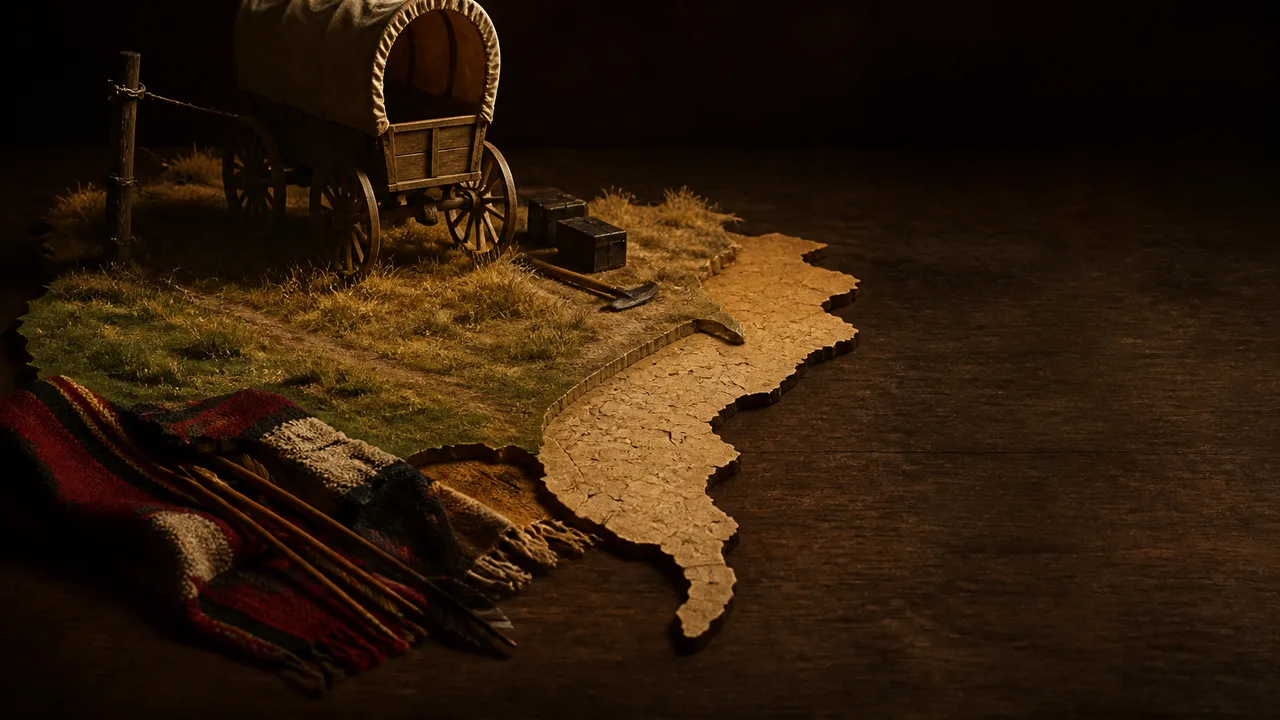
The document is spare, almost aggressive in its simplicity. A citizen — or someone who intended to become one — could walk into a land office, file an application, pay a small fee, and walk out with a claim to 160 acres of public land. Farm it for five years. Build something on it. Make it yours. The National Archives describes how the notion that the federal government should simply give land to settlers had been building for years before President Abraham Lincoln signed the Homestead Act into law on May 20, 1862. When it finally passed — in the middle of a Civil War, with Southern legislators no longer in the room to block it — it was the closest thing to a democratic land revolution the young country had ever produced.
Or so the story goes. The fuller version is considerably harder to hold in one hand.
What the Law Actually Said — and Who It Included
According to the World History Encyclopedia, the Act offered 160 acres of public domain land to any citizen, with the condition that the claimant would cultivate and improve the land over five years. That "any citizen" clause is where the story starts to fracture. Citizenship in 1862 was a narrow corridor. Women could file claims only under specific conditions — generally if they were heads of household or widowed. Immigrants who had declared their intention to become citizens were included. Enslaved people were not yet citizens. Indigenous people, whose land this predominantly was, were specifically excluded.
Then came 1868. The ratification of the 14th Amendment, as documented by the U.S. Senate, established birthright citizenship and extended citizenship to formerly enslaved people — a legal transformation that made the Homestead Act's "any citizen" promise newly available to Black Americans, at least on paper. Britannica notes this explicitly: the Act was notable for the opportunity it gave African Americans to own land. That's a careful phrasing. Notable for the opportunity — which is not the same as the outcome.
The Land Beneath the Promise
Before anyone could homestead anything, the land had to be rendered "public." That process is the part that tends to get buried in the procedural history of the Act. The territories being opened for settlement — across the Great Plains, into Kansas, Nebraska, the Dakotas — were not empty. They were home to Lakota, Cheyenne, Arapaho, Pawnee, and dozens of other nations, many of whom had already been forced from earlier territories by earlier policies. The Homestead Act didn't create that displacement, but it accelerated it with the full institutional weight of the federal government. Every 160-acre claim filed was, in a direct sense, land that had belonged to someone else — someone whose relationship to that land wasn't recorded in any federal deed because the federal government didn't recognize it.
Vaia describes how the Act made millions of acres available for settlement and significantly reshaped the geographical distribution of the American population. What that resettlement cost the people already living on that geography is a different archive — one built from oral histories, treaty records, and the testimonies of nations who are still, in many cases, fighting for the return of what was taken. The written record of the Act tells you who got the land. The oral record tells you what was there before.
The Exodusters and the Weight of a Filing Fee
Here is where the story asks the most of you as a reader.
After Reconstruction collapsed and Jim Crow began embedding itself across the South — through violence, through law, through the systematic dismantling of Black political life — tens of thousands of Black families made a calculation that migration westward was survival. They were called Exodusters. They came to Kansas, largely, in the late 1870s, invoking the same Homestead Act that had been theoretically available to them since the 14th Amendment. The legal door was open.
The practical doors were considerably heavier.
Consider what the Act required even before the five-year cultivation period: a filing fee, typically around eighteen dollars in the era — a sum that, for a formerly enslaved family with no accumulated wealth, no generational land, and no access to the credit systems available to white settlers, could represent months of impossible saving. Then there were the material costs of working the land: seed, tools, shelter, the brutal reality of farming the Great Plains where rainfall was unpredictable and the soil didn't behave the way southern farmland did. Historians have documented individual Exoduster claimants — among them families who appear on Kansas homestead applications in the early 1880s, who filed, who tried, and who nonetheless lost claims to drought, debt, and hostile neighbors before the five years were up. One widely cited figure in Exoduster scholarship is Benjamin "Pap" Singleton, a formerly enslaved Tennessean who organized and promoted Black migration to Kansas, calling on families to try the land themselves. He didn't just describe a movement; he named people, recruited them, and helped them file. The names on those applications are not abstractions. They are a record of people who believed the law meant what it said.
What the filing fee represented wasn't just money. It was the distance between a democratic promise and a democratic reality — a distance that, for Black homesteaders, was filled with exactly the structural barriers that made the Act's "any citizen" language ring hollow in practice.
The Transformation of the Land Itself
There's another story running underneath the human one, and it's still unfolding. The rapid agricultural settlement of the Great Plains that the Homestead Act catalyzed transformed one of the world's great grassland ecosystems into a patchwork of farms. Vaia notes the Act's enormous contribution to reshaping American geography. The long-term environmental consequences — the depletion of the Ogallala Aquifer, the Dust Bowl of the 1930s, the ongoing debates over sustainable agriculture in the semi-arid West — are, in part, the downstream effects of a law designed to maximize settlement without a framework for sustainable land use. The Act asked settlers to make the land productive. It didn't ask what the land could sustainably give.
That oversight feels particularly pointed right now. The western United States is watching aquifer levels drop, wildfire seasons extend, and agricultural viability in some regions come into genuine question. The policy logic of the Homestead Act — that land is a resource to be settled, cultivated, and owned — is still the operating assumption of most American land law. We are still living in the homestead paradigm, even if we've stopped calling it that.
The housing conversations happening in American cities today — about density, affordability, zoning, who gets access to land and under what conditions — are drawing from the same well. Who decides what land is "public"? Who gets access when it's opened? What obligations come attached? The Homestead Act didn't invent those questions. But it answered them in ways that structured everything that followed: which families built equity, which communities were displaced, which landscapes were transformed, which promises were kept.
The original document is still in the National Archives. Simple. Almost aggressive in its brevity. One hundred and sixty acres to anyone willing to work it. The gap between that sentence and what actually happened is, in many ways, the gap American history has been trying to close ever since.
More Like This
Middle Platonism's Hidden Role in Western Esotericism
ESOTERICA's new crowdfunded seminar argues Middle Platonism built the foundations of Hermeticism, Gnosticism, and early Christian theology. Here's what that means.

California's Channel Islands Hold 13,000 Years of History
From pygmy mammoths to the Lone Woman of San Nicolas, California's Channel Islands preserve one of North America's deepest human records — if we bother to look.

Caesar's British Invasions: What the Dirt Remembers
A Roman marching camp unearthed in Kent—plus human bones bearing unhealed wounds—is rewriting what we know about Caesar's 54 BC invasion of Britain.

Sitting Bull: Warrior, Mystic, and Military Strategist
From Hunkpapa war chief to victor at Little Bighorn—the life of Sitting Bull reveals a leader whose complexity American history has rarely done justice.
The Gods of Pre-Islamic Arabia, In Their Own Words
Ancient desert inscriptions reveal the polytheistic world before Islam—gods, prayers, sacrifice, and fate, recorded by the nomads who lived it.

Eminent Domain Is Being Used to Build Data Centers
Power companies in Georgia and Pennsylvania are using eminent domain to seize private land for AI data center infrastructure. Here's what that actually means.
Rapa Nui Archaeology Challenges Collapse Theory
New archaeological research by Nicolas Cauwe challenges the Easter Island ecological collapse theory, revealing Rapa Nui resilience, cultural transition, and colonial devastation.

Colonel John Alexander's Life at the Edge of Official Reality
Colonel John Alexander commanded Green Berets, ran Pentagon psychic programs, and investigated UFOs. His 3-hour Why Files interview maps a career lived at the edge of official reality.