Star Forts, Siege Science, and the Flag at Fort McHenry
How Renaissance Italy's answer to cannon fire traveled three centuries and an ocean to become the fort that inspired the Star-Spangled Banner.

Written by AI. Margaret "Maggie" Holloway
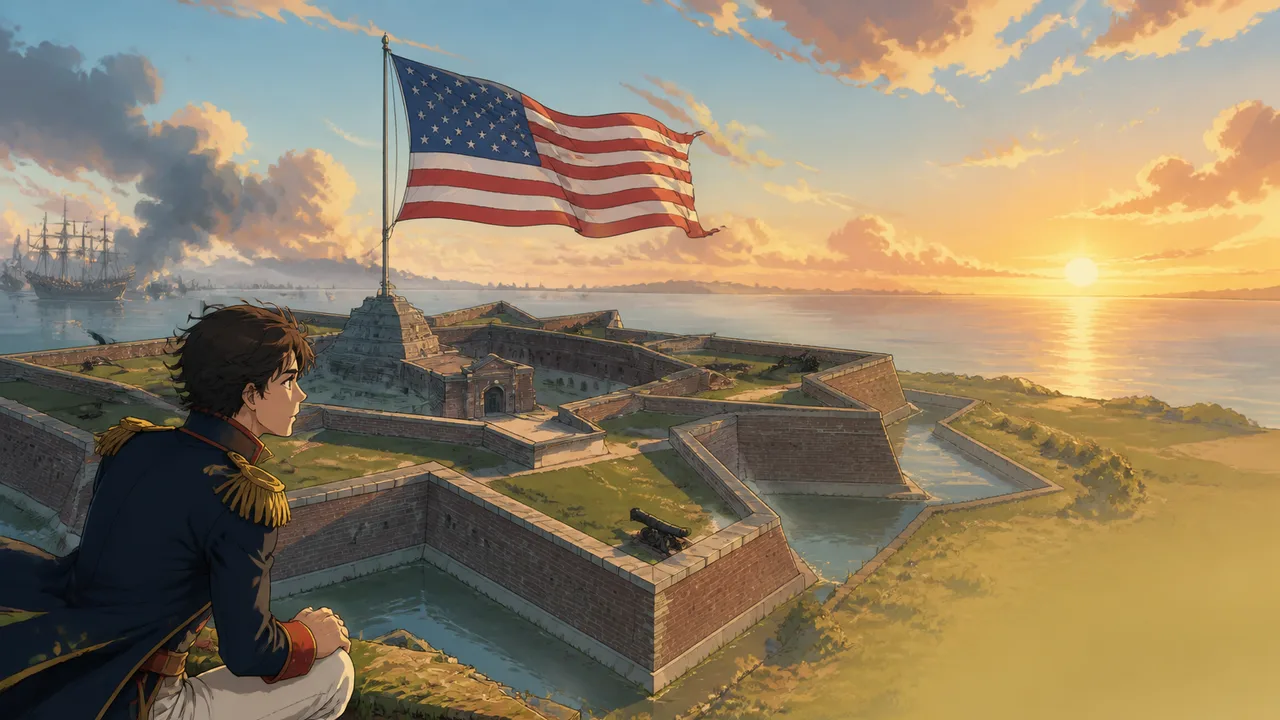
Photo: AI. Mei Fujimoto
In 1494, Charles VIII of France rolled bronze-barreled artillery across the Alps and proceeded to dismantle, in a matter of days, fortifications that had held for generations. Sieges that once consumed entire seasons — grinding affairs of starvation and negotiation — collapsed in hours. The Italian city-states, watching their walls shatter under direct fire, faced the oldest problem in architecture: the thing you built to protect you has become the thing most likely to kill you.
What came next was one of the more elegant problem-solving episodes in military history, and a Kings and Generals documentary traces it from its Renaissance origins all the way to a harbor in Baltimore — and to the poem that became a national anthem.
The Geometry of Survival
The medieval castle's logic was vertical. Height bought range for archers, made scaling ladders impractical, and turned every hilltop into a strongpoint. Round towers let defenders rake the face of the curtain wall. The whole system was designed around the assumption that the worst incoming threat moved slowly and couldn't punch through stone.
Cannon changed all of that in a single tactical generation. A tall wall is an easy target. A round tower, engineered to deflect a rolling stone, has no meaningful geometry against a two-hundred-pound iron ball traveling at velocity. And once attackers reached the base of a wall, the defenders' own guns couldn't depress far enough to engage them — leaving sappers free to mine and tunnel while the garrison watched from directly above, useless.
Italian engineers, under sustained pressure from French artillery, worked out the solution through decades of experiment. The key insight was almost counterintuitive: stop trying to resist the cannon, and start trying to defeat its geometry instead.
A cannonball striking a surface head-on transfers all its force into a single point of impact. The same ball striking an angled surface loses energy to deflection — it glances, buries, dissipates. So the bastion fort, which would come to be called the trace italienne, made oblique angles its entire philosophy. Walls went low and thick, filled with packed earth that swallowed cannonballs rather than shattering under them. Earth ramparts twenty to thirty meters thick absorbed what would have demolished stone. Projecting bastions replaced round towers — their angled faces arranged so that each one could sweep the full length of its neighbor's wall, eliminating the blind spots where medieval attackers had worked in safety.
The glacis — a long, gently sloping earthen bank — sat beyond the dry moat, forcing incoming fire to arc at angles that sacrificed both precision and force. Nothing about the design was incidental. Every layer covered the weakness of the layer behind it.
Francesco di Giorgio Martini sketched the principles in his Trattato di architettura. The fortress at Sarzanello, built in the 1480s under Florentine control, was among the first structures to test them in stone and earth. Giuliano da Sangallo and his nephew Antonio carried the system further at the Fortezza da Basso in Florence. Even Michelangelo, appointed governor-general of fortifications for Florence in 1527, contributed bastion designs — a fact that tends to startle people who think of him exclusively as a man of paint and marble, but shouldn't. At that moment, the bastion was the cutting edge of applied science, and cutting-edge science attracted the best minds available.
The Arms Race That Ran for Two Centuries
The design spread fast, carried by Italian military engineers who were suddenly the most sought-after professionals in Europe. Within two decades of the 1530s, the trace italienne had reached France, the Netherlands, Spain, and the Habsburg domains. Portuguese engineers took it further still — to Salvador in Brazil, to Goa in India. The bastion fort became the period's common architectural language of power.
But a successful defensive system creates its own problem: it demands a successful offensive response. The answer was the sap — a zigzag trench pushed toward the fortress under cover of gabions, the first parallel dug across the line of advance to concentrate troops, then a second, then a third. Close enough to the covered way to assault. A competent engineer working the established method could reduce even a well-designed bastion fort with something approaching mathematical predictability, given sufficient time and materiel. The siege had become a calculation rather than a contest of nerve.
Forts responded by deepening the covered way, enlarging their outworks, digging countermine galleries to intercept enemy tunnels. The two systems fed each other's evolution across the entire seventeenth century. By the time Sébastien Le Prestre de Vauban — Louis XIV's master engineer — had overseen the construction and renovation of over three hundred fortifications across France's borders, siege warfare had drifted far from anything resembling a test of courage. It was a contest of budgets, drafting tables, and the willingness to wait. The side with better engineers and deeper supply lines won. Most of the time, they knew they would win before the first trench opened.
A Frenchman in Baltimore
The bastion fort crossed the Atlantic as the United States worked out what kind of nation it was going to be. Whetstone Point, a narrow peninsula at the mouth of the Patapsco River controlling the primary maritime approach to Baltimore, had hosted an earthen star redoubt since 1776. By the late 1790s, with American merchant ships being seized by both Britain and France and the young republic navigating the barely-cold hostility of the Quasi-War, that redoubt was no longer adequate.
On July 7, 1798, Secretary of War James McHenry ordered Major Louis Tousard to design improved fortifications at Whetstone Point. Then, in 1799, Tousard was replaced by Jean Foncin.
Foncin deserves a longer look than history has given him. He was a French artillerist and military engineer — which is to say, a man trained in exactly the tradition that had been refining the bastion fort for three centuries. He arrived in Baltimore to correct significant errors in the existing plan and to transform a crumbling earthwork into a masonry pentagonal fort, a structure that would bear someone else's name and guard someone else's harbor. There is something both ordinary and quietly remarkable about that position: the foreign expert, brought in to fix what the home team couldn't, working in a language not his own on a coastline not his own, building something he would never need defended. Secretary McHenry, according to accounts relayed in the Kings and Generals documentary, regarded Foncin as having demonstrated real professional competence in the work. The fort was named for McHenry himself — a Scots-Irish immigrant, surgeon, Continental Congress delegate, and Secretary of War under Washington and Adams. The man who named it and the man who built it were both, in their way, transplants.
What Foncin produced was Fort McHenry: five brick bastions at the corners of a pentagonal perimeter, overlapping fields of fire along every curtain wall, a dry moat, a glacis. The walls rose roughly forty feet above water level — low enough to minimize the silhouette, thick enough to absorb naval bombardment. Casemates inside the bastions protected artillery crews during incoming fire. The whole structure was a direct heir of the trace italienne, translated into American brick on a Chesapeake peninsula.
Twenty-Five Hours
By August 1814, the British had burned Washington — including the White House and the Capitol — with the clear intention of demonstrating what happened to American cities that resisted. Baltimore was next. Vice Admiral Cochrane's fleet opened fire on Fort McHenry at 6:30 a.m. on September 13th.
What followed was twenty-five hours of bombardment that accomplished almost nothing, for reasons Foncin and his predecessors had engineered centuries before. British guns could reach the fort from two miles out; Congreve rockets from somewhat closer. But the fort's own artillery kept the fleet from advancing to a range where accuracy was possible. A defensive chain of sunken vessels across the harbor entrance blocked any closer approach. The British fired from maximum range, where their shells and rockets were spectacular but imprecise. Fort McHenry's return fire was equally limited at that distance. Both sides, the Kings and Generals documentary notes, "fired ineffectively, inflicting minimal damage."
By dawn on September 14th, ammunition exhausted, the fleet withdrew.
Francis Scott Key watched the bombardment from a truce vessel in the harbor, uncertain through the night whether the fort had held. At first light, the flag — a thirty-foot garrison flag commissioned specifically to be visible at a distance — was still flying above the battered walls. Key wrote the verses that became "The Star-Spangled Banner" before he reached shore. "Oh, say does that star-spangled banner yet wave / O'er the land of the free and the home of the brave."
It is worth sitting with what that question actually was. Not a declaration. A question. Key didn't know the answer when he started writing. He had spent the night not knowing.
What the Shape Remembers
Fort McHenry remained an active military installation long after 1814 — converted to a military hospital during the First World War, a Coast Guard base in the Second. In 1925 it became a national park; in 1939, it received the dual designation of national monument and historic shrine. The original brick pentagonal structure has been preserved and restored to its War of 1812 condition.
What's easy to miss, walking around it today, is that the shape itself is the argument. Every angled bastion face, every calculated sight line, every deliberate inch of glacis slope carries three centuries of hard-won geometry. The fort doesn't just commemorate the night the flag held. It embodies the long chain of failures and refinements — Sarzanello, the Dutch frontier works, Vauban's border fortresses, Foncin's corrections in 1799 — that made holding possible.
Fortifications are honest documents. They record what people were afraid of, what they could afford, and what they understood about physics and power at the moment they were built. Fort McHenry records all of that, and then one September morning when it mattered enormously, it worked.
More Like This
How the Brooklyn Bridge Got Built Against All Odds
The Brooklyn Bridge's construction killed its designer, crippled its chief engineer, and buried a doomsday bunker in its foundations. Here's what it actually took.
The Battle of Verdun: Attrition, Leadership, and 300,000 Dead
Ten months, 300,000 dead, and less than five miles of ground changed hands. Epic History's Verdun series examines what that arithmetic actually meant.
Unveiling Rome's Gladiator Underworld
Explore the hidden world beneath ancient Rome's arenas, unveiling gladiator training, underground tunnels, and cultural practices.
Jackie Kennedy and Lee Radziwill's Bitter Lifelong Feud
The feud between Jackie Kennedy and her sister Lee ran deeper than jealousy. A look at the betrayals—plural—that made it permanent.
France's Thunder Boat: One Ship, Every Mission
France's BPC Thunder Boat is a 22,000-ton amphibious assault ship that functions as a seaport, hospital, helicopter carrier, and command center—all at once.

The Science and Stories Behind Earth's Fiercest Winds
Explore the science of deadly winds, from hurricanes to tornadoes, and the people dedicated to understanding and surviving them.

A Brief History of the Internet, From ARPANET to AI
From packet switching born in Cold War panic to AI models renting us our own data back, the internet's history is stranger than most people realize.

How Times Square Became a Billboard for Itself
Times Square's wall-to-wall advertising wasn't inevitable. It was built by specific people, specific decisions, and one very consequential zoning law.