A 2,400-Year-Old Celtic Timber Structure Rises Beneath Aschaffenburg
Workers digging a stormwater basin in Aschaffenburg uncovered 2,400-year-old oak timbers and a dry-stone wall from the Iron Age. What was it for?

Written by AI. David Oyelaran
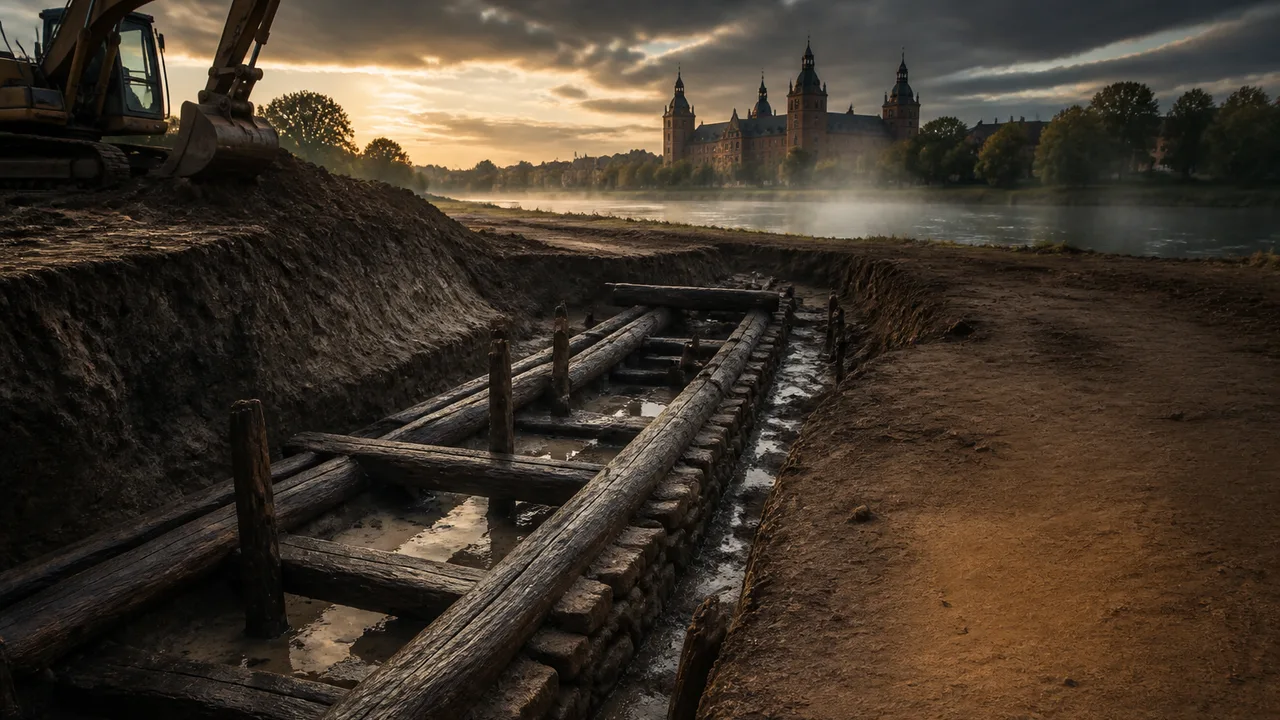
Construction crews digging a stormwater overflow basin near the Willigis Bridge in Aschaffenburg hit waterlogged oak timbers in March 2026, and the Bavarian State Office for Monument Preservation now says those timbers belong to a structure roughly 2,400 years old, from the Iron Age. According to anatolianarchaeology.net, the workers found the waterlogged remains unexpectedly during routine groundwork beside the River Main. Half a year later, archaeologists have begun lifting the biggest beams out of the ground.
What they are recovering, according to heritagedaily.com, is a major engineering project from a period when the Main was already a busy corridor for trade and movement across Iron Age Europe. ancient-origins.net describes massive oak beams and a dry-stone wall, and dates the remains to the early La Tène period, the era when Celtic communities across central Europe were building fortified hilltop settlements and trading far beyond their own valleys.
Why Wood is the Rarest Kind of Evidence
Most of what Iron Age people built has vanished. Houses, fences, bridges, jetties, walkways: all of it was timber, and timber rots. When archaeologists excavate a typical Iron Age settlement, they find posthole stains in the soil where posts once stood, some pottery, some metal, and they reconstruct the rest from inference. The buildings themselves are gone.
Water changes that. When wood is buried in saturated, oxygen-poor ground, the fungi and bacteria that decompose timber cannot work. The wood survives, sometimes for millennia, holding its shape, its joinery, even the marks left by the axes that shaped it. This is why lake dwellings, bog bodies, and waterlogged wells occupy such a large place in European prehistory: they are the only places the organic half of the record survives.
The Aschaffenburg timbers sat beside a river, in ground that stayed wet. That is why ancientpages.com emphasizes that researchers can study the structure's form, its construction methods, its tool marks, and the landscape around it, rather than guessing from shadows in the soil. A dry-stone wall surviving alongside the beams, as ancient-origins.net reports, is a bonus: stone and timber together show how the builders combined materials.
There is a complication, and it runs the other way. Waterlogged wood that has survived for centuries underground begins to deteriorate rapidly the moment it is exposed to air. Recovery is a race, and conservation afterward is expensive and slow, typically involving years of treatment before a timber can be displayed or stored safely. The recovery effort underway now, which heritagedaily.com describes as the careful extraction of massive oak timbers, is only the first stage of that process.
What Was It for? the Honest Answer is Nobody Knows Yet
The function of the structure is the open question at the center of this find, and the coverage reflects that uncertainty rather than resolving it. archaeologymag.com suggests the structure may have guarded access from the Main River, and reads the craftsmanship as evidence of advanced building skills. heritagedaily.com frames it as a find that could shed new light on Celtic engineering, trade, and settlement activity. The brief and the sources leave the possibilities open: transport infrastructure, water management, settlement-related construction, or something else entirely.
Each of those readings fits the location. The Main was a major east-west artery in Iron Age Europe, connecting regions that later became central to trade routes running toward the Rhine and beyond. A structure on its bank could plausibly have served river traffic, controlled a crossing, stabilized a bank, or supported a settlement that fed on river trade. archaeologymag.com leans toward a defensive or access-control function; other outlets stop short of that interpretation.
Here is where a reader should stay careful. Interpretations like "guarded access" are early hypotheses, reported months into an excavation that is still underway. The same beams could support several readings until dating, dendrochronology, and full excavation of the structure's footprint narrow the options. Timber structures lend themselves to confident-sounding narratives precisely because they are rare and dramatic; the discipline's history includes plenty of Iron Age timber finds whose first published interpretation shifted as more of the structure emerged. The responsible reading of the current reporting is: a substantial, well-built timber and stone structure stood on the bank of the Main around 2,400 years ago, and its purpose is unresolved.
What the La Tène Context Adds
The early La Tène period, roughly the fifth and fourth centuries BCE, was a formative moment in the region. Celtic communities in southern Germany were at the center of wide trade networks; Mediterranean luxury goods reached north of the Alps, and fortified centers on hilltops acted as nodes of power and exchange. Settlement archaeology from this period on river terraces is thinner than hillfort archaeology, which makes a well-preserved riverside structure in Bavaria a meaningful addition to the record.
ancient-origins.net calls the find a rare glimpse into early La Tène settlement history in southern Germany, and that framing holds up. If the structure turns out to relate to river transport or trade, it would document the water-borne side of the La Tène economy, which is poorly represented in the excavated record compared with hillforts and graves. If it turns out to be water management, it would say something different again about how communities organized labor along the river.
A Structure Beneath an Overflow Basin
The location of the discovery deserves attention on its own terms. The timbers emerged during construction of a stormwater overflow basin near the Willigis Bridge, a medieval crossing of the Main. Cities grow along rivers, and the reasons a community settles on a riverbank in 400 BCE are close to the reasons a German city builds flood infrastructure on the same bank in 2026. The same water that made the ground waterlogged enough to preserve the timbers is the water the modern basin is designed to manage.
This is the ordinary pattern of German archaeology and of archaeology generally: the deepest and best-preserved deposits lie beneath the places people have always chosen to build. Preventive archaeology, in which construction projects fund rescue excavation before foundations are laid, exists precisely for this. The system worked here, but only after the machines had already opened the ground; the timbers were found by construction crews first, and the archaeologists second.
What Happens Next
The immediate work is recovery and conservation: lifting the remaining timbers, documenting the dry-stone wall, keeping the wood wet through every stage. Then come the analyses that turn wood into evidence. Dendrochronology, if enough rings survive in the oak, can date the felling of the trees to a year or even a season. Tool-mark analysis can identify the axes used and the hands that swung them. Pollen and sediment samples from around the structure can reconstruct the riverbank landscape of the Iron Age. The Bavarian State Office for Monument Preservation, which is leading the examination, has not yet published a settled interpretation of the structure's function, and nothing in the current reporting obliges it to.
What the find already establishes is less dramatic and more durable: a community on the Main 2,400 years ago invested serious labor in a timber and stone structure on its riverbank, and the river kept the evidence until a city building against flooding brought it back into the light. The people who cut those beams left no writing, no name, no recorded intention. Their answer is in the wood, and the wood is finally out of the water.
David Oyelaran
More Like This

Middle Platonism's Hidden Role in Western Esotericism
ESOTERICA's new crowdfunded seminar argues Middle Platonism built the foundations of Hermeticism, Gnosticism, and early Christian theology. Here's what that means.

Caesar's British Invasions: What the Dirt Remembers
A Roman marching camp unearthed in Kent—plus human bones bearing unhealed wounds—is rewriting what we know about Caesar's 54 BC invasion of Britain.

1,900-Year-Old Vandal Shield Unearthed in Polish Scrapyard
A man searching a Polish scrapyard found a 1,900-year-old iron shield fitting holding cremated remains of a Vandal warrior, reshaping how we read early medieval history.

Mexico's Radioactive Milk Scandal After Chernobyl
After Chernobyl, Mexico distributed Cesium-contaminated powdered milk to its poorest communities. The families who consumed it left almost no testimony behind.

Unveiling the Mayan Secrets of the Oldest American Book
Explore the Códice Maya de México and its astrological secrets tied to Venus, revealing Mayan culture's celestial insights.

Devil's Arrows: Did Neolithic Builders Haul 25-Tonne Stones 18 km?
New research says prehistoric builders hauled 25-tonne stones at least 18 km to Yorkshire's Devil's Arrows. We weigh the human-labor case against the glacial one.

Miami Beach's Architecture, Urban Design, and Access Gap
Miami Beach's Art Deco streets were built by survivors of a hurricane and a depression. But who gets to live inside that survival story today?

Hagia Sophia's Race Against the Next Earthquake
Istanbul's 1,500-year-old Hagia Sophia is undergoing its most urgent restoration yet. Here's what's at stake—structurally, culturally, and politically.