The Sunken Bronze Age City Beneath Naxos
The ancient city of Grota lies partly submerged off Naxos. A new History Time video traces its extraordinary story from Neolithic origins to Bronze Age collapse.

Written by AI. Harold "Harry" Goodman
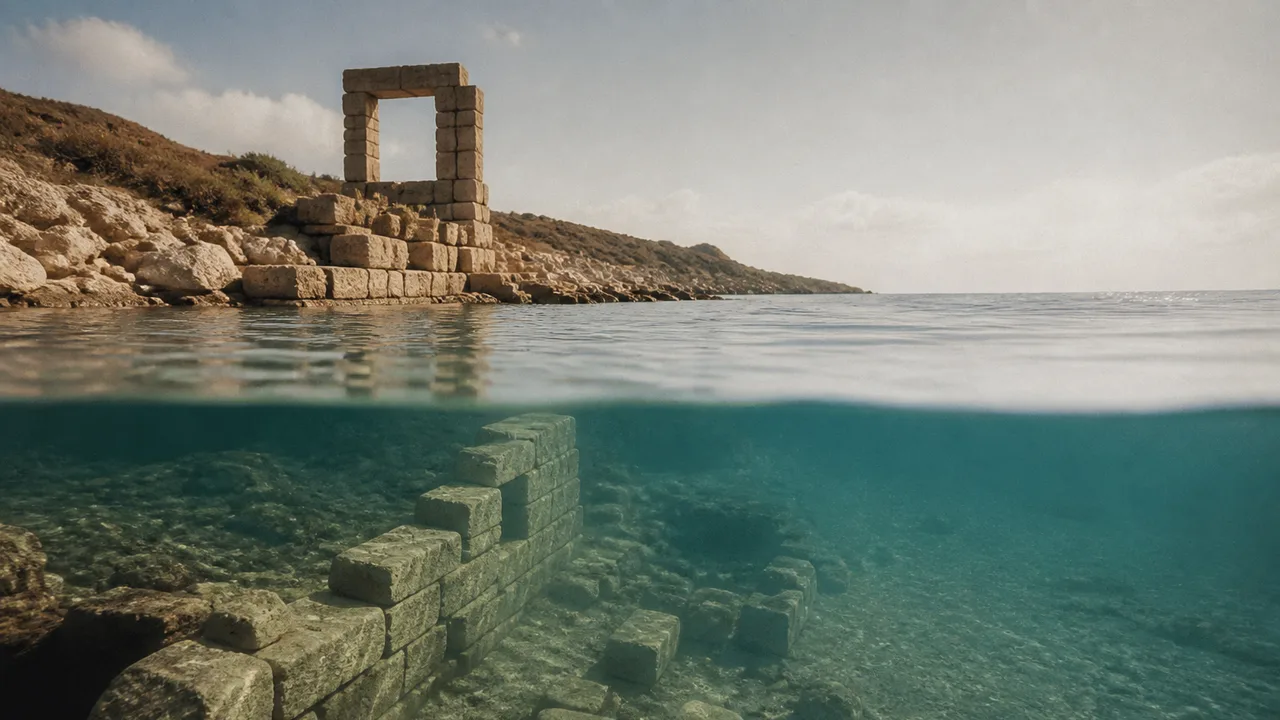
Photo: AI. Marcel Dubois
Just meters out into the surf at Grotta Beach, on the northern edge of the modern town of Hora on Naxos, the walls of a Bronze Age city sit beneath the Aegean. On calm days, Pete Kelly tells us in his recent History Time documentary, "a truly astonishing display is to be had. A real life Atlantis that sunk beneath the waves at the end of the late Bronze Age." On windy days, of which there are many in the Cyclades, there is nothing to see at all. The city keeps its own counsel.
That tension between visibility and concealment runs through Kelly's hour-long video on the prehistoric history of Naxos, published last week after several years in development. It is not, strictly speaking, a video about a sunken city. It is a video about the full arc of habitation on the largest island in the Cyclades, from Mesolithic hunters at Stelida Hill to the archaic Greek polis that eventually replaced the Bronze Age settlement. The submerged ruins are the destination, but the journey matters as much as the arrival.
A City Hiding in Plain Sight
The ancient settlement at Grota, the name by which the modern town of Hora was once known, has the distinction of sitting beneath one of the busiest tourist centers in the Cyclades. Hotels, restaurants, and beachfront real estate occupy the footprint of what Kelly describes as a significant Mycenaean urban center, complete with harbor installations, workshops, cemeteries, and colossal city walls. What has been excavated represents only a fraction of what survives.
The site's archaeology carries a frustrating history. A German archaeologist identified as Gabrielle conducted the first modern excavations in the 1930s, finding early Helladic structures and what he described as cyclopian walls from a Late Helladic fortified settlement. No plans of his digs were ever published, no pottery illustrated. He refilled his trenches after finishing, and the subsequent conflict between Germany and Greece caused even the locations of those trenches to be temporarily lost. Greek archaeologists Nikolaos Kondoleon and Vasilis Lambrinoudakis then worked the site intermittently from 1949 to 1985, finding evidence of habitation spanning from the early Bronze Age through the late Mycenaean era, as well as rich elite cemeteries on the hills of Aplomata and Kamini nearby.
What those cemeteries contained is worth dwelling on. Two clusters of collapsed chamber tombs yielded metalwork from the middle and late Bronze Age, jewelry, gold, seals, and ornate pictorial pottery. Imports came from Crete, Cyprus, the Dodecanese, Attica, the Peloponnese, and what Kelly calls the Argolid itself. The clear spatial demarcation between the two tomb clusters has led researchers to suggest the possibility of two competing aristocratic kin groups having governed Mycenaean Naxos. An abundance of bronze weaponry implies a warrior class, and symbols of administrative office among the grave goods suggest these were people actively managing the island's economy. Given the trade connections visible in the burial record, they were managing it well.
The Problem of the Missing Middle
One of the genuinely interesting puzzles Kelly navigates is what he calls the near-absence of Middle Bronze Age evidence on Naxos. The Early Cycladic period, roughly the third millennium BC, is well represented; the Late Bronze Age Mycenaean period is documented in some depth; but the period in between is thin on the ground. The site of Mikre Vigla, an exposed promontory on the island's west coast, provides some of the best evidence for that transitional phase, including a collection of anthropomorphic figurines that led to a proposed identification of the site as a Minoan-style hilltop sanctuary, reportedly one of the very few such sanctuaries found outside of Crete.
Kelly is careful about what this means. Minoanization, he argues, was likely more a matter of cultural fashion and economic aspiration than straightforward population replacement. Naxian potters, he suggests, may have developed their own expertise in imitating Cretan styles to a near-perfect level, possibly with the intention of selling those goods themselves: Naxians profiting from the regional craze for Cretan culture rather than simply being absorbed by it. The distinction matters for how we understand agency in Bronze Age Aegean networks. Whether you read the archaeological record as evidence of Minoan dominance or of Naxian entrepreneurialism depends substantially on which artifacts you weight most heavily.
What Ended It
Sometime around 1200 BC, Kelly argues, an earthquake struck the low-lying city at Grota. The flooding that followed, a predictable consequence for a settlement built at sea level, may have compounded the damage considerably. The old city was leveled, and a new, centrally planned settlement was built on top, oriented along a north-south axis and enclosed by walls with a stone base and mudbrick superstructure. That rebuilt city would outlast almost every other Mycenaean power center of its era. Even after the collapse of the palace states on the mainland in the 12th century BC, Naxos continued to function, making up what Kelly describes as part of a post-palatial Aegean geography. Mercantile activity persisted. Shipbuilding continued. The community became, in his framing, "more Naxian than anything else."
But the sea was patient. By the 11th century BC, the northernmost portion of the rebuilt city had been completely submerged. At some point, the decision was made to abandon the lower settlement entirely. The remaining population moved uphill to what would become the Castro, the site of the later archaic and classical cities. The old city became a place of the dead. Random burials were eventually organized into a geometric-era cemetery, its tombs built into and around the still-visible walls of the submerged settlement. A large earthen tumulus was eventually raised over that cemetery at Metropolis Square. Kelly reads this not as forgetting but as a kind of sustained veneration: "The impact they had on their descendants being so profound that they could not or would not abandon their city."
The Archaeology of Accumulation
What Kelly's documentary does unusually well is convey the sheer depth of time compressed into a single place. The Kora of Naxos is one of the only sites in the Cyclades with documented evidence of habitation from the early Bronze Age to the present. That is not a tourist brochure claim; it is an archaeological fact with consequences for how excavation there must work. Every construction project is a potential discovery. Every beachfront building sits on something older.
The most iconic structure visible in Hora today, the unfinished archaic temple on the Palatia promontory, was likely never completed, though Kelly notes that had it been finished, it would have ranked among the largest temples in the Greek world at the time. The Mycenaean city that preceded it, the one now partly beneath the waves, built cyclopian fortifications described as unique within the Cyclades. What connects those two moments, separated by several centuries and a wholesale population shift uphill, is the island's insistence on a single urban center. Unlike other large Cycladic islands, Naxos appears to have consolidated around one polity. Aristotle, Kelly notes, found this unusual enough to write about it, though that text, like much else from the ancient world, is lost.
Archaeologist Andreas Vlachopoulos, cited in the documentary, characterizes the Aegean sea routes of the post-palatial period as anti-monopolist, a maritime world without a center, where independent operators filled the vacuum left by collapsed palace economies. If that framing is right, then Naxos in the 11th and 10th centuries BC was not a survivor clinging to Bronze Age forms but an active participant in something genuinely new, using older infrastructure for new purposes.
The submerged city off Grotta Beach is not a tragedy, exactly. It is more like a palimpsest that got wet. The people who lived there did not vanish; they moved uphill, brought their dead with them in memory if not in fact, and built again. What lies beneath the surf now is partly visible on calm days, partly obscured by the modern town above, and substantially unknown. Kelly spent two days trying to see it clearly through the water. Future excavation, where modern habitation permits it, will be required for anything more.
More Like This
Pavlopetri: Inside the World's Oldest Sunken City
A Bronze Age city has sat submerged off southern Greece for 3,500 years. New technology is finally letting archaeologists read what it says about us.
Ancient Amazon Civilizations Revealed by Archaeology
LiDAR mapping and new excavations are overturning the myth of a pristine, empty Amazon—revealing cities, roads, and millions of lost inhabitants.

Newton and Darwin: Two Delayed Revolutions in Science
A look at Isaac Newton and Charles Darwin—two English geniuses whose world-changing works were published decades after their foundational discoveries were made.
Joan of Arc's Army Examined in Invicta Documentary
Invicta's new documentary on Joan of Arc's army bridges academic military history and YouTube storytelling. Harry Goodman examines what that translation costs and earns.

Britain's Hidden History, Written in Water and Stone
From Lancashire's industrial canals to Dark Age Northumbria, Tony Robinson walks the landscape history forgot — and finds it still legible underfoot.
Egypt's Lost City of Masn: Clues Found at Tell Abu Saifi
Archaeologists at Tell Abu Saifi in Qantara East may have found the lost Egyptian city of Masn, guided by a 3,000-year-old sandstone inscription along the ancient Horus Road.
Ken Leechman and the 1966 Winnipeg Gold Heist
How Ken Leechman, the Flying Bandit, masterminded Canada's biggest gold heist at Winnipeg Airport in 1966—and how it all unravelled.

Common History Myths That Schools Still Teach
From Napoleon's height to Viking helmets, a new video maps the historical myths that textbooks kept alive—and asks why bad history is so hard to dislodge.