Britain's Hidden History, Written in Water and Stone
From Lancashire's industrial canals to Dark Age Northumbria, Tony Robinson walks the landscape history forgot — and finds it still legible underfoot.

Written by AI. Margaret "Maggie" Holloway
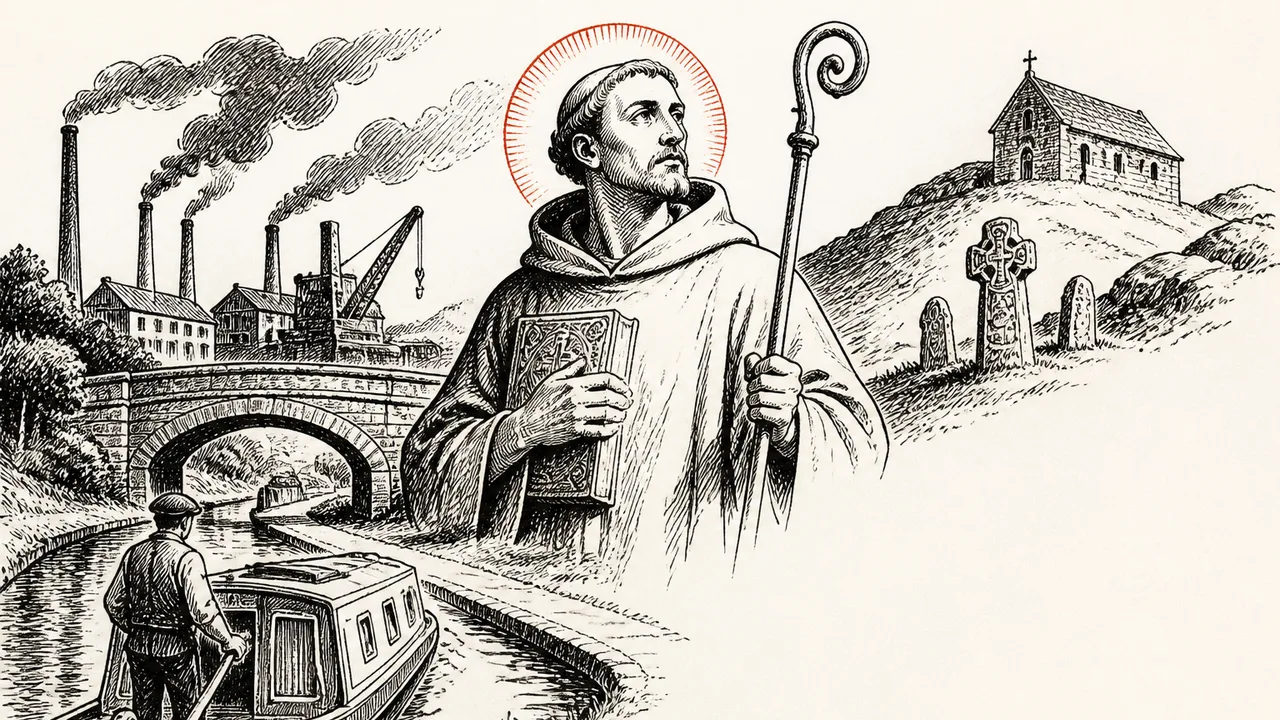
Photo: AI. Eira Pendragon
There is a kind of history that refuses to stay in books. It is scored into the land itself — in the grooves worn into an old stone bridge by two centuries of tow ropes, in the silhouette of a slag heap disguised as a hill, in the floor plan of a cave where frightened monks once laid a saint's body down to sleep. Tony Robinson's walks across Britain, collected in this documentary series from All Out History, are organised around a simple premise: that the best way to read the past is to put your boots on and go find it.
He walks 41 miles along the Lancashire stretch of the Leeds Liverpool Canal. He walks 70 miles from Melrose Abbey to Lindisfarne, tracing the footsteps of a 7th-century monk named Cuthbert. These are not heritage rambles with laminated information boards. They are arguments about what history is actually made of.
The Canal That Built an Empire's Supply Chain
The Leeds Liverpool Canal is 127 miles long, took 46 years to build, and finished five times over budget. It was, from almost the moment the first navvies raised their shovels, a monument to the gap between what engineers plan and what the world delivers.
Robinson begins in Liverpool, a city whose identity is so thoroughly anchored to its maritime story — the docks, the transatlantic trade, the cotton and tobacco — that the canal barely registers in the popular imagination. Industrial historian William Ashworth frames the oversight plainly: "Most people think of Liverpool and they think the docks, they think cotton, they think slavery, they think sugar, they think tobacco. But what's missing in the story typically is the important role of the canals."
The canal was born of a conflict. When Liverpool's merchants met with their counterparts from Leeds in 1768 to discuss the route, the two sides wanted different things. Leeds needed limestone from Yorkshire; Liverpool needed coal from Wigan. A proposed northerly route bypassing Wigan entirely prompted Liverpool's delegation to walk out of the meeting. The eventual compromise — a last-minute diplomatic fix that included an offshoot to the Wigan coalfields — set the template for a project that would spend the next four-and-a-half decades being rerouted, refinanced, and rescued from the edge of abandonment.
Chief engineer John Longbottom's solution to the construction challenge was elegantly pragmatic. He divided the work into one-mile sections, each contracted out separately, so the canal could be built simultaneously along its length. The waterproofing method was equally ingenious: clay, worked to remove impurities, mixed with water to a workable consistency, laid up to three feet deep, and then compacted — by navvies, certainly, but also, according to documents archaeologist Ian Miller describes, by hired herds of cattle and sheep driven back and forth along the channel. It worked remarkably well, which is either a testament to Georgian engineering or to the underrated utility of livestock.
What the canal did to the landscape along its route is the real subject of Robinson's walk, and it is not a simple story. At Aintree, directly behind what Robinson describes as a "rather ugly concrete wall," the Grand National came into existence in 1829 — started by a local hotelier on a canalside site, transformed a decade later into an event that drew 50,000 spectators and acquired its famous name. The Canal Turn obstacle, known to every racing fan, is named for the waterway visible through the trees at the racecourse's edge. The canal and the sport grew up together.
At Vauxhall in Liverpool, the canal was not only a transport corridor but a utility: pipes ran under the surface feeding water to canalside factories to power steam engines, with the condensed water returned through a second pipe system. Jam factories, match manufacturers, sugar refineries, biscuit companies — a whole industrial ecosystem grew along its banks, drawing on raw materials shipped in through the port and distributing finished goods back out through it.
Then there is the night soil. Liverpool's expanding population generated waste on a scale the city's streets could not absorb, and the canal offered a solution the original planners almost certainly never envisioned. Human sewage was collected and shipped out by barge into the Lancashire countryside, where farmers received it without toll charges because it enriched the fields. Robinson is good-humoured about this, as the moment deserves, but the underlying point is serious: the canal was such a fundamental piece of infrastructure that it ended up carrying the full metabolic output of an industrial city — the raw materials in, the finished goods out, and everything in between.
Longbottom himself ended badly. Accused of financial mismanagement — he had got tangled up in running packet boat services and investing in coal mines while supposedly overseeing the canal — he was sacked in the mid-1770s. The canal stalled for roughly a decade, strangled by costs no one had properly forecast and by the economic disruptions of the American War of Independence. When construction resumed in the 1790s, the world had changed: limestone was no longer the critical commodity. Coal was. The spur to Wigan, originally a secondary branch, became the main line. The delay that nearly killed the project turned out to be the making of it.
Longbottom, meanwhile, died in poverty. He wrote to the canal company asking for help in recognition of his contribution. They were slow to reply. They paid for his funeral.
The canal was finally completed on 22 October 1816 — 46 years after work began, under a completely different monarch, serving an economy that had transformed beyond anything the original 1768 meeting could have imagined.
The Monk Who Held a Kingdom Together
The second walk, from Melrose to Lindisfarne, covers different ground in every sense. Cuthbert — the Cuthbert of the documentary, who would have answered to something older — was born around 635 AD into the borderland between what is now Scotland and England, a landscape that in his lifetime had no border at all. The kingdom of Northumbria stretched from Edinburgh to York.
He arrived at Melrose Abbey on horseback, with a servant and a spear. Archaeologist David Petts, speaking to Robinson on the walk, notes that these details — the horse, the retinue, the weapon — mark Cuthbert unmistakably as an aristocrat. He was not a peasant who found God. He was a nobleman who chose a different kind of power.
What Cuthbert faced when he set out to preach across the moorlands was a faith landscape of genuine complexity. Roman Christianity had already been tried in Northumbria, brought north by the Italian monk Paulinus in 625. Paulinus spent 36 days preaching at Yeavering — an Anglian royal palace, now an archaeological site reduced to crop marks in a field — and baptised thousands in the River Glen. Eight years later, King Edwin was killed in battle, his kingdom overrun, and everything Paulinus had built dissolved back into paganism. The Roman mission simply evaporated when its royal patron fell.
The Irish Christianity that Cuthbert inherited was a different animal entirely. Where Rome brought hierarchy — pope, bishops, priests, a centralised authority — the Irish church brought community, simplicity, and a striking proximity to nature. Cuthbert would wade into freezing rivers at night to pray. He went for weeks at a time into plague-ridden moorland villages that other monks avoided. He was, by any reading, an unusual person.
One of the walk's most revealing stops is a ruined churchyard at Ancrum, where the question of how the monks actually made Christianity stick gets a proper airing. The method, it becomes clear, was not imposition but absorption. The eagle-and-salmon story that Robinson recounts on the riverbank — in which Cuthbert instructs his hungry companion to share their miraculous meal with the eagle that delivered it — maps directly onto pre-Christian mythology. In both early Irish and Welsh tradition, the salmon is a creature of sacred knowledge. The story works because it speaks a language pagans already understood.
As one archaeologist puts it to Robinson on the walk: "You do it by negotiation. You do it almost by stealth — you're introducing the new religion packaged in a way that is acceptable to pagans."
The crisis came in 664, at the Synod of Whitby, where the two versions of Christianity were forced to a reckoning. The dispute was partly practical — they could not agree on the date of Easter, meaning the king (raised in the Irish tradition) and his queen (raised in the Roman) were observing different liturgical calendars entirely. Northumbria's king resolved the standoff with a piece of frankly political theology: whatever the merits of the Irish saints, it was St. Peter who held the keys to heaven's gate, and he did not wish to antagonise him. Rome won.
Cuthbert did not leave with the Irish monks who refused the outcome. He stayed, and spent the rest of his active life as a reconciler — the person who had to make peace between the losing side and the victors, on the ground, in communities that had strong feelings about it. He eventually retreated to the barren rock of Inner Farne, where he lived as a hermit until near his death in 687. His recorded last words, as set down by the monk and historian Bede, were a plea for peace and unity among Christians.
Within three decades of his death, Cuthbert was a cult. Pilgrims flooded to Lindisfarne. The abbey, which had been a community of intentional poverty, became one of the largest landowners in Northumbria. Durham Cathedral — which Robinson calls "arguably the greatest Norman building in the world" — was built in his memory.
The walk ends, unexpectedly, at Inner Farne, where the National Trust's head ranger David Steele leads Robinson into a 16th-century peel tower and down into a vaulted cellar, where steel bars had recently been removed to reveal a flight of steps — and, at the bottom, a spring. A natural well, inside the building's foundations. The only spring on the island. Steele's suggestion — that no one builds over a spring by accident, that this building almost certainly respects the footprint of Cuthbert's original cell — is unprovable. But the archaeology points that way, and the spring is still running.
History rarely offers you a moment that clean. The ground keeps its own records.
More Like This
Unveiling Rome's Gladiator Underworld
Explore the hidden world beneath ancient Rome's arenas, unveiling gladiator training, underground tunnels, and cultural practices.
Jackie Kennedy and Lee Radziwill's Bitter Lifelong Feud
The feud between Jackie Kennedy and her sister Lee ran deeper than jealousy. A look at the betrayals—plural—that made it permanent.
Chapel Head: Time Team Digs the Cambridgeshire Fens
Time Team's "Beacon on the Fens" investigates Chapel Head in Cambridgeshire, uncovering a medieval chapel, Saxon pottery, and layers of prehistoric occupation.
Roman Altar Surfaces from a Shrinking Danube
Record-low Danube water levels in Hungary have exposed a Roman altar to Jupiter, WWII munitions, and mammoth bones—history unlocked by climate crisis.
The Science and Stories Behind Earth's Fiercest Winds
Explore the science of deadly winds, from hurricanes to tornadoes, and the people dedicated to understanding and surviving them.
Sion Abbey: The Lost Medieval Giant Beneath Sion House
Archaeologists uncovered Sion Abbey's vast church and cloisters beneath Sion House parkland—a Bridgetine monastery that rivalled Salisbury Cathedral in scale.
How the Brooklyn Bridge Got Built Against All Odds
The Brooklyn Bridge's construction killed its designer, crippled its chief engineer, and buried a doomsday bunker in its foundations. Here's what it actually took.
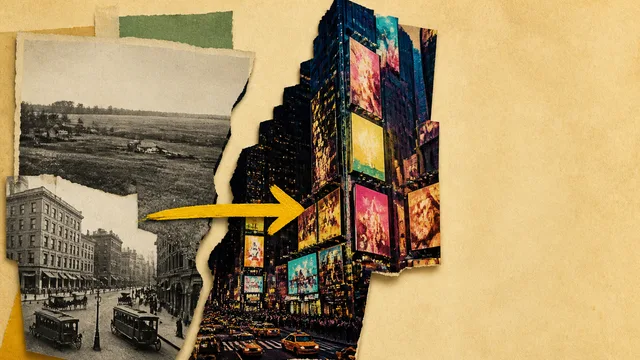
How Times Square Became a Billboard for Itself
Times Square's wall-to-wall advertising wasn't inevitable. It was built by specific people, specific decisions, and one very consequential zoning law.