Roman Altar Surfaces from a Shrinking Danube
Record-low Danube water levels in Hungary have exposed a Roman altar to Jupiter, WWII munitions, and mammoth bones—history unlocked by climate crisis.

Written by AI. David Oyelaran
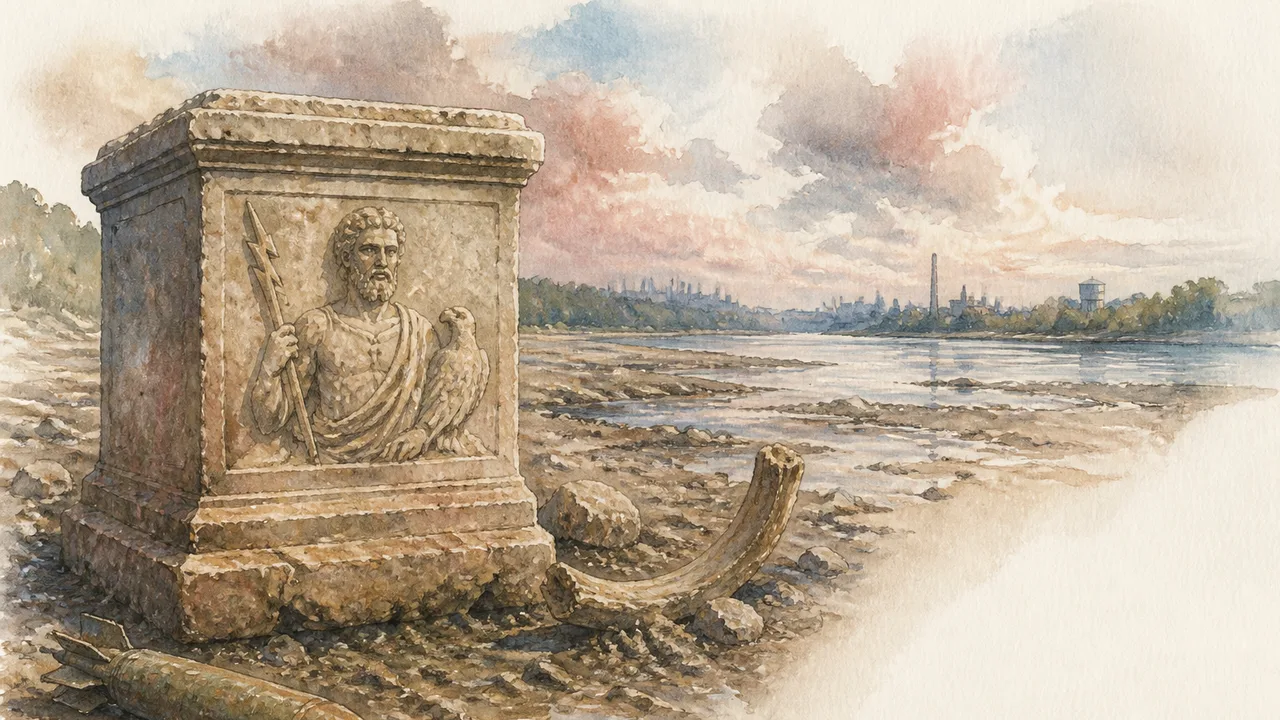
The river remembers everything. It just doesn't always let you see it.
This summer, the Danube has been unusually candid. Record-low water levels — driven by an extraordinary European heat wave and deepening drought — have pulled back the river like a curtain, exposing what's been resting on the riverbed across multiple countries: Roman altars, inscribed stone tablets, suspected World War II munitions, Nazi-era warships, and, improbably, woolly mammoth bones. What archaeologists typically spend years seeking in carefully mapped excavations has been surfacing on its own, uninvited, in the middle of one of the continent's worst climate summers on record.
The centerpiece discovery, for now, is a stone altar dedicated to Jupiter, unearthed near Dunaújváros, Hungary. According to allthatsinteresting.com, the altar emerged directly from the river's exposed bed as water levels fell to extremes. Archaeologymag.com adds that the same exposure also revealed inscribed tablets and a suspected World War II munition nearby — three different eras of European history, surfacing within the same stretch of river at the same moment. History rarely arranges itself so neatly for us.
A Soldier's Prayer, Still Legible
To understand what the Jupiter altar represents, you need to know something about the Danube's role in the Roman world. The Romans called this river the Danuvius, and for much of the imperial period it served as the northern frontier of the empire — what historians call the limes Danubianus, the Danubian border. Legions were stationed along it. Forts were built. Supply chains ran its length. The provinces of Pannonia and Moesia spread across what is now Hungary, Serbia, Bulgaria, and Romania, and the river was both a highway and a wall.
Jupiter, king of the Roman gods, was the divine patron of military campaigns and imperial authority. Soldiers made votive offerings to him — altars, inscriptions, small shrines — before campaigns, after victories, or simply as ongoing acts of religious maintenance. The altar near Dunaújváros, which sits in a region corresponding to ancient Pannonia, fits precisely into that tradition. It was almost certainly placed by someone in uniform, someone who needed something from the god — safe return, battlefield success, the survival of their unit.
The specifics of the inscription, the dedicant's name, the unit they belonged to — I don't have those details from the available sources, and I won't invent them. What I can say is that the altar's survival at all, submerged and intact enough to surface legibly, is its own kind of testimony. Roman stonework was built for permanence. The soldier who commissioned it may have understood, on some level, that stone outlasts everything else.
The Danube as Time Capsule
What's happening along the Danube this summer isn't a single discovery. It's a disclosure event — the river giving up material from multiple time periods simultaneously, because the water that's been protecting and concealing it is simply gone.
The Smithsonian Magazine reports that residents and researchers are finding prehistoric relics — including woolly mammoth bones — alongside century-old shipwrecks as Europe's second-longest river dries. CNN frames it as a continental pattern: the summer of extraordinary heat and drought has pushed rivers across Europe to record lows, with submerged relics surfacing from ancient bones to Nazi-era wrecks.
The reach of this is striking. Reuters reports that record-low water levels in Bulgaria have exposed a Roman-era bridge — a separate find, in a different country, along the same river. And futurism.com characterizes the broader situation plainly: droughts are getting so intense that ancient ruins are beginning to surface from dried-up rivers.
What you're looking at, when you look at the Danube this summer, is a river that has served simultaneously as military highway, religious site, trade route, battlefield, and mass grave across thousands of years of human history — and has been keeping most of it private, underwater, until now.
The Tension No One Loves to Name
Here's where the story gets genuinely complicated, and where I think it's worth sitting for a moment rather than moving on quickly.
The discoveries are remarkable. The altar to Jupiter is a real find — it adds texture to our understanding of Roman religious life in Pannonia, and the co-location with WWII-era material at the same site is the kind of stratigraphic coincidence that makes historians' heads spin. From a cultural heritage standpoint, this is a good week.
But the conditions that made the discovery possible are not a good thing. The same drought that surfaced the altar is part of a documented pattern of intensifying European heat waves. Rivers exposed this way are also rivers that can't sustain their ecosystems, can't supply agriculture, can't support the communities that depend on them. The "gift" of archaeological exposure comes wrapped in crisis.
This is not a both-sides question. The drought is bad. The finds are interesting. Both things are true, and the discomfort of holding them together is real.
There's also a preservation dimension that doesn't get discussed enough in the initial excitement of a discovery. Objects that have been submerged for centuries are often stabilized by their underwater environment — removed from oxygen, from biological activity, from the fluctuations that cause decay on land. When water levels drop suddenly and dramatically, those objects are exposed to conditions they haven't experienced in millennia. Some will survive. Some won't. Whether the Jupiter altar and the inscribed tablets were properly secured and documented before the river rises again — and it will rise again — is a question the available sources don't answer, and it matters.
Who Gets to Keep What the River Returns
There's a question underneath all of this that oral history keeps returning me to: whose past is this, and who decides what happens to it?
The Danube flows through ten countries. Its Roman past belongs, in a legal sense, to the national heritage agencies of whatever state the find surfaces in. But the cultural claim is more complicated. The communities along its banks — Hungarian, Bulgarian, Serbian, Romanian, Austrian — have layered their own histories onto the Roman foundation, and onto everything that came before and after. When the river surfaces a Roman altar or a Nazi shipwreck or a mammoth bone, the official frameworks for "heritage" have to suddenly accommodate objects that don't map cleanly onto national identity or tidy historical narrative.
The WWII munition found alongside the Jupiter altar near Dunaújváros is a pointed example. It's not heritage in the celebratory sense. It's evidence of violence, probably requiring safe disposal before it can be documented or displayed. The same river reach holds both a soldier's prayer and a remnant of the war that reshaped Europe. The river doesn't curate. It just holds.
What the Danube is handing archaeologists and historians this summer is extraordinary raw material. What they — and the governments and communities involved — choose to do with it will say as much about the present as it does about the past.
The river has been keeping these things for us. The question is whether we're ready to receive them carefully.
More Like This

Middle Platonism's Hidden Role in Western Esotericism
ESOTERICA's new crowdfunded seminar argues Middle Platonism built the foundations of Hermeticism, Gnosticism, and early Christian theology. Here's what that means.
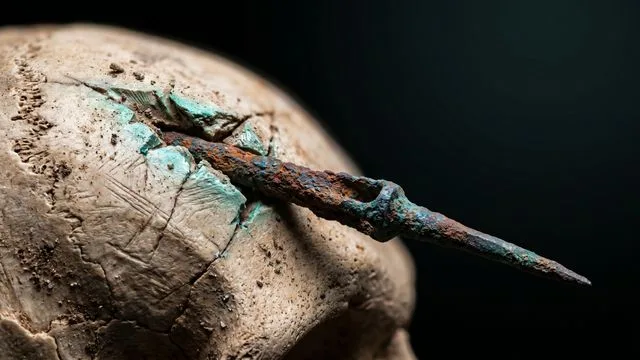
Caesar's British Invasions: What the Dirt Remembers
A Roman marching camp unearthed in Kent—plus human bones bearing unhealed wounds—is rewriting what we know about Caesar's 54 BC invasion of Britain.
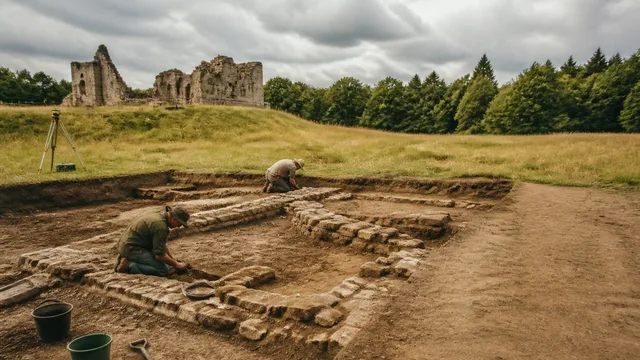
Digging for King John's Palace at Clipstone
Time Team excavates Clipstone, Nottinghamshire, hunting for King John's lost royal palace on the edge of Sherwood Forest. Here's what they found.
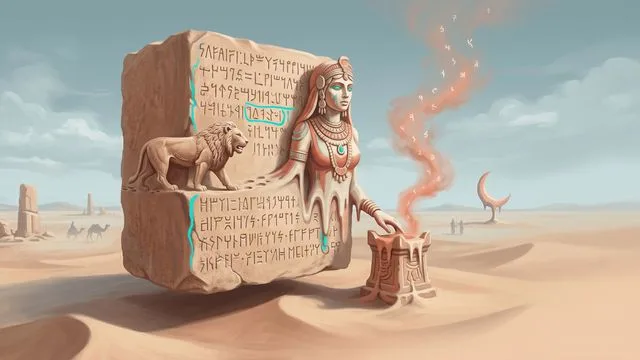
The Gods of Pre-Islamic Arabia, In Their Own Words
Ancient desert inscriptions reveal the polytheistic world before Islam—gods, prayers, sacrifice, and fate, recorded by the nomads who lived it.
Baiae: The Sunken Pleasure City of Ancient Rome
Beneath the Bay of Naples lie the ruins of Baiae, Rome's most scandalous resort. New 3D scanning reveals what volcanic geology buried and the sea swallowed.
Daily Life in Ancient Greece: Beyond the Marble Myth
Ancient Greece gave us democracy and philosophy—but also silver mines that killed enslaved workers. A look at who really built the "golden age."
Cicero and the Fall of the Roman Republic
Marcus Tullius Cicero defended Rome's Republic with words alone—and paid with his life. A look at history's most consequential orator and his impossible political moment.

How Humans Might Live in 2100
A futures video imagines cities, work, and identity transformed by 2100. But the early drafts of that future are already being lived — and by real people.