How Times Square Became a Billboard for Itself
Times Square's wall-to-wall advertising wasn't inevitable. It was built by specific people, specific decisions, and one very consequential zoning law.

Written by AI. Margaret "Maggie" Holloway
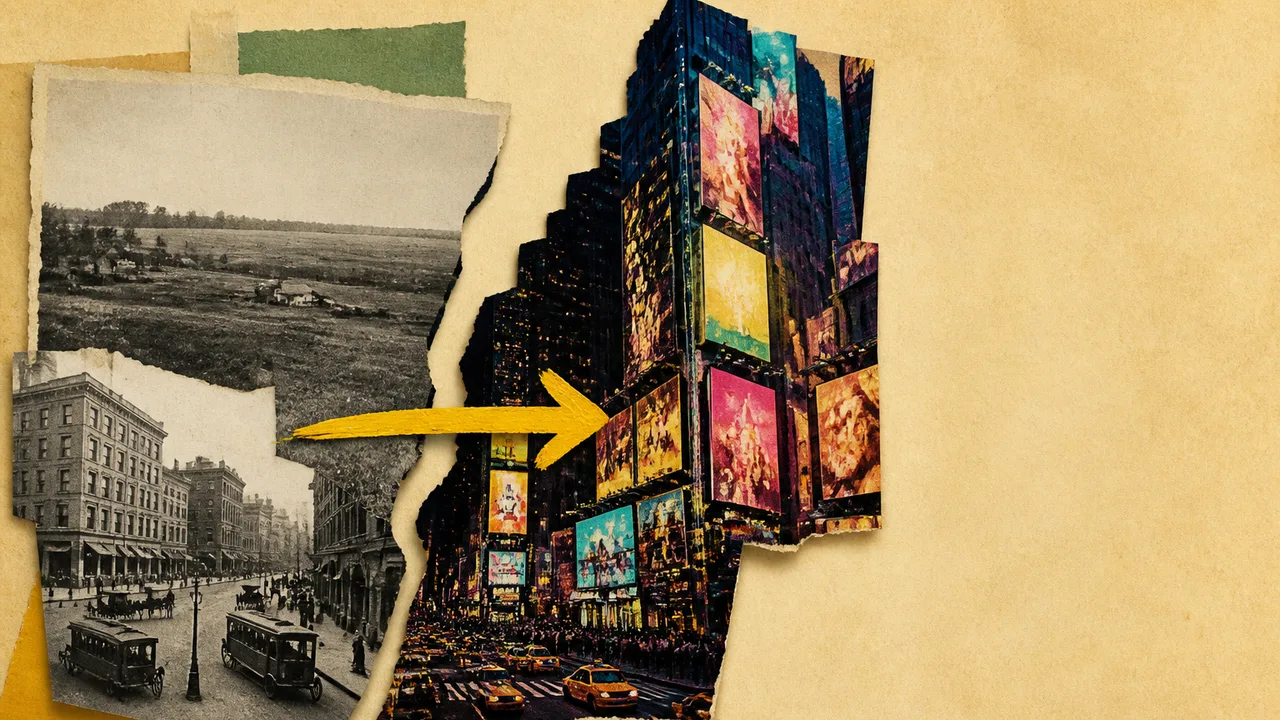
Photo: AI. Wren Sugimoto
It was once a horse market. Before it was a crossroads of the world, before it was the place where a glittering ball drops on New Year's Eve and a million people stand in the cold pretending they're having fun, the area now known as Times Square was Longacre Square — a functional, unglamorous hub of New York City's carriage trade. Stables, blacksmiths, harness shops. The kind of place where commerce was physical and the air smelled accordingly.
Understanding how you get from there to here — from hay bales to forty-story LED screens visible from New Jersey — is really a story about infrastructure, opportunism, and a series of choices that compounded on one another until the outcome felt inevitable. It wasn't.
The Geometry That Made Everything Possible
The Fourth Place video essay Why Times Square Is Covered in Ads opens with a clarification that most people probably need: Times Square is not a square. It's an hourglass. A "confluence," as the video puts it — the particular shape that results when Broadway's diagonal slash collides with Manhattan's rigid street grid, a collision baked into the Commissioner's Plan of 1811. The result is a series of long, narrow triangular traffic islands with extraordinary sightlines. Stand at one end and you can see several blocks in either direction.
Advertisers noticed this before almost anyone else did. Long before electric lights, long before the subway, the geometry of Longacre Square was already a natural billboard frame. The apex of those triangles was prime visual real estate, and the wood-and-canvas advertisements that eventually colonized the area's low rooftops — cigars, tonics, talcum powders — were simply the first people to act on what the street layout was quietly announcing.
But geometry alone doesn't explain the density of what Times Square became. For that, you need foot traffic. And for foot traffic at scale, you need the subway.
The Announcement That Changed Everything
In 1894, New York City announced the construction of what would become the Interborough Rapid Transit system. Several of its first lines were planned to converge directly beneath what was then still called Longacre Square, under 7th Avenue and 42nd Street. That convergence point is today the busiest subway station in New York City, and the announcement of its construction set off a real estate speculation wave that effectively transformed the neighborhood before a single tunnel was dug.
Adolph S. Ochs, owner of the New York Times, was among the entrepreneurs who saw what was coming. He purchased a distinctive flatiron-shaped plot at the square's southern end and built a new headquarters for his paper. By 1904, as the tunnels were being excavated below, he successfully lobbied the city's board of aldermen to rename Longacre Square after his newspaper. The building still stands at that address — or rather, the bones do. One Times Square has since been gutted, remodeled, and encased in digital screens to the point of structural anonymity.
That same building was home to one of Times Square's more utilitarian advertising experiments: a news zipper, a scrolling bulletin of text that, according to the One Times Square Wikipedia entry, debuted on its facade in 1928. In an era before television or the internet, the fastest way to learn that World War II had ended, or that a president had been shot, was often to stand on a midtown sidewalk and read a building.
Oscar Good and the Science of Not Looking Away
The man most responsible for Times Square's visual identity is someone most people have never heard of: Oscar J. Good, whose OJ Good Company pioneered what he called "spectaculars" — oversized electric billboards that used automated flashers to simulate motion. Good had identified something fundamental about human perception: static text gets ignored; movement cannot be. The eye has no choice. It looks.
Good's company produced Times Square's first electric billboard in 1904, a flashing promotion for Trimble Whiskey on the Studebaker Building at 47th Street. By 1917, the spectaculars had scaled up to the Wrigley's Chewing Gum installation atop the building between 43rd and 44th Streets — described at the time as the world's largest sign.
By the 1930s, the arms race was fully engaged. Advertisements got bigger, brighter, and more technically elaborate, eventually consuming entire building facades. The Fourth Place video frames this shift bluntly: "The sightlines of Times Square that were once dominated by transportation, history, culture, and locality were now dominated by corporatism and hyper capitalism. Instead of focusing on buildings and faces and people and traffic, these massive bright advertisements forced your eye to focus on Coca-Cola, Chevrolet."
Even wartime austerity couldn't fully suppress the impulse. When wartime dimout orders required the city to go dark during certain hours, advertisers pivoted to mechanical spectacle. The Camel Cigarette billboard on 44th Street — installed during the war years — featured a soldier figure connected to a steam injection system that exhaled real puffs into the Manhattan air. It was equal parts engineering and theater, and it became one of the most iconic images in Times Square's history.
The Decade That Almost Erased It All
By the 1960s and '70s, Times Square had bottomed out. Suburbanization, manufacturing decline, a collapse in transit ridership — the postwar urban crisis hit midtown hard. The historic theaters along Broadway and 42nd Street converted to grindhouses and adult venues. Vacancy rates soared. Landlords who couldn't cover costs from interior rents turned to the exterior: buildings became, as the Fourth Place video describes them, essentially "a metal frame, a hollow structural scaffold designed solely to hold up billboards."
The 1984 redevelopment proposal was the city's response. Philip Johnson and John Burgee were brought in to design a collection of identical granite towers that would have encased the neighborhood in what the Fourth Place video accurately calls "1980s corporate urban renewal." The plan required stripping away nearly every billboard in sight.
What happened next is the most genuinely surprising turn in Times Square's story. A coalition of preservationists, lighting designers, and architects pushed back — arguing not that the billboards were beautiful, exactly, but that they were Times Square. Remove them and you had removed the thing itself. The city, remarkably, agreed. The 1987 Special Midtown District zoning regulations didn't just permit the billboards — they protected and, for new construction, legally required them. It was a decision that ran against nearly every urban renewal instinct of the era.
Whether it was the right call is genuinely complicated. The 1990s cleanup under Mayor Giuliani restored some historic buildings and swept out the adult entertainment venues, but the new office towers built in the district — legally required to feature large LED displays — served, as the Fourth Place video notes, "one group and one group only: corporations." The zoning had preserved the visual intensity of Times Square while handing control of that intensity almost entirely to commercial interests.
The Twenty-Second Attention Span
The LED revolution that arrived in the 2000s was the logical endpoint of everything Oscar Good had started with his flashers in 1904. Constant motion, constant light, around-the-clock advertising with no static moment to rest the eye. The Fourth Place video points to a telling data point: the average length of a single ad spot in Times Square today is approximately twenty seconds. That compression is itself a measure of something — of how thoroughly our visual systems have adapted to, and been trained by, the environment Good's principles helped create.
The street-level urbanism did improve meaningfully in 2009, when car traffic was removed from Broadway through Times Square under Mayor Bloomberg. That change — pedestrian plazas replacing lanes of cars — introduced something the neighborhood hadn't had in decades: a reason to stand still that wasn't waiting for a crosswalk. The Fourth Place video credits that shift with generating broader improvements along Broadway in the years since.
But the question the video ultimately lands on is worth sitting with: what exactly is being preserved by the 1987 zoning? The Fourth Place creator puts it directly — the billboards have become "the architectural manifestation of modern capitalism," and yet the law treats them as heritage worth protecting. The preservation logic was that the lights were the identity. The uncomfortable corollary is that the identity has always been, at its core, a sales pitch.
What would it look like if Times Square's buildings were liberated from that obligation — if the visual hijacking simply stopped? The hourglass geometry that made the space legible in the first place would still be there, the sightlines still extraordinary, the subway still the busiest in the city. You'd have one of the most remarkable urban forms in the Western Hemisphere. Whether it would be better is a question the city has never seriously entertained, because the 1987 zoning answered it before anyone thought to ask.
More Like This

Unveiling Rome's Gladiator Underworld
Explore the hidden world beneath ancient Rome's arenas, unveiling gladiator training, underground tunnels, and cultural practices.
Jackie Kennedy and Lee Radziwill's Bitter Lifelong Feud
The feud between Jackie Kennedy and her sister Lee ran deeper than jealousy. A look at the betrayals—plural—that made it permanent.

Monowi, Nebraska: America's Last One-Person Town
Monowi, Nebraska has exactly one resident: 91-year-old Elsie Eiler, who is also the town's mayor, clerk, treasurer, librarian, and tavern keeper.
The Science and Stories Behind Earth's Fiercest Winds
Explore the science of deadly winds, from hurricanes to tornadoes, and the people dedicated to understanding and surviving them.

China's Greater Bay Area and the Cost of Megacity Growth
China's Greater Bay Area megacity project promises an economic future — but farmers losing ancestral land tell a story American Main Streets already know.

How Akira (1988) Rewired Global Animation and Cinema
Katsuhiro Otomo's Akira used 160,000 hand-drawn cels, 327 custom colors, and an inverted production process to permanently change how animated films get made.
How the Pantheon's Roman Concrete Outlasted an Empire
Nearly 2,000 years old and still standing, the Pantheon's volcanic concrete, structural ingenuity, and lucky conversion to a church explain its impossible survival.
What Ancient Engineering Actually Tells Us
From Sacsayhuamán to Roman harbors, ancient construction raises real questions about lost knowledge—and what we assume about pre-industrial capability.