Egypt's Lost City of Masn: Clues Found at Tell Abu Saifi
Archaeologists at Tell Abu Saifi in Qantara East may have found the lost Egyptian city of Masn, guided by a 3,000-year-old sandstone inscription along the ancient Horus Road.

Written by AI. David Oyelaran
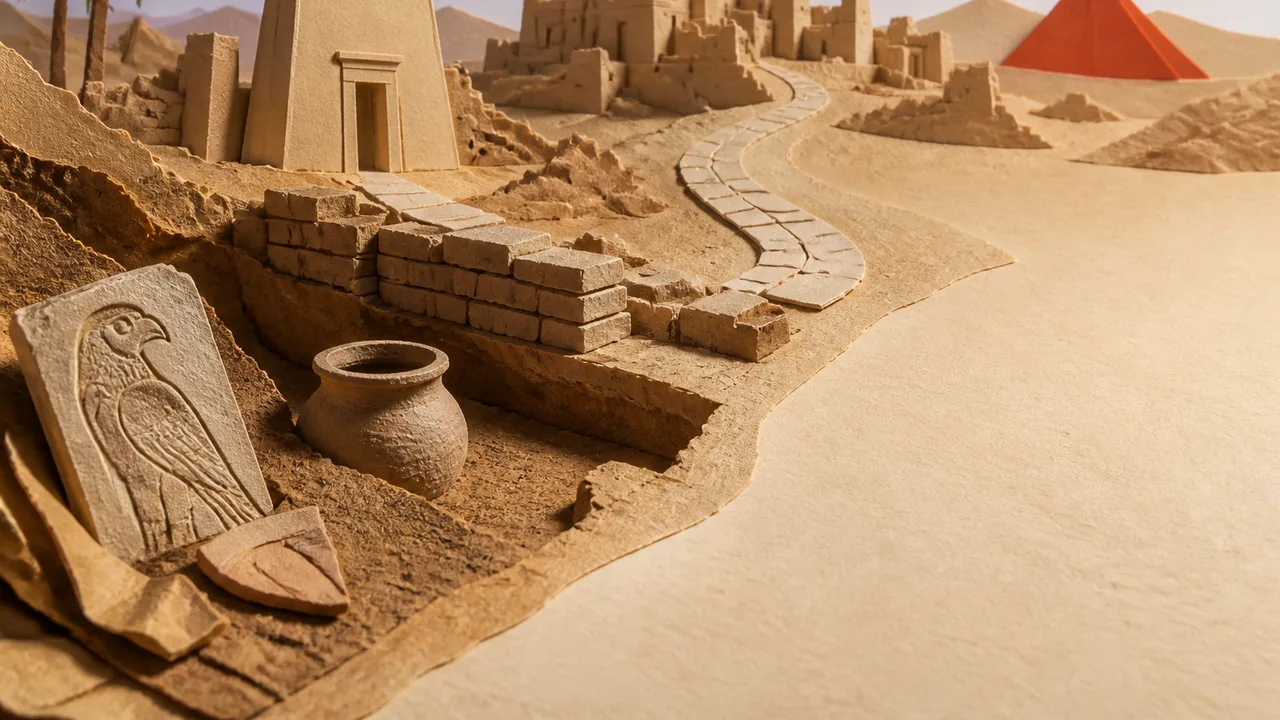
There is a particular kind of patience that archaeology demands—not the patience of waiting, but the patience of listening. Of sitting with a place long enough that it begins to talk back. The team working at Tell Abu Saifi, in the Ismailia Governorate of northeastern Egypt, has been practicing that patience for several seasons now. And this summer, the site appears to have said something worth hearing.
Researchers excavating Tell Abu Saifi in Qantara East have uncovered what may be the strongest evidence yet for the location of Masn—an ancient Egyptian city referenced in texts dating more than 3,000 years back, but never definitively placed on a map. The centerpiece of this season's finds is a sandstone lintel inscription that names the site, according to The National. An inscription that actually names a place is not nothing. In a landscape full of ruins that can be argued in multiple directions, a proper noun carved in stone tends to settle debates—or at least sharpen them considerably.
What the Ground Gave Up
Tell Abu Saifi is a tell—an archaeological mound formed by successive layers of human habitation, each generation building on the rubble of the last. These sites carry time inside them in a way that feels almost geological. What this season's excavations produced, beyond the lintel, includes evidence of ancient roads and fortifications that Ancient Origins reports are reshaping interpretation of the entire site. Not just what it was, but what it meant within the broader geography of pharaonic power.
The significance of that geography is hard to overstate. Tell Abu Saifi sits along the route of the Way of Horus—the ancient military road that once connected the Nile Delta to the eastern Mediterranean Levant. The road's ancient Egyptian name was wꜣwt Ḥr, "Ways of Horus," per Wikipedia's entry on the Way of Horus. It was the road pharaohs used to project force eastward, and the road armies used to come home—or not. Tjaru, a well-documented fortress-city, sat at the road's eastern gateway; it is a place on the route, not an alternate name for it. The distinction matters because Tell Abu Saifi's position along this corridor is precisely what makes its identification as Masn archaeologically coherent.
La Brújula Verde notes that the current excavation season has also produced evidence that may clarify the original route of the Way of Horus itself—not just a node on it, but the path between nodes. That is the kind of finding that ripples outward. Establish a city's location and you've fixed a dot. Establish the road connecting the dots and you've recovered an entire system.
The Architecture of Control
What draws me to this story isn't just the drama of a lost city found—though there is genuine drama in a name carved into stone surviving three millennia to confirm itself. It's what a military road actually represents in terms of how an ancient state organized itself.
The Way of Horus was not merely a route for armies. Pharaonic Egypt used a chain of fortresses and waystations along the road, each with its own water supply, each positioned at intervals that reflected the logistical realities of moving troops through arid terrain. Previous excavation seasons at Tell Abu Saifi had already turned up Pharaonic water wells, according to the Times of India—the kind of infrastructure that doesn't get built for casual travelers. Wells along a military road are a statement of intent: we are not passing through, we are holding this.
Masn, if the identification holds, would join a known sequence of such stations. Ahram Online places the latest finds in the context of "previous excavation seasons," emphasizing that this is cumulative work—each season's evidence building on the last. That cumulative quality is what distinguishes a hypothesis that's gaining weight from one that's merely being repeated. And Daily News Egypt reported the discovery in August, noting it strengthens the hypothesis that Tell Abu Saifi is linked to the lost city.
The New Kingdom context matters here. This was the period of Egypt's greatest imperial reach—the era of Ramesses II, of Thutmose III's campaigns, of an Egyptian state that was conducting foreign policy as far north as Syria. Controlling the road east wasn't optional; it was existential. A city like Masn wouldn't have been a sleepy waystation. It would have been a nerve ending in a very active nervous system.
What "Found" Actually Means
There's a temptation, in reporting this kind of story, to collapse the conditional. "Archaeologists may have found" becomes "Archaeologists found" in the headline, and then the uncertainty gets scrubbed from the public understanding of the work. It's worth resisting that.
The honest version, as Ancient Pages and others are careful to frame it, is that the evidence strengthens the hypothesis. The sandstone lintel inscription names the site. The fortifications are consistent with a militarily significant settlement. The road alignment matches what we know of the Way of Horus. These are convergent lines of evidence, and convergent lines of evidence in archaeology are genuinely exciting—but convergence is not confirmation. Scholars will want peer review, comparative analysis with other known sites along the route, and probably several more seasons of excavation before anyone stamps a definitive answer on this.
That's not hedging. That's how the field actually works, and it's worth honoring. The people doing this excavation are not in a rush to plant a flag; they're in the business of building a case.
Sinai as Historical Subject
One thing this story keeps nudging me toward is how little attention the Sinai Peninsula receives as a subject of Egyptian history in its own right—as opposed to a corridor between more celebrated places. The peninsula has long been treated as a passthrough: the path to Canaan, the path to the Levant, the path to exile, the path home. But the archaeological record at Tell Abu Saifi suggests something denser than a passthrough. Fortifications. Wells. A named city substantial enough to be inscribed in its own right, mentioned in New Kingdom texts.
If Masn is confirmed, it joins a picture of Sinai as a place where Egypt didn't just travel—a place where Egypt stayed, organized, administered, and presumably lived. That's a different story than the corridor narrative allows. And it's the kind of story that tends to get lost precisely because it doesn't fit the dramatic arc we expect. The road to somewhere interesting is rarely credited with being interesting itself.
The sandstone that named Masn sat in the ground for three thousand years. The question now is what else it was trying to say.
More Like This

Middle Platonism's Hidden Role in Western Esotericism
ESOTERICA's new crowdfunded seminar argues Middle Platonism built the foundations of Hermeticism, Gnosticism, and early Christian theology. Here's what that means.
The Gods of Pre-Islamic Arabia, In Their Own Words
Ancient desert inscriptions reveal the polytheistic world before Islam—gods, prayers, sacrifice, and fate, recorded by the nomads who lived it.
A 1.27-Billion-Year-Old Mars Meteorite Changes Everything
A dark green Martian rock found in Algeria in 2019 just filled a 1.8-billion-year blank in Mars's geological record — and it came from a region no one knew existed.

Mexico's Radioactive Milk Scandal After Chernobyl
After Chernobyl, Mexico distributed Cesium-contaminated powdered milk to its poorest communities. The families who consumed it left almost no testimony behind.
Myth, Obsession, and the Men Who Dug for Troy
Arthur Evans and Heinrich Schliemann both found ancient civilizations while chasing myths. What does that tell us about archaeology—and obsession?
Colossal Marble Statue Unearthed at Ancient Sardis
A 2.2-meter marble statue found at Sardis, Turkey, raises sharp questions about art, power, and identity in Persian-occupied Lydia circa 500 BC.
Cicero and the Fall of the Roman Republic
Marcus Tullius Cicero defended Rome's Republic with words alone—and paid with his life. A look at history's most consequential orator and his impossible political moment.

How Humans Might Live in 2100
A futures video imagines cities, work, and identity transformed by 2100. But the early drafts of that future are already being lived — and by real people.