France Sold Its Nuclear Turbine Crown Jewel to GE
How France sold the world's most powerful nuclear steam turbine to GE in 2015, then spent years engineering a buyback — and what it cost everyone involved.

Written by AI. Jonathan Park
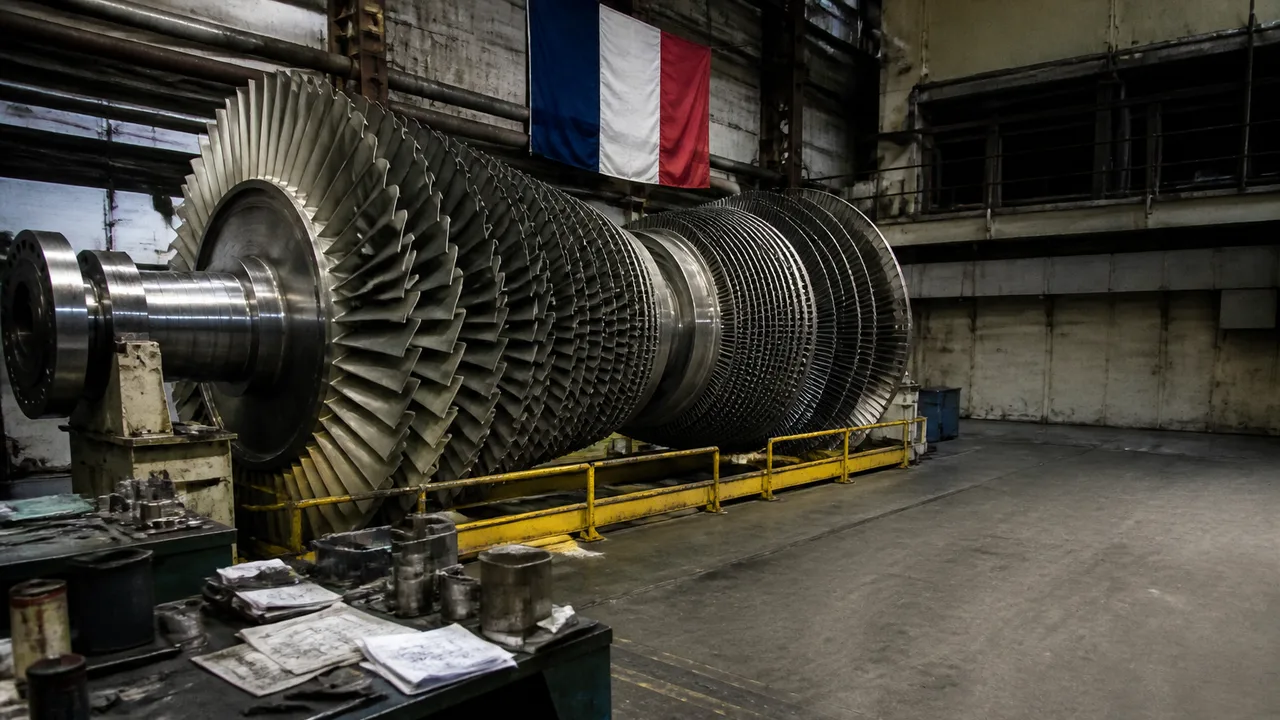
Photo: AI. Marcel Dubois
The Arabelle turbine is not something most people have heard of. It weighs 3,700 tons, stretches 50 meters, and sits inside a handful of the world's largest nuclear power plants. Its rotor — 14 meters long, 140 tons — is machined to tolerances of one-hundredth of a millimeter. When France's nuclear fleet runs, the Arabelle is a big reason why.
In 2015, that turbine — along with the rest of Alstom's energy division — passed into the hands of General Electric. The French government, which had ample tools to block the deal, ultimately let it happen. Then spent the better part of a decade trying to undo it. The story of how that sequence occurred, told in sharp detail by the Asianometry YouTube channel, is less a cautionary tale about globalization than it is a study in the gap between what governments say matters and what they're willing to pay to protect it.
The Thing Itself
Before getting to the politics, it's worth understanding why the Arabelle exists in its particular form — because the engineering constraints explain almost everything about its strategic value.
Nuclear steam is fundamentally different from the steam produced by fossil-fuel plants. Thermal plants can superheat their steam to temperatures upward of 540 degrees Celsius, burning off moisture and giving turbine blades cleaner, drier flow to work with. Nuclear reactors can't do that — the temperatures required would damage the metal cladding around the fuel. So nuclear turbines operate with wetter, cooler steam, which means by the time that steam reaches the low-pressure stages of the turbine, it has expanded enormously in volume and carries water droplets that, over time, erode the blades.
The engineering response to that problem is to make the blades longer — large enough to extract maximum energy from the wet, expanded steam. The Arabelle's low-pressure last-stage blades, according to Asianometry, reach 1.9 meters in length. That scale, and the specialized manufacturing knowledge required to produce and maintain it, is exactly what makes the turbine hard to replicate and hard to replace. Alstom held roughly 30 to 40 percent global market share in nuclear steam turbines, with 136 units in operation worldwide at the time of the sale.
How a Champion Became a Liability
Alstom's path to distress is a recognizable corporate story, told fast: a company with genuine technical excellence that kept making strategically defensible decisions that collectively destroyed it.
The 2000 acquisition of ABB's turbine division — roughly €2.7 billion — was supposed to give Alstom the scale to compete with GE and Siemens in gas turbines. Instead, it delivered a portfolio of defective heavy gas turbines, a wave of litigation, and a debt load that coincided with the collapse of the gas turbine boom. Germany's announced nuclear phase-out in 2000 and the 2011 Fukushima disaster further gutted the nuclear turbine market. By 2014, the company had been rescued once by the French state, had changed major shareholders, and was still hemorrhaging competitiveness. CEO Patrick Kron put the gas turbine gap in plain terms: "When the American company sells 150 gas turbines in a year, Alstom sells only about 10."
That's not a gap you close with incremental investment. It's a structural problem. And Kron, knowing the market was near a cyclical peak, moved to sell.
The Sale That Wasn't Supposed to Happen This Way
GE's formal offer for Alstom's energy assets landed in April 2014, and the political reaction in France was immediate and intense. Economic minister Arnaud Montebourg, a vocal economic nationalist who had been kept in the dark during negotiations, pushed hard for an alternative. He passed what became known as the Alstom decree, expanding the French government's foreign investment veto into sectors including energy and transport. A competing bid from Siemens and Mitsubishi emerged, though it was structurally messier, offered less cash, and came without GE's job retention pledges.
Here's where the story gets genuinely murky. Overlapping with all of this was a Department of Justice investigation into Alstom for alleged violations of the U.S. Foreign Corrupt Practices Act. Several senior Alstom executives had been arrested and charged in the United States. In late 2014, Alstom pled guilty and paid a fine of $772 million. The investigation was active while the GE deal was being negotiated.
Critics drew a direct line: a French company, under legal pressure from U.S. authorities, selling its crown jewels to an American buyer. Frédéric Pierucci, one of the Alstom executives arrested, later wrote a book titled American Trap making precisely that argument — that the prosecution was a tool of economic warfare. The book found a large readership in China, particularly after U.S. actions against Huawei raised similar questions about the use of American legal reach as competitive leverage.
The DOJ denied it. Alstom CEO Kron denied it. But even the man who ultimately approved the deal wasn't fully convinced. Emmanuel Macron — who replaced Montebourg as economic minister in late 2014 after Montebourg was pushed out for publicly criticizing government policy — told French parliament in March 2015: "Personally, I was indeed convinced myself of the causal link between this investigation and Mr. Kron's decision, but we have no proof."
That's an unusual thing for a minister to say about a deal he just approved. It also doesn't constitute evidence. What it does is mark the exact boundary between what was politically knowable and what was legally provable. Macron approved the revised transaction — an 80/20 joint venture with a golden share retained by the French government — on the grounds that there was no legal basis to block it outright. "We have no legitimate grounds to intervene. We do not have a command economy. We're not in Venezuela," he said during internal deliberations, according to Asianometry's account.
GE paid approximately €9.7 billion for the Alstom energy assets. The deal closed in 2015.
GE's Expensive Miscalculation
Jeffrey Immelt, GE's CEO at the time, described his rationale in his 2021 memoir: acquiring Alstom eliminated a competitor, added a profitable service business, and came during a period of strong performance at GE Power. The logic was sound at the peak of a cycle, which is precisely when logic tends to look most convincing.
What followed was a cascade. The Paris Agreement in 2015 accelerated the energy transition away from fossil fuels. New gas turbine orders fell sharply. GE's internal forecasts, per Asianometry, dramatically overstated the market even as the downturn was already underway — projecting new plant orders roughly double what actually materialized. GE failed to cut costs fast enough and failed to integrate the Alstom assets effectively.
By October 2018, GE announced a $23 billion goodwill write-down on the Alstom acquisition — a formal acknowledgment that it had badly overpaid. The company shed tens of thousands of jobs from the power division. GE's market capitalization, which had been around $300 billion at the time of the deal's close, collapsed.
That implosion is what opened the door for France.
The Buyback
A distressed seller and a motivated buyer eventually find each other. GE, in the midst of a years-long restructuring, was in no position to argue hard for a turbine business that was generating problems rather than profits. The French state wanted the Arabelle back — partly for the coming nuclear build-out, partly because the strategic argument that had been overridden in 2014 now looked a lot more compelling.
EDF, the French power utility that would need to own the business, was not enthusiastic at first. As a utility, not a manufacturer, EDF's CEO Jean-Bernard Lévy reportedly told associates as late as 2020 that he could source turbines from China. The government's response was essentially: fine, but here's the deal — take on the Arabelle business, and we'll green-light a major nuclear expansion program worth billions in new turbine orders.
In February 2022, Macron announced the buyback at the Arabelle factory in Belfort, alongside a broader nuclear renaissance program. The symmetry was not lost on anyone: the same man who approved the sale in 2014 was now announcing the repurchase. GE received €175 million for the business, while retaining certain intellectual property assets. The final price, compared to what GE paid for the entire Alstom energy portfolio, tells you most of what you need to know about what eight years inside GE had done to the division's value.
A National Asset, Carrying Scars
The Arabelle turbine is back in French hands. Whether that's enough is the genuinely open question.
Asianometry notes that EDF had already flagged quality defects in parts and drops in performance metrics during GE's ownership. Years of ownership uncertainty — combined with a broader structural transition that depressed investment across the industry — left the division underweight on R&D, supply chain stability, and talent retention. GE Vernova, the energy entity that emerged from GE's breakup, is now riding a gas turbine boom driven partly by AI data center demand. Alstom, refocused on trains, is growing. The Arabelle's story is less settled.
France has announced an ambitious nuclear expansion. The Arabelle turbine is central to executing it. But national strategic asset is a phrase governments use to describe things they've decided matter — not a description of current operational health. Reclaiming the asset was the easier part. Rebuilding what years of instability eroded is the work that's actually in front of them.
More Like This
USMCA Won't Be Renewed: What Annual Reviews Mean
The Trump administration has blocked USMCA's 16-year renewal, opting for annual reviews. Here's what that means for trade, business, and North America.
Bill Ackman's Art of Finding Invisible Money
Explore Bill Ackman's strategy of finding hidden value in companies, beyond standard metrics.
Seine-Nord Europe Canal: Building Through the Somme
France's €7.3bn Seine-Nord Europe Canal will link its waterways to Rotterdam and Antwerp—but it's being dug through ground that never finished burying its dead.
Applied Computing Bets $20M on AI for Oil and Gas
Applied Computing raised $20M to build a foundation AI model for oil, gas, and petrochemical plants. Here's why that's more complicated than it sounds.
The Electrical Grid Is Being Rebuilt for AI—Now What?
AI and EVs are forcing a complete grid overhaul. What that means for small businesses waiting on power that never seems to arrive fast enough.

How APL Turned an NBA Ban Into a Brand Identity
APL's NJ Falk breaks down the six storytelling threads behind one of e-commerce's most unlikely brand-building moves—starting with an NBA ban.
AI Company Logos All Look Alike. Here's What That Reveals
AI companies keep designing the same circular, gradient logo. Is it groupthink, strategic mimicry, or something more revealing about the industry itself?

World Cup Streaming Scams Fuel a $220M Black Market
Cybercriminals are exploiting World Cup fever with stolen streaming accounts and fake FIFA sites. Here's what the $220M underground economy actually looks like.