Fusion Energy Is No Longer Just a Physics Problem
Fusion reactors have cleared their core scientific hurdle. What remains are hard engineering challenges—and a tight race against the clock and other clean energy sources.

Written by AI. Olivia Meng
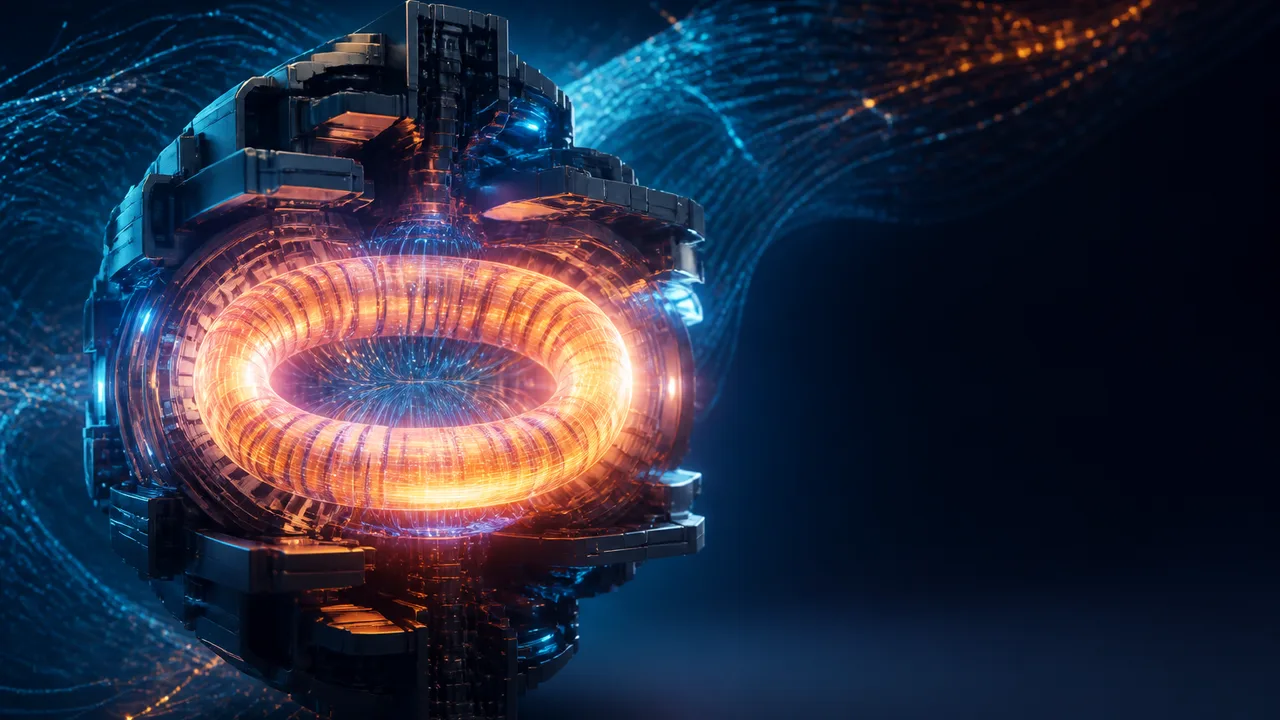
Photo: AI. Dante Nwosu
The joke has been running for so long it stopped being funny. Ask any physicist when fusion power will arrive, and the answer has been the same since the 1950s: thirty years. The punchline, of course, is that it was always thirty years—a horizon that moved as you walked toward it.
Something has changed. Not the horizon, but the ground underfoot.
In a converted industrial park in Devens, Massachusetts, Commonwealth Fusion Systems is assembling a reactor called SPARC. The first half of its vacuum vessel—48 tons of metal, machined to tolerances measured in fractions of a millimeter—was delivered in July 2025. By January 2026, the first of 18 toroidal field magnets had been installed. First plasma is targeted for 2027. These are not aspirational milestones on a whiteboard. They are construction schedules on a machine that physically exists.
The question worth sitting with is not whether fusion works. According to a recent Interesting Engineering breakdown of the technology, it does—or rather, the physics unambiguously permits it. "It is no longer whether the physics permits net energy gain from magnetic confinement," the video states plainly. "It does." The question that now consumes researchers, investors, and engineers is a harder and more practical one: can fusion be built fast enough, cheaply enough, and reliably enough to compete with the renewable energy systems that are already being deployed at scale?
How the Physics Works—and Where It Always Broke Down
The underlying mechanism of fusion is not complicated to describe. Hydrogen isotopes, heated to temperatures exceeding 150 million degrees Celsius—roughly ten times hotter than the core of the sun—move fast enough that their electromagnetic repulsion is overcome. They fuse, releasing energy. The primary byproduct is helium. There is no long-lived radioactive waste. If containment fails, the reaction simply stops; there is no meltdown scenario. On paper, it is the cleanest, densest energy source imaginable: a single gram of fusion fuel contains the energy equivalent of approximately eight tons of crude oil.
The engineering trap is that the sun achieves fusion through gravitational confinement—250 billion atmospheres of pressure at its core—a condition we cannot replicate. The prevailing alternative is magnetic confinement, using a device called a tokamak to suspend a ring of superheated plasma away from the reactor walls using powerful magnetic fields. The plasma must be held stable long enough for meaningful numbers of fusion reactions to occur. This is where, historically, every effort has come apart.
The best result on record belongs to the Joint European Torus, which achieved 16 megawatts of fusion power in 1997 at a Q ratio of 0.67—meaning the reactor produced two-thirds of the energy it consumed to heat the plasma. Close. Not close enough.
The international community's answer was ITER, a massive tokamak under construction in the south of France, originally budgeted at 5 billion euros. The current cost estimate exceeds 20 billion, and first plasma has slipped to the early 2030s. The video is direct about what went wrong: "ITER's difficulties are not a failure of physics. They are a consequence of scale." Its conventional superconducting magnets require the machine to be enormous—the tokamak alone weighs 23,000 tons—and at that scale, every engineering problem compounds.
Three Things That Actually Changed
The CFS approach, spun out of MIT's Plasma Science and Fusion Center, rests on a different bet: make the magnet stronger, and you can make the reactor smaller.
In September 2021, CFS tested a magnet using REBCO—rare earth barium copper oxide—achieving a field strength of 20 Tesla, independently validated by the US Department of Energy. The physics here is nonlinear in CFS's favor: plasma confinement improves with the fourth power of magnetic field strength. Double the field, and confinement pressure increases by a factor of 16. A magnet that is incrementally stronger enables a reactor that is dramatically smaller. The REBCO material also operates at 20 Kelvin rather than the 4 Kelvin required by ITER's niobium-tin magnets, which simplifies the cryogenic systems substantially.
The second development is plasma control. Fusion plasma at operating temperatures is violently unstable—subject to edge-localized modes, kink instabilities, and disruptions that can dump the entire energy content of the plasma into the reactor walls in milliseconds. In 2022, DeepMind demonstrated that reinforcement learning systems could control plasma shape in a Swiss tokamak in real time, adjusting 19 magnetic coils simultaneously to maintain configurations that would be impossible to program manually. CFS has since partnered with Nvidia and Siemens to build an AI-driven digital twin of SPARC—a complete computational simulation of the reactor's plasma behavior, thermodynamics, and magnetic topology that can be used to test scenarios before the machine is switched on.
The third shift is financial, and it may be the most structurally significant. Since 2020, private investment in fusion has exceeded $6 billion globally. CFS alone has raised nearly $3 billion, with investors including Google, Tiger Global, and Temasek. More telling than any individual investment is a contract: Italian energy company Eni has signed a power purchase agreement with CFS for electricity from its planned commercial reactor. A power purchase agreement is not a bet on a technology—it is a commitment to buy a product contingent on its existence. It means a major energy company ran its own due diligence and decided the engineering risk was acceptable.
SPARC, ARC, and the Mainframe Analogy
SPARC itself will not generate electricity. It is a demonstration reactor, targeting a Q value greater than 2—producing at least twice the energy consumed by the plasma heating system. If it hits that target, it will be the first magnetically confined fusion plasma to achieve net energy gain. The commercial machine, called ARC (affordable, robust, compact), is planned for a site near Richmond, Virginia, targeting 400 megawatts of electrical output—enough to supply approximately 300,000 homes—with grid delivery potentially in the early 2030s.
The Interesting Engineering video draws an analogy worth examining: the SPARC-to-mainframe comparison. ITER is the mainframe—one enormous, expensive machine designed to achieve maximum performance. SPARC is the bet that smaller, faster iteration beats single-device optimization. "Not a better machine, but a faster development cycle." The analogy is useful but imperfect: mainframes didn't need to solve tritium breeding or survive years of 14 MeV neutron bombardment before anyone would buy one.
Those unsolved problems deserve more than a footnote.
What the Optimism Doesn't Resolve
Tritium—the hydrogen isotope that, combined with deuterium, fuels the most viable fusion reactions—is vanishingly rare. The global inventory is measured in kilograms, most of it produced as a byproduct of heavy water fission reactors in Canada. A commercial fusion plant would need to breed its own tritium using lithium blankets surrounding the plasma. This has never been demonstrated at scale.
The first wall of a fusion reactor—the surface directly facing the plasma—will face neutron fluxes that no existing material has been tested against for the duration a commercial plant would require. Current candidates include RAFM steels and tungsten alloys, but long-term data on neutron damage at fusion-relevant energies is limited. And regulatory frameworks for fusion power remain incomplete; fusion doesn't map neatly onto existing nuclear licensing structures, and while several countries are developing fusion-specific pathways, none have been finalized.
These are not objections designed to restore the thirty-year horizon. The video frames them correctly: "None of these are trivial, but none of them are fundamental physics problems, either. They are material science and mechanical engineering challenges with identifiable solution pathways." That framing is honest. It is also worth holding alongside the fact that "identifiable solution pathways" and "solved" are not the same thing.
A Field, Not Just a Company
CFS is the most advanced and most capitalized player, but it is not the whole story. TAE Technologies in California is pursuing a field-reversed configuration that avoids tokamak geometry entirely. Helion Energy employs pulsed magnetic compression. Tokamak Energy in the UK is developing a more compact spherical variant. There are now more than 40 private fusion companies worldwide pursuing at least six distinct confinement approaches. That diversity matters: it means the field is not betting everything on one path, and a single engineering dead end cannot stall the whole enterprise.
It also means that the question of which approach wins—if any wins on a timeline that matters for the energy transition—remains genuinely open. The clean energy landscape of the early 2030s will look nothing like today's. Solar, wind, and battery storage are on steep learning curves with compounding cost advantages. Fusion arriving in that environment won't be evaluated in isolation; it will compete.
For seventy years, fusion's central problem was scientific. That problem, by any honest reading of the current evidence, is solved. What the next decade will reveal is whether the engineering can be executed at the pace and price the energy transition actually requires—and whether fusion, when it finally arrives, finds a grid that still has room for it.
More Like This

Rethinking Cosmic Acceleration: A Local Illusion?
Exploring the debate on whether the universe's acceleration is a local phenomenon, challenging the concept of dark energy.

How the Asteroid Impact Ended the Dinosaur Era
Explore the catastrophic asteroid impact that ended the dinosaurs, its immediate aftermath, and the long-term environmental changes.
Subcritical Reactors: Nuclear Power's Safety Fix?
A new generation of subcritical reactors promises to make nuclear meltdowns physically impossible. But can they deliver on cost, scale, and timeline?
Nuclear's New Fuel Has 11,000 Empty Holes
Inside the nuclear fuel supply chain scramble — from Piketon, Ohio to Saskatchewan — and why the six-to-seven-year timeline deserves your skepticism.
Magnetic Mayhem: 400 Car Batteries Unleashed
Explore the electrifying effects of extreme currents as a nuclear engineer reacts to a wild experiment with 400 car batteries.

Understanding the Real Risk of Brain-Eating Amoebas
Explore the facts and myths surrounding brain-eating amoebas. How real is the threat, and can climate change affect its spread?

Where Sunburn Catches You Off Guard
Shade, cold weather, and clear water offer less UV protection than most people assume. Here's what the science actually says about when sunburn risk is highest.

Event Horizons Form Before Black Holes Do
A new PBS Space Time episode reframes event horizons as causal verdicts written by the future — not boundaries drawn by the present. The implications run deep.