Kickstarter CEO Everett Taylor on Funding Without VC
Kickstarter CEO Everett Taylor breaks down pre-orders, pitching, and why venture capital might be the worst deal you ever make for your business.

Written by AI. Jonathan Park
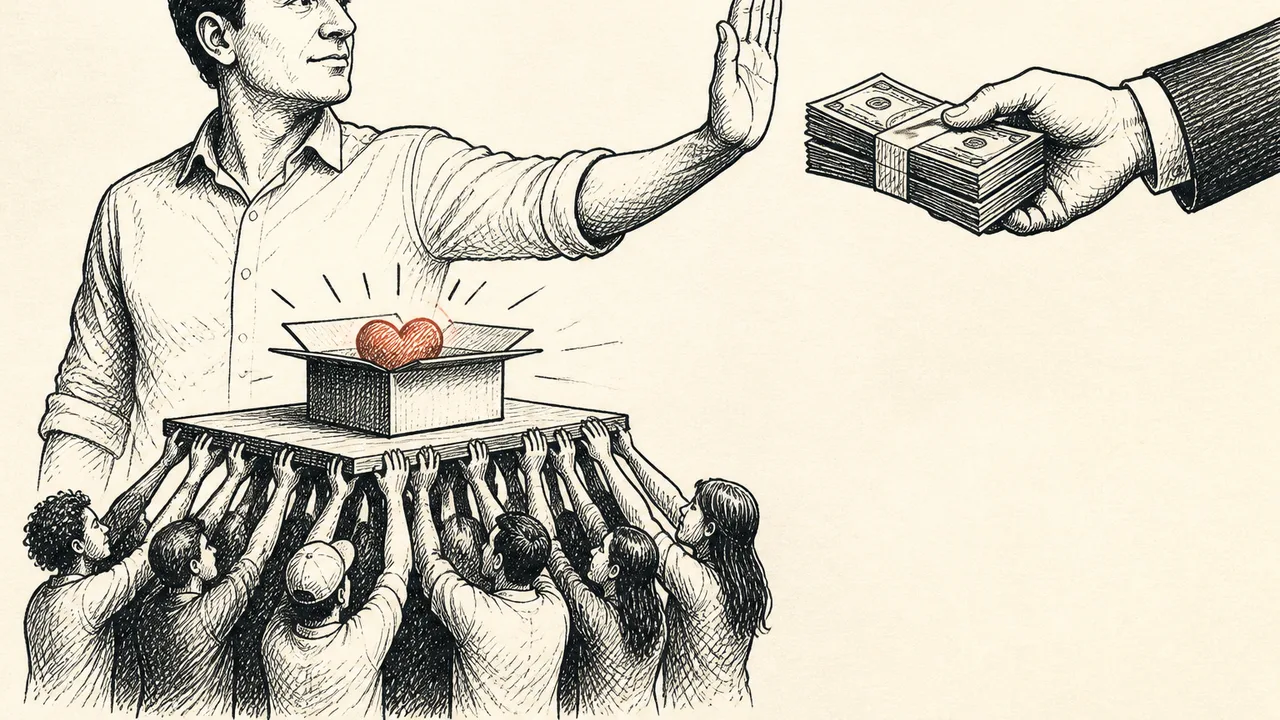
Photo: AI. Eira Pendragon
There's a story Everett Taylor tells about a friend—a founder who, at Series A, got a $250 million offer for his company. Would've walked away with something north of $100 million personally. Life-changing money. His investors said no. They needed a bigger exit. The company never got there. The founder ended up with a fraction of what he could have had.
Taylor, the CEO of Kickstarter, tells that story not to indict venture capital as an institution, but to illuminate something most first-time founders don't fully grasp until it's too late: when you take VC money, you're not just taking money. You're importing someone else's definition of success—and that definition probably doesn't look like yours.
It's a useful frame for understanding what Taylor has been building at Kickstarter, a platform that has facilitated over $8 billion in funding since its founding and that Taylor is deliberately repositioning away from its "begging for money" reputation toward something he thinks is more accurate: a pre-order engine that lets founders test demand, keep their equity, and build businesses on their own terms.
Sell Yourself First. Everything Else Is Secondary.
Before Taylor gets into the mechanics of campaigns and cost structures, he makes a point that's almost annoyingly simple but apparently not simple enough, because most people skip it: you have to be able to sell yourself before you can sell anything else.
"Founders, you may not be a marketer, but you better be a marketer for yourself," Taylor told Codie Sanchez on her BigDeal podcast. "You should be your own CMO."
What he's describing isn't bravado for its own sake. It's functional. Confidence in a pitch—real or performed convincingly—signals to potential backers that you believe the thing is going to happen, which is the first domino that has to fall before anyone else believes it. Taylor is explicit that imposter syndrome doesn't stay in your head; it leaks into everything. Your Kickstarter video. Your investor conversations. Your team.
The counterweight to confidence isn't self-awareness, he argues—it's emotional regulation. Knowing when you're scared or uncertain and being able to show up anyway. That's a different skill than just believing in yourself, and it's one that's largely absent from the way entrepreneurship gets discussed in public. We lionize the "delusional founder" archetype without acknowledging that the most functional version of that isn't delusion—it's the ability to feel doubt and not let it run the meeting.
The Pre-Order Pyramid and Why Video Is Non-Negotiable
Taylor's framework for a successful Kickstarter campaign—what Sanchez dubs the "pre-order pyramid"—is built on five elements: exclusivity, urgency, value, timeliness, and trust. The order matters less than the presence of all five. A campaign with a great discount offer but no trust signal is a campaign people browse and abandon. A campaign with clear authority behind it but no urgency is one people bookmark and forget.
Trust, Taylor emphasizes, is the most underrated of the five. Kickstarter's own data reinforces this: over 90% of campaigns that hit their funding goal do fulfill—but that non-trivial failure rate is exactly why backers are skeptical, and why campaigns that can't demonstrate execution credibility struggle.
The primary vehicle for building that trust quickly? Video. Not a long-form explainer. Not a dense product page. A video, ideally hitting within the first 30 seconds, that makes you feel like the person behind the campaign is real, competent, and going to actually ship the thing.
"Most of the time when I see a Kickstarter fail, they didn't even care to do a video," Taylor said. "Like video is the way."
This is probably the most actionable thing he says in the whole conversation, and also the easiest to verify. The campaigns that move money quickly are almost always the ones where you can watch someone explain why they built the thing, what problem it solves, and—crucially—why they're the person to solve it. Text doesn't do that. A face does.
Kickstarter is apparently leaning harder into this: Taylor mentioned the platform is moving toward a more mobile-first, video-first interface in 2025, acknowledging what creators who've been on the platform already know empirically.
The Cost Problem Nobody Talks About
Here's where Taylor's advice gets genuinely useful in a way that saves people money: the math on pre-orders fails more often than it should because founders miscalculate their costs before they set their prices.
The ring example he and Sanchez riff on is instructive. You price your ring at $50 as an early backer special. You haven't fully accounted for packaging, shipping, platform fees, and tariffs. Your actual cost of fulfillment is $60. Congratulations, you've just built a business model that loses money every time it works.
Taylor's rule of thumb: build a 25–30% buffer above your estimated costs for anything with complex physical supply chains—hardware, goods manufactured overseas, anything subject to shipping volatility. For lighter, more predictable products like comic books or graphic novels, 10–15% might be adequate. The logic is straightforward: tariffs can change, shipping rates spike, manufacturers have minimums that don't match your projections. You can't predict all of it. What you can do is not pretend the unknowns don't exist.
The practical upshot: if you're trying to raise $500K, your campaign goal probably needs to be structured around $650K–$700K. Not because you're being greedy. Because the difference between those numbers is the difference between a business that works and one that technically funded but left the founder owing money.
The VC Question: Who Actually Needs It?
Taylor's position on venture capital is more nuanced than the podcast framing makes it sound. He's not anti-VC—he's situationally anti-VC, which is a meaningful distinction.
If you're building a capital-intensive infrastructure company—something in the SpaceX tier that literally cannot exist without hundreds of millions before it generates a dollar—yes, go raise institutional money. If you're building enterprise B2B SaaS, Kickstarter probably isn't the right distribution channel for your fundraise. Taylor says as much explicitly.
But for the vast middle ground—consumer products, creative work, games, lifestyle businesses, anything that can be made and shipped within 12–18 months—his argument is that the VC trade-off is almost never worth it. You give up control. You take on your investors' return requirements. And you may find yourself, like his friend, unable to take life-changing money off the table because the people who own pieces of your company need a bigger number.
"When you go out and raise millions of dollars, that company isn't yours anymore," Taylor said. "Having a board of directors—that's like Game of Thrones."
What's worth sitting with here is the asymmetry he's describing. Kickstarter's sweet spot, he says, is businesses doing $1 million to $100 million in revenue—profitable, lean, lifestyle-sustaining. That's a category of business that gets almost no cultural coverage. We celebrate unicorns and glorify the raise, not the margin. A business making $150K–$300K a year in owner earnings on $1 million in revenue is genuinely, objectively a good business—and it's invisible in the startup conversation.
What's Actually Happening at Kickstarter
The turnaround story Taylor tells about his tenure is instructive for reasons beyond Kickstarter specifically. He inherited a company down over 20% year-over-year in revenue, fully remote, on a four-day work week, facing intensifying competition. The through-line of what he did: reject the prior assumption that the platform's scale meant it didn't have to listen to its users.
The tools he's added—pre-launch capabilities, post-campaign pledge management with dynamic shipping pricing—are responses to things creators had been asking for for years that the company had ignored. "We are helping people build real businesses," Taylor says now, framing it as a rebranding of what Kickstarter actually is rather than a pivot.
What's interesting about Kickstarter's position in 2025 is that it occupies a genuinely weird space: a platform that predates the creator economy conversation but is now very much part of it, competing for attention and creators against Patreon, Substack, and a dozen other platforms that have professionalized the independent monetization game. Whether Taylor's repositioning—more video, more mobile, more post-campaign tools—is enough to win that competition isn't clear yet. The $28 million the Cyberpunk trading card game just raised on the platform suggests the audience is still very much there. Whether the next generation of creators finds Kickstarter or something else is the open question.
The platform, like the pre-order strategy Taylor is advocating, is a bet on the idea that you can build something real without giving up the thing you're building it for.
More Like This
Rockefeller's Wealth-Building Secrets Revealed
Explore how John D. Rockefeller built a $400 billion fortune through strategic discipline and overlooked industries.

Vibe Coding Grew Up. Karpathy Explains What's Next
Andrej Karpathy says vibe coding raised the floor. Agentic engineering is the harder discipline forming on top of it—and the gap between who gets it is widening fast.
Email Isn't a Revenue Channel—It's an Ad Cost Problem
Sammy Tran argues e-commerce brands are measuring email all wrong. The real job? Making your paid ads cheaper. Here's what that actually looks like.

TikTok Is Now a Serious App Marketing Tool
Julia Pintar of Playkit says TikTok is now the most effective free channel for app launches. Here's the playbook—and the questions it leaves open.

Malcolm Gladwell's Success Rules, Audited
Malcolm Gladwell's pond theory, mentor myth, and coddling critique — stress-tested against the actual startup ecosystem that either proves or buries his claims.

How APL Turned an NBA Ban Into a Brand Identity
APL's NJ Falk breaks down the six storytelling threads behind one of e-commerce's most unlikely brand-building moves—starting with an NBA ban.

ENGO Raises €5.1M to Scale AR Sports Glasses
Grenoble startup ENGO has raised €5.1M to expand its lightweight AR glasses for athletes. Here's what the funding tells us about the wearable tech race.
China's Economy Grew 4.3% in Q2, Its Slowest Since 2022
China's Q2 2026 GDP grew just 4.3%, its weakest since the COVID lockdowns of late 2022. Here's what the numbers reveal about the structural cracks underneath.