Fordlandia Exposed the Limits of Ford's Planned Town
Fordlandia promised rubber and an American town in the Amazon. Its history shows what happens when a company plans workers' lives from far away, without local knowledge.

Written by AI. Sofia Ramirez
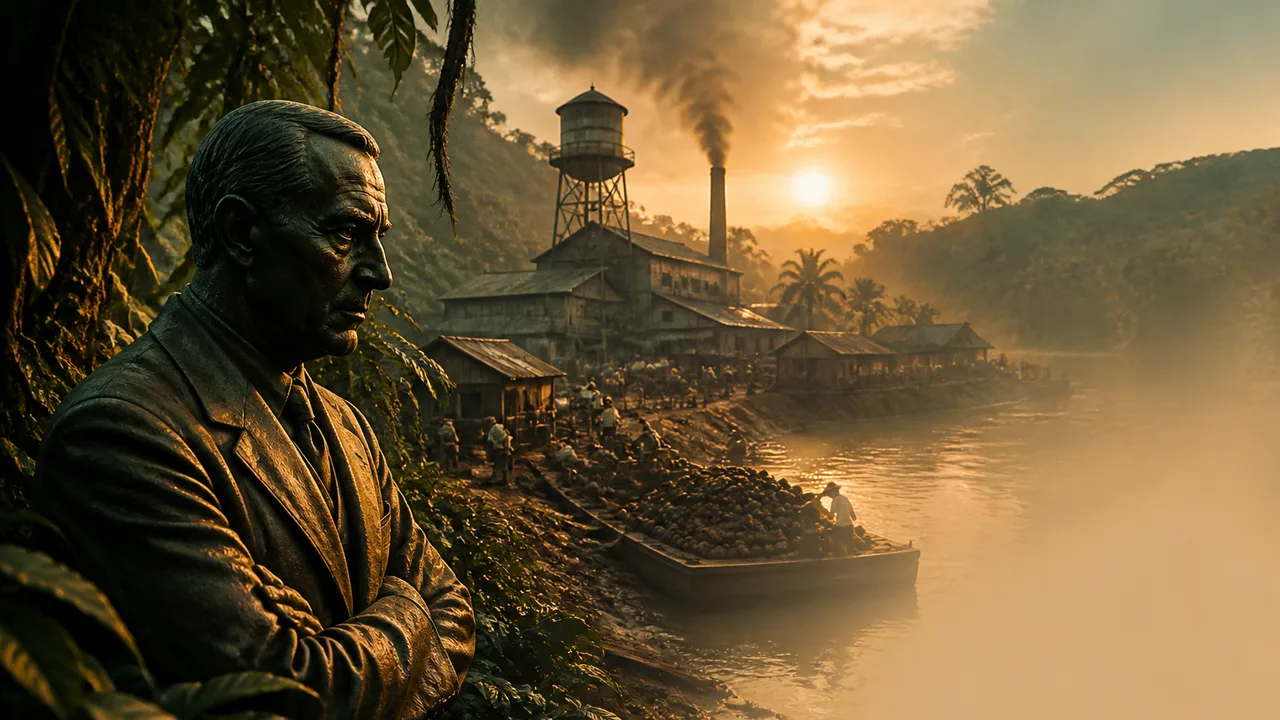
In 1928, Henry Ford’s company began building an American-style town in the Brazilian Amazon to secure its own supply of rubber. Fordlandia would have electric lights and indoor plumbing, alongside a plantation meant to serve the company’s industrial needs. The plan joined two ambitions: grow a vital raw material and show that Ford’s ideas about orderly life could work far from Michigan.
The town had to work for people who lived there, too. Workers and their families would inhabit the place that Ford’s company designed, while rubber trees had to grow in an environment the company could not redesign. Those were practical tests of the project, not footnotes to its more unusual architecture.
By 1934, the original settlement had been abandoned as Ford’s experiment in the region faltered. The dates are brief enough to make Fordlandia sound like a punchline. They leave out the question that gives its history a longer life: who gets to decide what progress looks like when one institution supplies the investment, writes the rules and expects everyone else to make the plan work?
A Rubber Supply with a Town Attached
Ford’s interest in the Amazon began with a manufacturing problem. Automobiles required rubber, and a company that relied on outside suppliers had reason to want a dependable source of its own. Ford secured a vast tract of Amazon land in 1927, described as roughly the size of Connecticut. The settlement followed in 1928.
That business case deserves to be taken seriously. A secure supply could offer a manufacturer more control over a crucial input. Building housing and utilities near a plantation could help a workforce live there. Electric lights and indoor plumbing were substantial amenities, not merely decorative signs of an American town transplanted into the forest.
Ford’s project went further than supplying a place to work and live. It paired rubber cultivation with a model community inspired by the American Midwest. In that arrangement, the company’s ideas about home, work and social order traveled with its machinery and money. The factory-town template offered a ready-made answer to questions that residents might have answered differently for themselves.
A town can look coherent on a plan because the plan leaves out disagreement. A street has a fixed location; a family’s expectations about daily life do not. Infrastructure can improve conditions while the institution that owns it retains the power to set the terms. Fordlandia carried both possibilities at once.
The People Inside the Plan
The scale of Fordlandia becomes easier to grasp through a child than through a land survey. Leonor Weeks DeCeco was eight when she joined her father there, NPR recounted in its interview with her. A company seeking rubber had also drawn families into a new community. Children would grow up there; adults would have to organize the ordinary business of living around the company’s design.
That detail changes the question we ask of a planned town. An investor can judge a plantation by whether it produces rubber. Residents must also judge whether its rules and routines give them a workable life. The two measures can overlap. They can also pull apart, especially when decisions come from people whose primary obligation is to the enterprise.
Fordlandia’s workforce had customs and expectations of its own. Its residents were people with reasons to accept, contest or adapt a company’s arrangements, rather than interchangeable pieces of an industrial system. The record cited here does not offer a representative account of what workers collectively wanted. Treating them as a single voice would repeat the planning error in a friendlier vocabulary.
A fair reading also leaves room for what the company offered. Utilities and investment could appeal to people seeking work or services. A worker might value those benefits and still object to a rule governing daily life. That combination is familiar wherever an employer has substantial power over the place its employees call home. The question is how much room residents have to shape the bargain after they arrive.
The Forest Had Its Own Requirements
Rubber trees made a second demand on Ford’s plan. The company needed cultivation to succeed in the Amazon, an environment that could not be standardized simply by importing a town design. The BYU Design Review describes Fordlandia’s difficulties as a collision between industrial ambition, ecological realities and cultural misunderstanding.
An industrial town and a plantation operate on different terms. A company can specify the dimensions of a building or the layout of a road. Growing a crop requires attention to local conditions over time. Knowledge held by people familiar with the land can become essential even when a distant company holds the title and pays for construction.
Fordlandia’s failure illustrates the cost of treating that knowledge as secondary. Capital could bring lights, plumbing and an ambitious plan into the forest. It could not guarantee that rubber cultivation would follow the logic of an assembly line. Nor could the promise of a model town settle how its inhabitants wanted to live.
Ecology and labor belong in the same account because both required the company to learn from the place where it operated. A plan drawn elsewhere could be revised as conditions became clear. That required admitting that people on the ground had information the plan lacked, and giving their knowledge weight in decisions. Fordlandia was built around a stronger claim: the template itself could supply the order the project needed.
What the Abandonment Leaves Behind
The original settlement’s abandonment by 1934 marked a failure of that template. It did not erase the investment or the lives drawn into the project. A corporate chronology can move quickly from founding to failure; a resident’s chronology includes everything that happened between those points, and the need to carry on afterward.
The temptation now is to treat Fordlandia as an exceptionally strange episode: an American industrialist, a huge Amazon property, a Midwestern town and an ending no planner wanted. Its particulars are unusual. Its central problem is recognizable. Development plans often arrive with a persuasive account of what a place needs and a clear source of money to provide it. The people expected to live with the result may have less authority over the decisions than the institution paying the bills.
Fordlandia’s lights and plumbing represented useful improvements, while its rubber ambition answered a concrete business need. Its history asks readers to hold those facts beside another: a useful amenity does not answer every question about who controls a community. The strongest plan for a town still has to survive contact with the judgment of its residents and the conditions of its land.
Ford could decide to build Fordlandia. The people who lived there, and the Amazon in which it stood, determined whether his plan could become a functioning place.
More Like This
Douglas MacArthur and the People He Left Behind
MacArthur is remembered as a military legend. But what about the veterans he gassed, the soldiers he abandoned, and the Japanese citizens who built a new democracy?
California's Hidden Underground: Caves, Tunnels, and Buried History
From a buried Gold Rush city to survival tunnels built by Chinese immigrants, California's underground holds layers of geology, history, and forgotten infrastructure.

Ramstein Air Show Disaster: Response and the Long Aftermath
The 1988 Ramstein air show crash killed 70 people. Its emergency response, differing injury counts and survivors' long aftermath raise questions about public safety.
Medieval England: How Peasants and Guilds Shaped Society
A new documentary traces medieval England's social divide through two real families—one peasant, one guild merchant—and the starkly different worlds they inhabited.
Savannah's Urban Grid: A Utopia Built on Slavery
Savannah, Georgia was designed as an egalitarian utopia in 1733. What it became reveals how idealism and slavery shaped one of America's most walkable cities.
La Grande-Motte's Pyramid Architecture Finds New Admirers
La Grande-Motte's futurist pyramids, once mocked, are now drawing architourists to the Languedoc coast. Here's what's driving the revival—and what it costs.

An 11,000-Year-Old Statue of a Man Riding a Leopard
Archaeologists unearthed an 11,000-year-old statue at Karahan Tepe, Turkey, showing a man riding a leopard. What does it tell us about Neolithic power?

Coin Flipping Is Not as Random as We Thought
From Roman dispute-settling to modern physics research, coin flipping turns out to carry a measurable bias. Here's what that means for fairness.