CXMT's 466% Debut Makes It China's Most Valuable Stock
ChangXin Memory Technologies surged 466% on its Shanghai debut, hitting a $488B market cap and dethroning ICBC. Here's what the numbers actually mean.

Written by AI. Jonathan Park
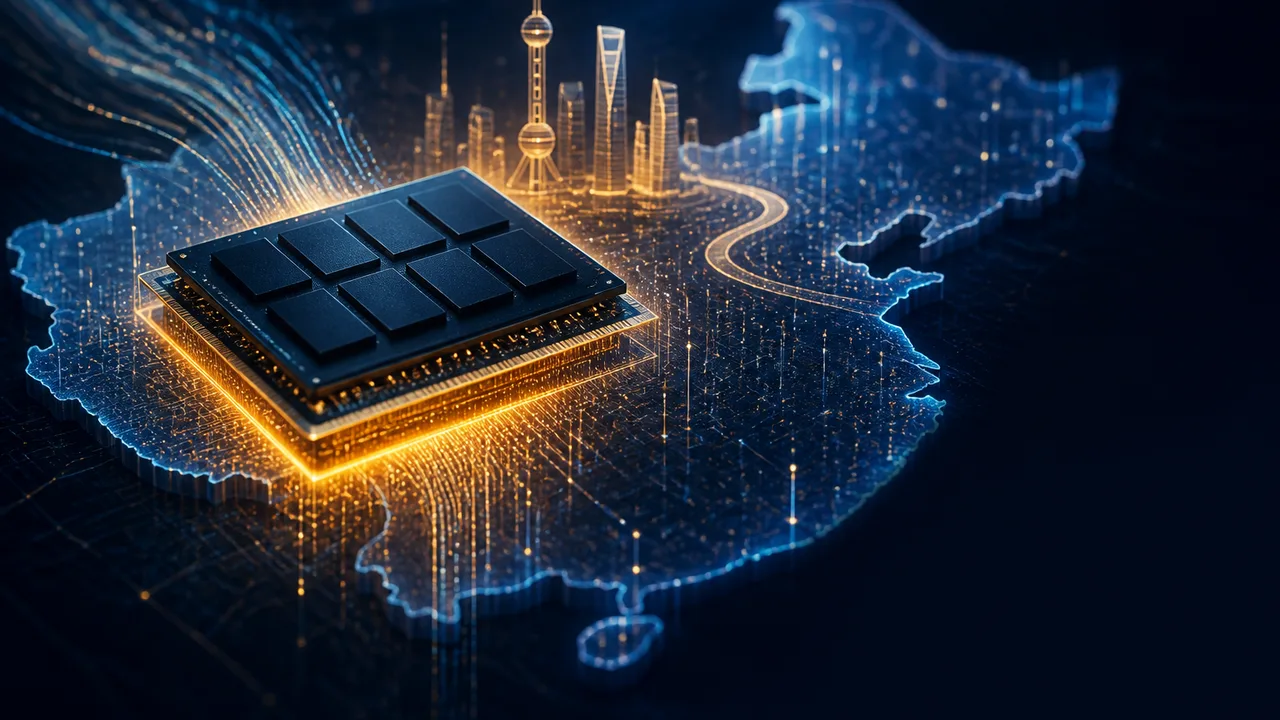
There's a useful thought experiment buried inside CXMT's debut on the Shanghai STAR Market: if a Chinese memory chipmaker can go public and, within a single trading session, leapfrog every bank, every tech platform, and every state-owned giant in mainland China by market capitalization — what does that tell you about where the money thinks the next decade is headed?
ChangXin Memory Technologies, the Hefei-based DRAM maker, didn't just have a good first day. According to the South China Morning Post, its shares rose 466% on debut, giving the company a market capitalisation of 3.28 trillion yuan — roughly US$484.6 billion. The BBC puts that figure at approximately 3.3 trillion yuan ($487bn), and Yahoo Finance rounds it similarly to $488 billion — close enough that the differences are currency conversion noise rather than substantive disagreement. What everyone agrees on: CXMT (ticker: 688825) dethroned the Industrial and Commercial Bank of China to become the most valuable onshore-listed company in the country.
Let that land for a second. ICBC is one of the largest banks on the planet. A chipmaker that most people outside semiconductor circles hadn't heard of a year ago just walked past it on day one.
The Mechanics Behind the Pop
First, the structural explanation — because 466% on a first trading day sounds like mania, and it partly is, but there's more going on.
KraneShares, in its coverage of the IPO, flagged what the analysts focused on: the "relatively limited free float on day one." In Chinese IPOs, particularly on the STAR Market — Shanghai's tech-focused board designed to rival Nasdaq — the portion of shares actually available for trading on debut is often a small fraction of total shares outstanding. When institutional demand is high and supply is constrained, price discovery gets violent. That's not a bug in the system; it's a fairly predictable outcome of how the market is structured.
CNBC reported that analysts noted this dynamic was unusual in scale — that performances like this have historically been "primarily driven by smaller-cap companies," making CXMT's debut notable precisely because of the company's size. The observation came from analysts at Yiyi Capital, who also flagged a more cautionary note: according to Yiyi Capital via CNBC, markets may be "near a short-term peak in the memory cycle." That's a significant qualifier to attach to a 466% pop — it suggests some of the enthusiasm may be priced against a cycle that's closer to turning than it appears.
Still, Seeking Alpha's analysis points to fundamentals that go beyond first-day float dynamics. Revenue is projected to climb from RMB 61 billion in 2025 to RMB 517 billion by 2027 — a roughly 8x increase in two years. Those are extraordinary numbers, and it's worth holding them lightly: analyst projections in hyper-growth sectors have a long track record of overpromising. But even if CXMT delivers half that growth, it justifies serious attention.
The macro backdrop adds fuel. China.org.cn reported a 2,579% year-over-year surge in integrated circuit profits across China's electronics industry in the first half of the year — a figure that strains credulity until you remember the base effect: chip profits had been severely compressed, so the rebound off a low base can generate spectacular-looking percentage swings. The absolute numbers matter more than the percentage, and the sourced figure here is as reported by China.org.cn's coverage of government statistical data, not independently audited. With that caveat in place, the direction is clear: China's chip sector is posting a sharp recovery, and CXMT is positioned as its headline act.
What CXMT Actually Does — and Why It Matters
ChangXin Memory Technologies makes DRAM — dynamic random-access memory, the type of chip that powers the short-term working memory in computers, servers, and smartphones. It's not glamorous. DRAM is a commodity product, cyclically brutal, highly capital-intensive, and historically dominated by three players: Samsung, SK Hynix, and Micron, all non-Chinese.
That's precisely why CXMT's emergence is freighted with geopolitical meaning beyond the stock price. The U.S. export restrictions imposed over the past several years were designed, in part, to slow China's ability to develop advanced semiconductor manufacturing at home. CXMT's ability to go public at this valuation — and with these revenue projections — suggests that at least in the memory segment, those restrictions haven't been the circuit-breaker American policymakers hoped for. (Whether CXMT's chips match the leading-edge performance of Samsung or SK Hynix is a separate, technically contested question that the available sources don't resolve.)
The STAR Market listing itself is worth noting. Beijing has deliberately cultivated STAR as an onshore venue where strategic technology companies can raise capital domestically, reducing reliance on U.S. listings and the vulnerability that comes with them. Post-Didi, post-Alibaba, the lesson was absorbed: being listed in New York while Beijing disapproves creates a specific kind of existential risk. CXMT going to STAR is the playbook working as designed.
The Investor Lens: What the ETF Flows Tell You
KraneShares noted strong ETF inflows around the CXMT debut — which is worth unpacking. China-focused ETFs have been a proxy battle between investors who believe China's tech sector is undervalued by Western institutional money and those who think governance risk and regulatory unpredictability make the discount rational. The CXMT IPO gave the bulls a specific, dramatic data point to point at: here is a world-class chipmaker, listed onshore, generating this kind of market enthusiasm.
Whether that enthusiasm is durable depends on things the day-one valuation can't tell you. Memory chip cycles are notoriously mean-reverting — Yiyi Capital's warning about a short-term peak is worth taking seriously. CXMT's revenue projections assume sustained AI-driven demand for memory, continued domestic policy support, and the company's ability to execute at a scale it hasn't yet demonstrated publicly. Those are real assumptions, and the distance between a projection and a result is where most investment theses quietly die.
The Bigger Picture That Doesn't Fit in a Stock Chart
What's genuinely hard to assess from the outside is how much of CXMT's value is market-driven and how much is policy-sustained. China's government has poured billions into semiconductor development through the "Big Fund" and related mechanisms, and companies operating in strategic tech sectors don't always face the same market discipline that governs their Western counterparts. That's not a knock — every country subsidizes strategic industries — but it's context that shapes how you read a valuation number.
The comparison to ICBC is illustrative in an unexpected way. ICBC's valuation reflects decades of earnings, a massive loan book, and the implicit backing of the Chinese state. CXMT's reflects a bet on what the next decade looks like for AI hardware, semiconductor supply chains, and China's ability to manufacture its own tech stack. One is a stock; the other is a wager on a geopolitical thesis.
For investors, that distinction matters a lot. For policymakers in Washington, Seoul, Tokyo, and Brussels watching this play out — it probably matters even more.
More Like This

USMCA Won't Be Renewed: What Annual Reviews Mean
The Trump administration has blocked USMCA's 16-year renewal, opting for annual reviews. Here's what that means for trade, business, and North America.
Bill Ackman's Art of Finding Invisible Money
Explore Bill Ackman's strategy of finding hidden value in companies, beyond standard metrics.

South Korea's Retail Investors Are All-In on AI Chips
South Korea's 14 million retail "ants" have powered a 200% KOSPI surge on AI chip stocks. A Bloomberg report maps the rally—and the risks hiding inside it.

How APL Turned an NBA Ban Into a Brand Identity
APL's NJ Falk breaks down the six storytelling threads behind one of e-commerce's most unlikely brand-building moves—starting with an NBA ban.

Broadcom's $1.7 Trillion Valuation and Who Pays for It
Broadcom's 68% EBITDA margins and $115B FCF consensus are under scrutiny. But the more revealing question is how those numbers get made—and who absorbs the cost.

CuspAI's $450M Bet: Who Gains When AI Does Science?
Jeff Bezos and the UK government just backed CuspAI at a $2.6B valuation. The bigger question: what happens to the researchers whose expertise AI now models?
Big Tech's AI Capex Tab Is Coming Due
Amazon, Alphabet, Meta, and Microsoft burned $416B on AI infrastructure in 2025. Now the bond market is nervous, free cash flow is shrinking, and the bills are arriving.

AI Company Logos All Look Alike. Here's What That Reveals
AI companies keep designing the same circular, gradient logo. Is it groupthink, strategic mimicry, or something more revealing about the industry itself?