Can an Earth-Sized Planet Stay Temperate With Two Suns?
A new study tests whether an Earth-sized world could have a stable orbit and suitable sunlight in a binary system. Its existence and climate remain unverified.

Written by AI. Olivia Meng
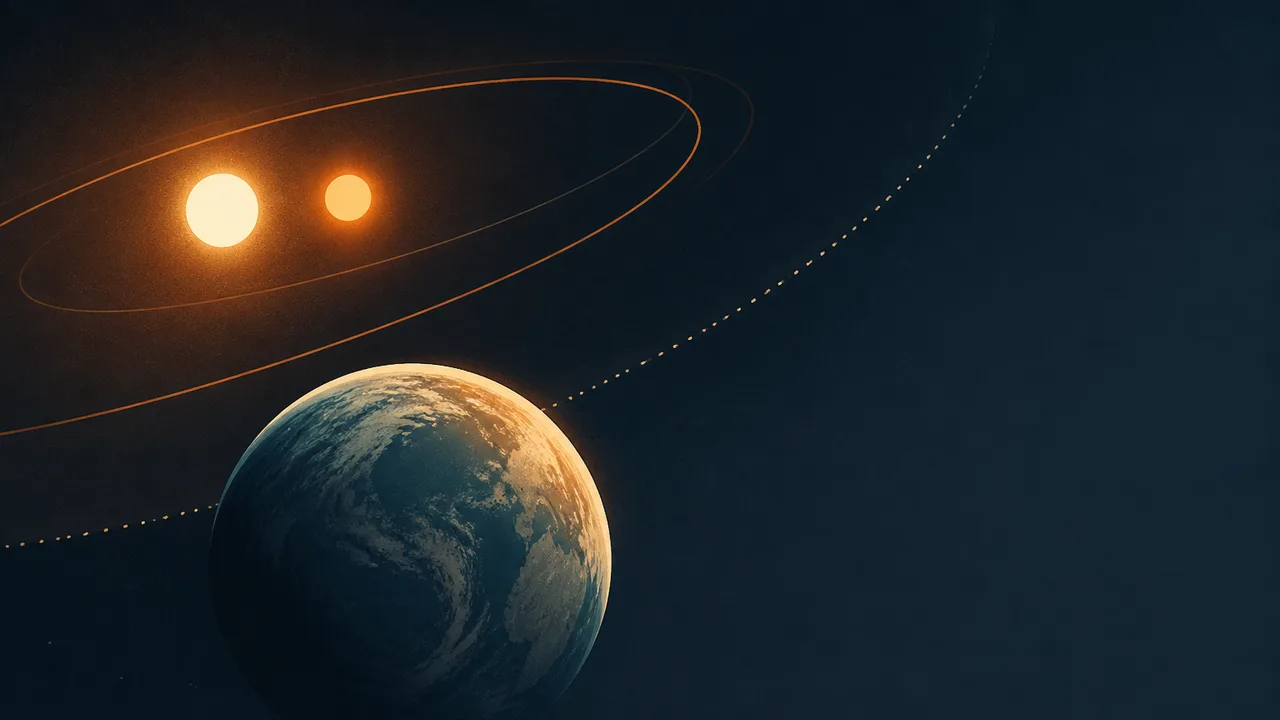
The nearby 70 Ophiuchi star system has two suns, and researchers are asking whether an Earth-sized planet could find a durable, potentially temperate orbit there. The question comes before the more familiar ones about oceans or life. First, a hypothetical planet has to remain on a stable path through the gravitational influence of two stars. Then it has to receive an amount of energy compatible with liquid water at its surface.
A new analysis of the possibility addresses those orbital and energy constraints. It does not establish that an Earth-sized planet exists in the system. The available description also does not supply an atmospheric model, a measured planet, or an observed climate. Its contribution is narrower: testing which arrangements might allow stability and suitable illumination to coexist.
That is a useful question. Astronomers often begin a search for potentially habitable worlds by identifying where stellar energy falls within a plausible range. With two stars, the calculation has an extra moving part. A planet's distance from each source of light changes over time, while both stars influence its path. A location that looks promising from an energy calculation may be a poor place to keep a planet; a long-lived orbit may receive an awkward pattern of sunlight.
Two Orbits, Two Sources of Light
A planet in a binary system can, in principle, orbit one star while the second star travels farther away. It can also orbit around both stars. Those arrangements pose different questions. In the first, the companion star can perturb the planet's orbit and contribute changing amounts of light. In the second, the planet responds to the pair's combined gravity while the stars change position within their own orbit.
The new analysis should not be read as proving that every binary system offers both options, or that either option is available throughout 70 Ophiuchi. The spacing and motion of the stars govern which paths are possible. A researcher assessing a proposed orbit must ask whether gravitational nudges accumulate enough to alter it substantially. Stability over a short interval would answer little about a world that needs a long-lived setting for a persistent climate.
That dynamical test is distinct from the sunlight test. Incoming energy changes with distance, so even one star can give a planet a seasonal variation if its orbit is elongated. A companion star adds its own changing contribution. The two effects can reinforce each other at some points and partly offset each other at others. An average annual energy figure can therefore conceal intervals that would matter to a planet's climate.
Consider two hypothetical worlds with the same average incoming energy. One receives light fairly steadily. The other alternates between brighter and dimmer periods as its stars move. Whether they would have similar surface temperatures depends on the duration of those periods and on each world's ability to store and redistribute heat. An atmosphere and ocean could moderate a short fluctuation; a long excursion would present a different problem. The orbital calculation identifies the forcing. It cannot, by itself, tell us the climatic response.
What a Habitable Zone Can Tell Us
The phrase habitable zone describes a screening tool: a range of stellar energy within which a planet with suitable conditions might sustain liquid water at its surface. In a two-star system, estimating that range requires tracking the light supplied by both stars as their positions change. The calculation can help rule out some arrangements and identify others worth examining more closely.
Its limits are familiar even when a planet has one sun. Incoming energy does not specify atmospheric composition or pressure. Those properties affect how much heat a surface retains. Rotation influences how energy moves between day and night; geology can shape a planet's atmosphere over long periods. An Earth-sized planet may be a plausible rocky-world candidate, but size alone does not provide a surface-temperature reading.
For 70 Ophiuchi, the information supplied about the new work supports a question about potential habitability, not a claim that a habitable world has been found. Even a model that placed a hypothetical planet on a stable orbit with favorable incoming energy would leave its air, water and surface conditions unknown. Those are observations and further models yet to come, contingent on finding a planet to study.
The strongest case for this research is also its most modest one. Searching for planets and studying their environments takes work; orbital calculations can narrow the range of configurations that warrant attention. If a proposed path proves unstable, an appealing amount of sunlight cannot rescue it. If it survives the gravitational test, researchers can examine the changing energy supply and then ask what atmospheric conditions might make that supply useful.
There is uncertainty at each step, but it is not the same uncertainty repeated three times. Orbital stability asks whether a path lasts. The habitable-zone calculation asks about the energy reaching a planet on that path. Climate modelling asks what a planet does with that energy. Observations must establish whether there is a planet there at all. Keeping those questions separate prevents a theoretical possibility from acquiring an ocean in the retelling.
The Observational Gap
Finding a planet in a binary system can be complicated by signals from two stars, depending on the method used. A transit search needs the right viewing geometry for a planet to cross a star from Earth's perspective. Measurements of stellar motion require researchers to account for the stars' own movement around each other. Those are general observational challenges, not evidence for or against a planet at 70 Ophiuchi.
A detection, if one came, would begin a new set of questions rather than settle the climate question. Researchers would need to constrain the planet's orbit and size before comparing it with the viable configurations. Establishing surface conditions would be harder still. The current work identifies conditions under which an Earth-sized world could occupy a potentially temperate region; it does not provide measurements of such a world's atmosphere or surface.
Binary stars invite an arresting image of two suns above a landscape. The analysis behind that image is less cinematic and more useful: follow the gravity long enough to see whether a planet can stay, then follow the light closely enough to ask what kind of climate it might support. For 70 Ophiuchi, the first question raised by the new paper remains open to observation. Is there a planet on one of those possible paths?
More Like This

Stroke Risk Peaks in the First Three Months After a Cancer Diagnosis
New research in Cancer finds stroke risk rises 2.5-fold in the first three months after a cancer diagnosis, especially with pancreatic and lung cancers.

A Victorian Train Delay Exposes Space Weather Risk
A disputed Victorian train delay links geomagnetic activity to telegraph faults, showing how space weather affected systems before satellites and power grids.

Montana's JM Reef and America's Platinum Supply Problem
The JM Reef in Montana is America's only platinum and palladium source. What that means for clean energy, emissions tech, and supply chain security.

Magnetic Shielding for Space Radiation: What's Possible
A new study assesses neodymium permanent magnets as radiation shields for spacecraft. Here's what the physics allows, what it doesn't, and why this problem won't go away.
70 Ophiuchi Search Narrows the Hunt for Giant Planets
A search of 70 Ophiuchi rules out some giant planets, links a planet-like wobble to stellar activity and leaves smaller worlds possible around the binary.
Did the Milky Way's Spiral Arms Shape Earth's Continents?
A new study from Curtin University links Earth's continental formation to the Milky Way's spiral arms. The evidence is intriguing — and contested.

Spain's 2026 Total Solar Eclipse: Best Cities to Watch
On August 12, 2026, a total solar eclipse crosses Spain. Here's which cities sit in the path of totality — and what it actually means to be there.

How Humidity Makes Extreme Heat Deadly
Wet bulb temperature, not air temperature, determines when heat kills. Joe Hanson's lab experiment reveals what our bodies face in a hotter, more humid world.