70 Ophiuchi Search Narrows the Hunt for Giant Planets
A search of 70 Ophiuchi rules out some giant planets, links a planet-like wobble to stellar activity and leaves smaller worlds possible around the binary.

Written by AI. Priya Sharma
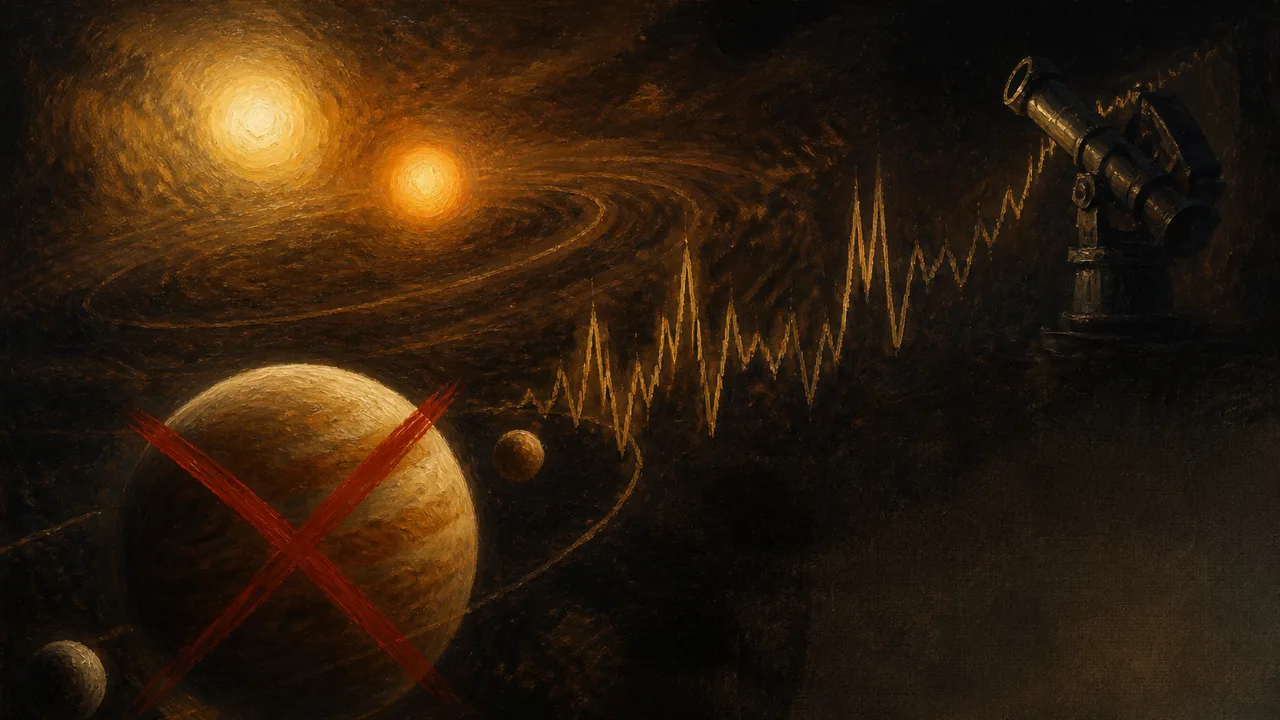
A new study of 70 Ophiuchi AB finds no coherent planetary signal in the measured velocities of either star. The researchers also find that long-term changes in those velocities are consistent with stellar activity modulated by rotation. For this nearby binary, the result places substantial limits on some large companions while leaving other planetary orbits open.
The team led by Yiting Li took 499 new velocity measurements of 70 Oph A and 334 of 70 Oph B from 2023 to 2025 with the Planet Finder Spectrograph on the Magellan II Clay Telescope in Chile. They combined those measurements with decades of earlier velocity observations and astrometry, measurements of the stars’ positions, to update the orbit of the two stars. Their analysis of the combined records reports different planet limits for A and B.
What the Search Could Have Found
A planet’s gravity can pull its star alternately toward and away from Earth. Radial-velocity measurements look for that motion along our line of sight. In 70 Ophiuchi, the two stars already move around each other, so the researchers must account for the binary orbit before assessing any smaller residual signal. Stellar activity can also affect measured velocities. A wobble, by itself, does not identify the object or process producing it.
For 70 Oph A, the study draws on a 27-year radial-velocity baseline. The authors say it excludes Jupiter-mass planets inside five astronomical units, with sensitivity reaching 0.3 Jupiter masses at one astronomical unit and 0.5 Jupiter masses at two. An astronomical unit is approximately the Earth–Sun distance. For 70 Oph B, the new spectrograph data rule out planets more massive than roughly 0.25 to 0.3 Jupiter masses inside half an astronomical unit. The quoted upper limits assume planets orbit in the plane of the two stars’ orbit.
A’s five-astronomical-unit exclusion cannot be transferred to B, whose stated exclusion covers the inner half astronomical unit. The threshold of 0.3 Jupiter masses at one astronomical unit from A cannot be assigned to two astronomical units, where the reported threshold is 0.5. A planet around B beyond its tested inner region, or one on an orbit tilted relative to the binary’s plane, falls outside the quoted exclusions. Falling outside an exclusion supplies no evidence that such a planet exists.
The same analysis finds that stable orbits around A can extend to about 2.5 astronomical units and include the star’s habitable zone. The authors say Saturn-mass planets or smaller on stable orbits there remain allowed. Stability asks whether an orbit can persist in the gravitational environment of two stars. The habitable-zone designation concerns distances where liquid water might be possible on a suitable planet. Neither calculation puts a planet in that orbit.
A Claim from 1855, a Different Test Today
William Stephen Jacob’s 1855 claim of a planet did not hold up, the University of Michigan says. The present study evaluates measured changes in the stars’ velocities, with positional data helping establish their binary orbit. Its exclusions concern the masses and orbits the modern search could detect; they do not identify what led Jacob to his erroneous conclusion.
The more immediate predecessor to Li’s result is the velocity record itself. Li described earlier measurements as compatible with a Jupiter-sized planet. With the new observations added, the team finds no coherent planetary signal and judges the long-term velocity variability of both stars consistent with activity linked to stellar rotation. That assessment offers an explanation for the observed variation without requiring every fluctuation to have one demonstrated cause. The exclusion limits pose another question: which companions should this search have detected, given their mass, location and assumed orbital plane?
Two Directions of Motion, Two Types of Orbit
Radial velocity measures motion along our line of sight; astrometry records motion across the sky. Used together, they can constrain an orbit and a companion’s mass more fully than either projection alone. For 70 Ophiuchi, the combined records helped the researchers update the binary stars’ orbit and their dynamical masses. That orbital solution helps account for the motion of A and B around each other. The activity analysis addresses changes remaining in their measured velocities; the planet limits specify which additional signals the search was equipped to find.
The limits also concern a particular orbital arrangement. A planet on one of the stable orbits discussed around 70 Oph A would circle one star of the pair. A planet circling both stars would occupy a circumbinary orbit. Rafael Luque and Matthew Standing discuss the distinct challenges of radial-velocity searches for circumbinary planets in a methods chapter. That general discussion cannot extend Li’s exclusions for planets around individual stars to planets circling the pair.
A Jupiter-mass planet inside five astronomical units of A faces the paper’s stated exclusion under its orbital assumptions. A Saturn-mass planet in a stable orbit within A’s habitable zone remains possible; the activity-linked wobble provides no detection of one.
More Like This
The Quantum Twin Paradox and the Nature of Time
A new trapped-ion experiment may finally reveal whether time is a quantum property—bridging the long-standing gap between quantum mechanics and general relativity.

Nuclear Clocks Are Now Real — Here Is What That Means
Two independent teams built working nuclear clocks in 2026. Here's what the thorium-229 breakthrough actually achieved — and what it hasn't yet.