Apollo 11's Triumph Was Built on Lessons From Failure
Apollo 11 survived computer alarms, thin fuel margins and earlier tragedy through disciplined teamwork, redundancy and a program reshaped by past failure.

Written by AI. Sofia Ramirez
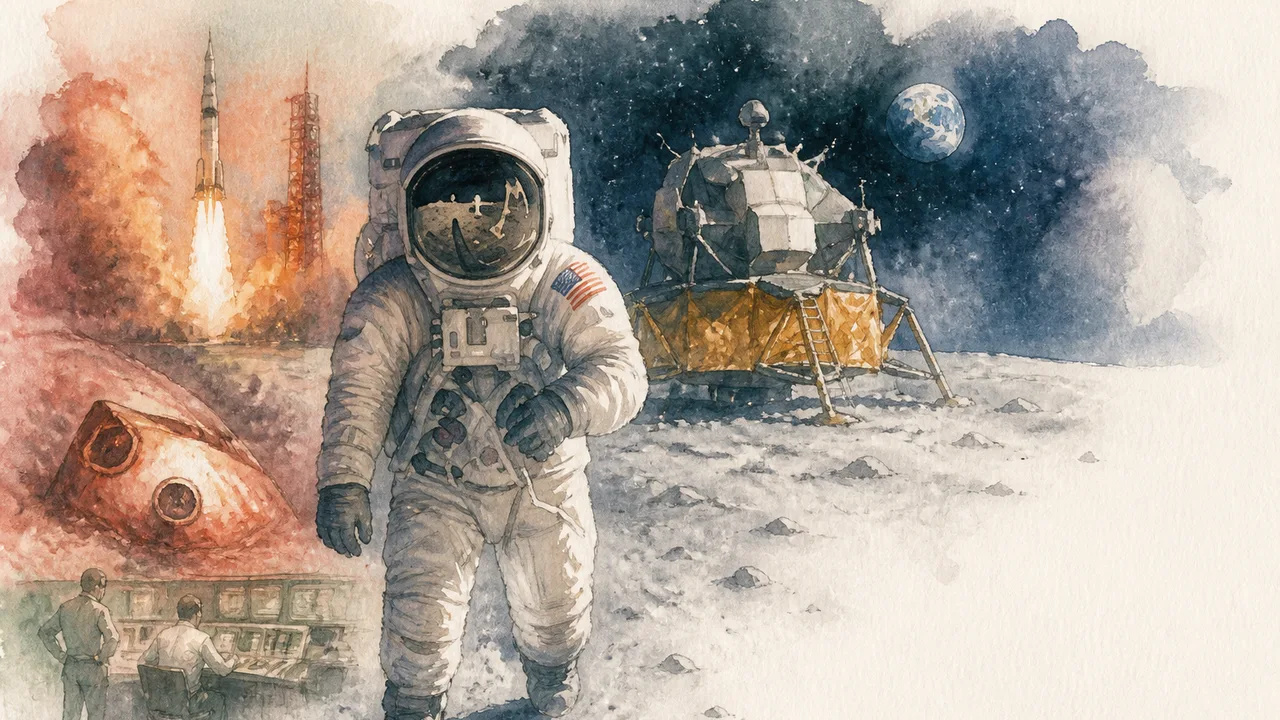
Apollo 11 left Earth on July 16, 1969, atop what one later account calls a “controlled explosion.” Neil Armstrong, Buzz Aldrin and Michael Collins were attempting a sequence no crew had completed: fly to another world, land two people, bring them back to lunar orbit and return all three safely to Earth.
Public memory has sanded that sequence down to a few durable objects. The bootprint. The flag. Armstrong’s first words from the lunar surface. A flag fits a poster; a checklist does not.
The checklist offers a more revealing history. Apollo 11 emerged from a program that had already killed astronauts, discovered dangerous flaws and repeatedly tested whether hardware, procedures and people could function together. During the lunar descent, computer alarms demanded interpretation while the fuel margin narrowed. Touchdown settled only one uncertainty. Armstrong and Aldrin still had to leave the Moon, find Collins in orbit, reconnect with the command module, survive re-entry and undergo quarantine.
Apollo 11 succeeded through organized risk: dangerous work divided into problems that people could identify, rehearse and monitor. Its accomplishment becomes larger, and more human, when the possibility of failure remains in the frame.
Apollo 1 Changed the Meaning of Readiness
On January 27, 1967, a fire during a ground test killed Apollo 1 astronauts Virgil “Gus” Grissom, Edward White II and Roger Chaffee. The disaster exposed lethal weaknesses in the spacecraft and in the assumptions surrounding its operation.
The word “accident” can shrink institutional responsibility into a bad moment. Apollo 1 involved hardware, materials, procedures and decisions made across an enormous organization. The fire forced scrutiny of how those pieces had combined inside a high-pressure, oxygen-rich cabin from which the crew could not escape in time.
NASA and its contractors subsequently revised the spacecraft and its safety practices before crewed Apollo flights resumed. Those changes became part of Apollo 11’s inheritance. So did a harsher understanding of what confidence could conceal.
Calling Apollo 1 a lesson carries its own danger. Death can start to sound like tuition, as though catastrophe were a required payment for progress. The fire was neither an abstract engineering exercise nor a useful failure in itself. Three men died in a spacecraft that never left the ground. The program’s later achievement depended on whether institutions responded to that loss with investigation and change.
Organizations often praise resilience after disaster while leaving vague who encountered the hazard first, who raised concerns and who possessed the authority to act. Apollo’s history shows institutional learning at work, but it also leaves a standing question: Why must some dangers become fatal before a large system treats them as urgent?
The Moon Landing Depended on Earlier Missions
Apollo 11 appears inevitable when history starts at the launchpad. It looked far less certain from inside the schedule.
ABC News’ account of the mission sequence notes that Armstrong had served as backup commander for Apollo 8. Apollo 11 would not have become the first landing attempt if Apollo 9 and Apollo 10 had gone badly. Each mission tested parts of the architecture that the next crew would need.
That progression matters because it relocates achievement from one heroic instant to a chain of conditional decisions. Apollo 8 tested operations around the Moon. Apollo 9 worked through the lunar module in Earth orbit. Apollo 10 rehearsed much of the landing mission without touching down. Apollo 11 inherited their results, unresolved risks and accumulated procedural knowledge.
The crew assignments also reveal how contingency shaped the familiar cast. Armstrong’s place in the story came through a rotation system and the outcome of earlier missions. The first human step on the Moon depended on many previous steps, most of which never became household memories.
The Alarms Required Judgment, Not Perfection
During the descent toward the lunar surface, computer alarms appeared inside the lunar module. Controllers had to determine whether the alarms meant the landing should be aborted or whether the computer remained capable of handling the work that mattered most. The decision to continue rested on preparation, communication and a system designed to prioritize critical tasks under strain.
Meanwhile, the available fuel kept falling. Armstrong and Aldrin landed, but the narrow margin has remained central to accounts that emphasize the dangers surrounding the mission.
That episode complicates the popular image of advanced technology as a machine delivering certainty. Apollo’s computers, spacecraft and communications systems created capabilities no earlier generation possessed. They also produced data that human beings had to interpret in seconds.
Improvisation worked because it sat on top of rehearsal. Controllers could make judgments under pressure because teams had studied failures, defined responsibilities and practiced responses. Redundancy gave people options. Procedures gave them a common language. Neither removed risk.
The landing also occupies more cultural space than everything that followed. Armstrong and Aldrin had to launch from the lunar surface in the ascent stage, rendezvous with Collins and transfer back into the command module. The crew then faced the return journey and re-entry through Earth’s atmosphere. Recovery did not end the process; quarantine reflected unresolved concern about possible biological contamination.
Success remained provisional until the crew returned alive.
The Workforce Behind the Famous Voices
Astronauts carried the immediate physical risk, and their decisions shaped the outcome. The mission also depended on engineers, programmers, technicians, machinists, inspectors, communications staff, recovery crews and flight controllers distributed across workplaces far from the Moon.
Popular accounts struggle to represent that labor. A three-person crew gives a story a manageable cast. A sprawling network of contractors and specialists does not. Even David Whitehouse’s Apollo 11 account, summarized around interviews with key participants and the competition of the space race, reflects the gravitational pull of prominent names.
The imbalance is partly archival. Senior officials and astronauts generated records that institutions preserved and promoted. Lower-profile workers appear more unevenly, often through technical documentation rather than polished personal narratives. The available sources here provide little detail about workplace hierarchy, contractor relations or how credit moved through the Apollo system, so sweeping claims about those experiences would outrun the evidence.
Still, the structure of the mission makes their importance plain. Somebody built each component, checked each connection, wrote each procedure and watched each instrument. Apollo 11 was a national spectacle assembled from shifts, handoffs and specialized tasks. Its labor history lives inside the hardware.
Cold War Competition Set the Pace
The United States pursued the Moon landing amid direct competition with the Soviet Union. That rivalry supplied money, deadlines and political urgency. Whitehouse’s account emphasizes the exhilarating competition that propelled the era, while IMDb’s description of a 2006 Apollo 11 documentary captures the prevailing public language: the landing was hailed as the supreme triumph of American technology.
National competition explains much of the program’s scale. It does not fully explain why Apollo 11 retained symbolic force after the immediate contest faded. The mission combines several stories that remain legible: state power, scientific ambition, personal danger, collective labor and the hope that disciplined cooperation can push beyond an apparent limit.
That symbolism can also flatten politics. Apollo consumed public resources during an era of conflict and inequality, and any assessment of its legacy has to leave room for arguments about who benefited from national spending and which needs received priority. Admiration for engineering does not settle those questions. Neither does criticism of Cold War priorities erase the work or danger involved.
The strongest reading of Apollo 11 holds those tensions together. Governments pursued prestige. Astronauts accepted extreme risk. Institutions learned after preventable deaths. Thousands of workers converted political ambition into functioning machinery. The mission succeeded without proving that its systems or decision-makers were infallible.
The bootprint endures because it compresses all of that into one clean shape. The fuller history is crowded with alarms, revisions, rehearsals and people whose names never crossed the distance between the Moon and Earth. Apollo 11 reached the lunar surface because thousands of people treated success as a chain of fallible decisions, each one requiring somebody to notice what could still go wrong.
More Like This
Douglas MacArthur and the People He Left Behind
MacArthur is remembered as a military legend. But what about the veterans he gassed, the soldiers he abandoned, and the Japanese citizens who built a new democracy?
California's Hidden Underground: Caves, Tunnels, and Buried History
From a buried Gold Rush city to survival tunnels built by Chinese immigrants, California's underground holds layers of geology, history, and forgotten infrastructure.
Medieval England: How Peasants and Guilds Shaped Society
A new documentary traces medieval England's social divide through two real families—one peasant, one guild merchant—and the starkly different worlds they inhabited.

Neil Armstrong: The Reluctant Hero of Apollo 11
Neil Armstrong flew 78 combat missions, survived two near-fatal crashes, and walked on the moon—then spent the rest of his life insisting it was all just luck.
Mariner 2 and the Burn That Taught NASA to Steer in Deep Space
On September 4, 1962, Mariner 2 fired its engine en route to Venus, the first deep-space course correction. How controllers steered what they could not see.
The Bari Disaster: Mustard Gas, Secrecy, and 1943
On December 2, 1943, a German raid on Bari killed over a thousand people—and released mustard gas that officials spent decades trying to erase from history.

Who Owns the Sky? The Human Cost of Giant Telescopes
From Mauna Kea protests to the Columbia Seven, the race to build the world's biggest telescopes carries human costs science documentaries rarely pause to name.