Andrew Johnson's Impeachment and What It Actually Settled
Andrew Johnson became America's first impeached president in 1868. The case was about a cabinet firing—but the stakes were the shape of democracy itself.

Written by AI. Sofia Ramirez
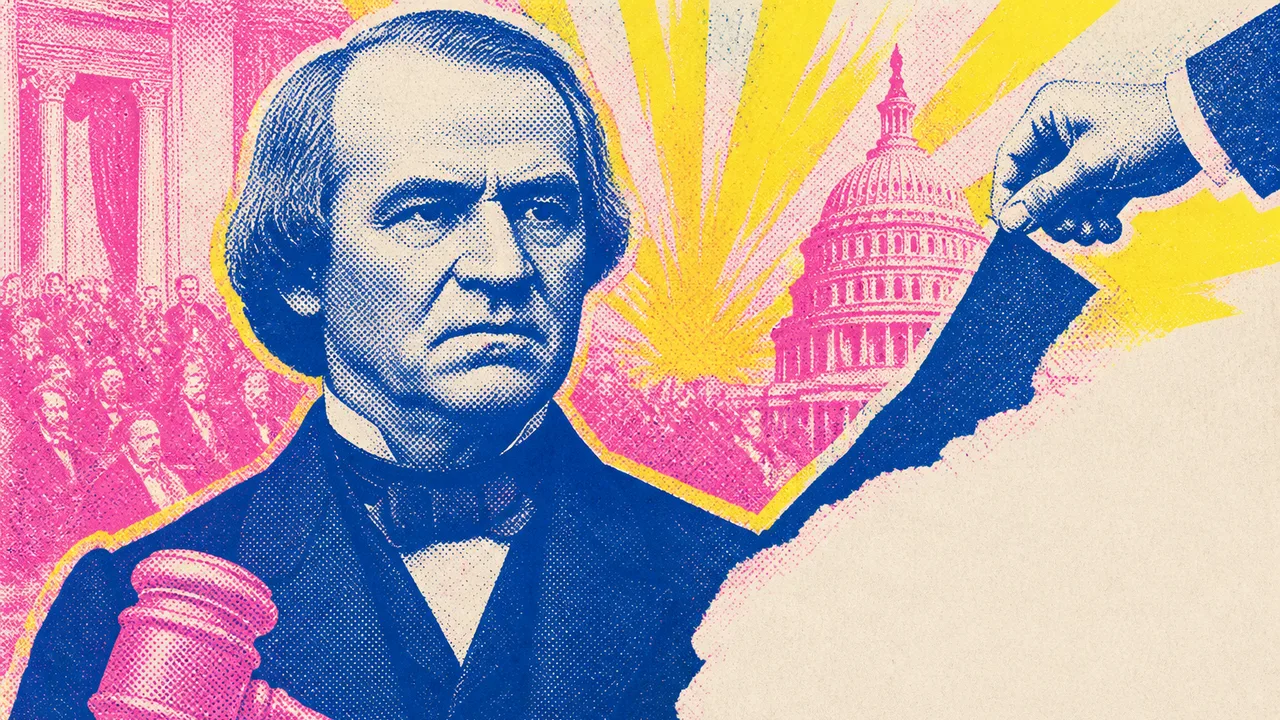
The body was barely in the ground when the trouble started.
Abraham Lincoln was assassinated on April 14, 1865. By April 15, Andrew Johnson was president. And within weeks, it was clear to the Radical Republicans who controlled Congress that the man now occupying Lincoln's office had almost nothing in common with Lincoln's vision for what came next.
What followed was three years of escalating warfare between the executive and legislative branches—not the metaphorical kind that fills op-ed columns, but the structural kind, the kind that ends in constitutional crisis. By February 24, 1868, the House of Representatives voted 126 to 47 to impeach Andrew Johnson, making him the first president in American history to face that process, according to the House's own historical archives.
The nominal trigger was a cabinet firing. The actual stakes were considerably higher.
The Man Who Wasn't Lincoln
Understanding why Johnson's presidency became a disaster requires understanding what he actually believed—and those beliefs were not subtle.
Johnson was a Southern Democrat from Tennessee, a man who had opposed secession not because he thought slavery was wrong but because he thought disunion was. He was placed on the 1864 National Union ticket as a gesture toward cross-party wartime unity. Nobody in that coalition was under the illusion that Johnson was a Radical Republican. What they perhaps underestimated was how actively he would work against what Reconstruction was trying to accomplish.
The Radical Republicans in Congress had a program: restructure the South, give Black men the right to vote, station federal troops to enforce the new order, and make re-admission to the Union contingent on accepting these terms. Johnson had a different program: get the Southern states back in as fast as possible, restore local white governance, and leave the question of Black citizenship largely to the states—which is to say, largely to the people who had just lost a war defending slavery.
This was not a technical disagreement. The World History Encyclopedia's profile of Johnson captures the ideological fault line clearly: Johnson's Southern Democratic roots placed him in fundamental opposition to the Reconstruction agenda the Radical Republicans were pushing through Congress. The clash wasn't merely political positioning. For the four million people who had been enslaved and were now nominally free, the difference between Johnson's version of reunion and the Radicals' version was the difference between citizenship and something that looked uncomfortably like the old system rebranded.
The Tenure of Office Act: A Constitutional Trap, or a Constitutional Correction?
By 1867, Congress had passed its own Reconstruction Acts over Johnson's vetoes and was watching him actively undermine their implementation. They needed leverage. What they came up with was the Tenure of Office Act, which prohibited the president from removing Senate-confirmed officials without Senate approval.
Johnson walked right into it.
Edwin Stanton was his Secretary of War—and critically, a Radical Republican sympathizer who was quietly working with Congress against Johnson's own policies. Johnson wanted him gone. When he attempted to push Stanton out, the Library of Congress research guide on federal impeachment notes that Congress finally had its opening: this was the violation they needed. Earlier impeachment attempts in 1867 had failed; the Stanton dismissal gave the House a concrete statutory violation to work with.
History.com's account puts the legal charge plainly: Johnson violated the Tenure of Office Act by removing Stanton from office. The House moved to impeach on those grounds, along with related charges of challenging congressional authority.
The Senate trial that followed lasted nearly three months. The U.S. Senate's own account of the proceedings documents the formal charges in the kind of dense legal language that reminds you just how seriously the moment was being treated—this was not a political stunt, at least not only a political stunt. It was a constitutional reckoning dressed in parliamentary procedure.
In the end, the Senate fell one vote short of the two-thirds majority needed to convict. Johnson survived. And here is where the history gets genuinely complicated.
What Acquittal Actually Protected
The conventional reading of Johnson's acquittal, the one that tends to get taught in civics classes, frames it as a triumph of constitutional principle over political vengeance. Senator Lyman Trumbull of Illinois, one of the Republicans who voted to acquit, articulated the stakes in terms that have aged into something like received wisdom: as Wikipedia's account of the impeachment documents, Trumbull argued that had Johnson been convicted, the president's core political power—the freedom to disagree with Congress without facing removal—would have been destroyed, along with the Constitution's system of separated powers.
That's a serious argument. The Tenure of Office Act itself was of dubious constitutionality (it was eventually repealed, and the Supreme Court later ruled a similar law unconstitutional). If the standard for removal became "the president defied a law Congress passed specifically to trap him," the presidency would become functionally subordinate to whatever legislative majority happened to be in power. You don't have to be a fan of Andrew Johnson to find that troubling.
But here's the tension that the civics-class version tends to smooth over: the principle being protected—executive independence—was in this specific case being exercised to obstruct racial equality. The "checks and balances" Johnson's defenders were preserving were, in practice, operating as a check on Black citizenship. The separation of powers is a genuinely important structural principle. It was also, in 1868, protecting a president who was doing everything in his institutional power to ensure that formerly enslaved people would not actually be free in any meaningful sense.
Explore the Archive's summary notes that Johnson "proved to be far less popular" than Lincoln—which is an understatement of considerable historical magnitude. What it doesn't quite capture is the human cost of his survival.
The Precedent Problem
One thing Johnson's impeachment settled, at least provisionally, is that impeachment is genuinely hard to execute. The bar is high by design. Getting 126 House members to vote for impeachment was the easy part; getting 36 senators to vote for conviction required breaking with their own president, and enough of them blinked.
The senators who voted to acquit weren't necessarily Johnson loyalists. Several were genuinely worried about the precedent—if you can impeach a president for this, what can't you impeach a president for? That anxiety has echoed through every impeachment proceeding since.
What the Johnson case also established, perhaps inadvertently, is that the formal charges almost never capture the real argument. The real argument in 1868 wasn't about Edwin Stanton's job security. It was about whether Congress or the president would control the terms of Reconstruction—which meant, at its core, whether Black Americans in the South would have federal protection or be left to the mercy of the people who had enslaved them.
The formal charges gave everyone a procedurally clean way to have that fight. Lyman Trumbull could vote to acquit on constitutional principle without having to say out loud that he was also giving Andrew Johnson's Reconstruction policy a pass. The gap between the stated charges and the actual stakes is a feature of impeachment proceedings, not a bug—and it has never gone away.
Johnson served out his term. Ulysses Grant succeeded him. Reconstruction continued for another decade before it was effectively dismantled by a combination of political exhaustion, federal retreat, and organized white supremacist violence—a story that has almost nothing to do with Andrew Johnson's acquittal and almost everything to do with the limits of what constitutional mechanisms can accomplish when the political will to enforce them collapses.
The first impeachment in American history ended with the president keeping his job, the constitutional architecture intact, and the people it was supposed to protect largely unprotected. Whether that outcome reflects the system working as designed or failing at the most important moment it faced is, depending on what you think the system is for, either a vindication or an indictment.
Both answers are correct. That's the part that doesn't get easier with time.
More Like This
Douglas MacArthur and the People He Left Behind
MacArthur is remembered as a military legend. But what about the veterans he gassed, the soldiers he abandoned, and the Japanese citizens who built a new democracy?
The Bari Disaster: Mustard Gas, Secrecy, and 1943
On December 2, 1943, a German raid on Bari killed over a thousand people—and released mustard gas that officials spent decades trying to erase from history.
America's Economic Cycles: Reinvention or Stagnation?
Examining America's economic pivots every 80-90 years and their impact.
Attila the Hun: Scourge of God or Economic Strategist?
Attila never sacked Rome—yet he's history's ultimate barbarian. The real story is stranger, and more familiar, than the legend.
J. Edgar Hoover: How the FBI's First Director Held America Hostage
For 48 years, J. Edgar Hoover ran the FBI as his personal empire. His story is a masterclass in what unchecked institutional power actually looks like.
McClellan's Civil War Failure and the Cost of Hesitation
George McClellan built the finest army America had seen — then refused to use it. What his hesitation cost the Union, and what it still costs us today.
California's Hidden Underground: Caves, Tunnels, and Buried History
From a buried Gold Rush city to survival tunnels built by Chinese immigrants, California's underground holds layers of geology, history, and forgotten infrastructure.
Neil Armstrong: The Reluctant Hero of Apollo 11
Neil Armstrong flew 78 combat missions, survived two near-fatal crashes, and walked on the moon—then spent the rest of his life insisting it was all just luck.