AI Could Change How Physicists Work, but Tests Come First
AI could help physicists design experiments, search data and test models. Its impact depends on whether findings withstand scrutiny and replication in the lab.

Written by AI. Olivia Meng
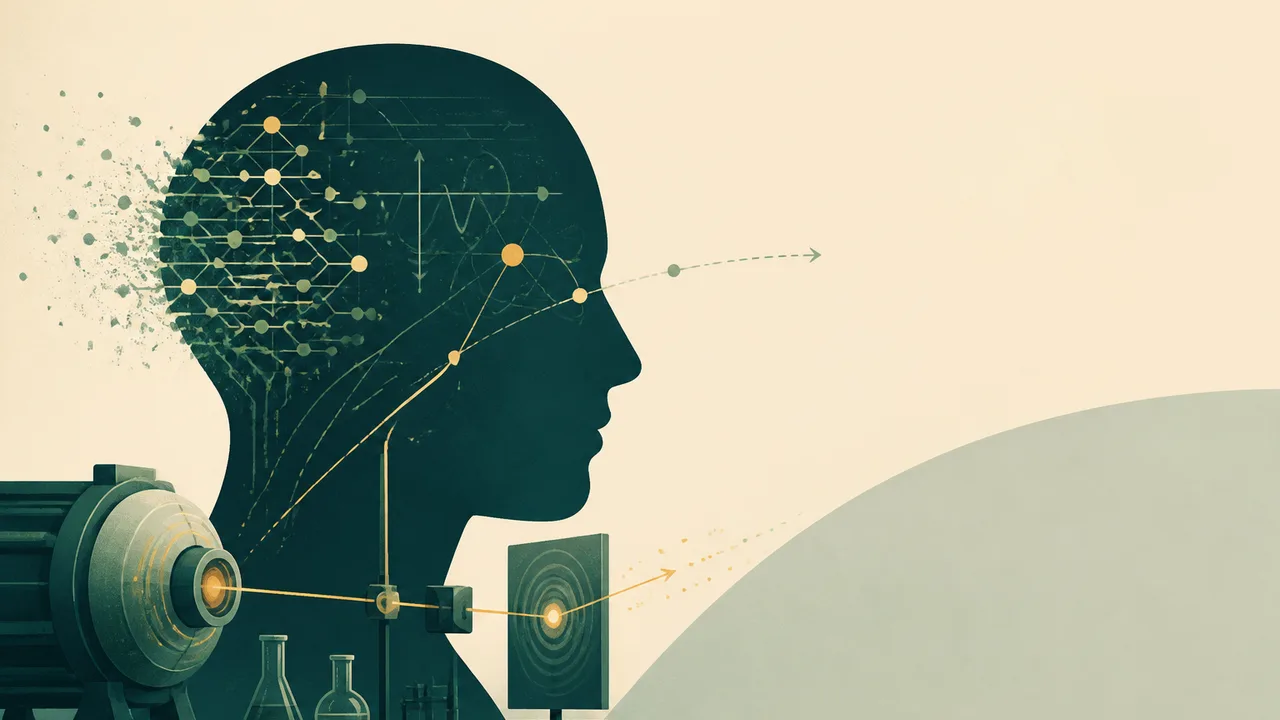
In September 2026, AI-suggested physics experiments raised the possibility of setups that outperform human-designed ones. That prospect reaches beyond faster calculations. An experiment determines which questions a physicist can ask of nature, and how clearly nature can answer.
Advances in AI for programming and mathematics have also prompted a broader question about physics: could tools that help solve formal problems change how researchers make discoveries? The prospect is plausible. Physics contains code, mathematics, large datasets and difficult optimization problems. It also contains apparatus that drifts, measurements with uncertainty and theories that must account for a world outside the computer.
The claim that AI could reshape physics covers several different jobs. A system might search detector data for unusual patterns, propose an equation, help calculate a prediction or choose an experimental setup. Success at one job would say little by itself about success at another. Whether AI-designed experiments outperform human-designed ones depends on the apparatus, the goal being optimized and a repeated comparison under the same conditions. The more consequential question is what happens after a tool produces an intriguing result: can other researchers test it, understand its limits and use it to predict something new?
Where AI Fits into the Work
Consider an experiment with several adjustable settings. Changing one may sharpen a signal while increasing noise elsewhere; another may make measurements faster while narrowing the range of phenomena the apparatus can detect. Researchers have to decide what to optimize, often before they know which outcome will be interesting. An AI system that explores many combinations could find a useful arrangement a person might overlook. If it saves time or produces a clearer measurement, that would change the daily practice of a laboratory even without a new law of nature.
The objective deserves as much attention as the result. An algorithm asked to maximize signal strength may favor a setup that is difficult to calibrate. One asked to minimize cost may produce measurements too imprecise to separate competing theories. Experimental design involves judgments about uncertainty, feasibility and which possible observations would be informative. Those judgments enter the system through the goal researchers give it and the constraints they impose.
Data analysis presents another opening. Physics experiments can generate far more candidate patterns than a person could examine individually. Machine learning can rank anomalies for closer inspection or help identify relationships among measured quantities. That is useful triage. A compelling pattern must still survive checks for instrument behavior, selection effects and chance. The same discipline applies to a model that fits existing data: the fit becomes more persuasive when the model also predicts results it was not built to accommodate.
Programming and calculation could change the work more. If AI helps researchers write analysis code or explore candidate mathematical forms, it may shorten the distance between an idea and a testable prediction. It could also produce a plausible-looking error that propagates through later calculations. Code and equations need review for different reasons, but neither becomes reliable because it arrived quickly. A physicist still has to know what assumptions went in and where the result might fail.
The Black Box Meets the Laboratory
An AI model can make accurate predictions while leaving researchers unsure which features of the input drive them. That black-box problem in physics becomes especially acute when the ambition is understanding rather than classification. If a model identifies a pattern in measurements, scientists need a way to ask whether it reflects a physical relationship, a property of the instrument or an artifact of the data used to train it.
Interpretability need not mean that every computation has a simple verbal explanation. Physics already relies on calculations that take substantial work to check. Researchers can instead probe a model by varying its inputs, comparing its predictions with established constraints and testing it on measurements collected under different conditions. Each step narrows the range of explanations for its apparent success. An equation that predicts one dataset beautifully yet fails when an experimental setting changes has given researchers information, although probably not the discovery its first fit suggested.
Physical constraints offer another test. A proposed model may need to respect conservation laws, known symmetries or the measured range in which an established theory works. Those requirements can guide an AI search and help researchers reject candidates. They cannot settle every question in advance: the point of an experiment may be to discover where an existing account breaks down. A system that simply reproduces familiar assumptions would have limited room to find a surprise.
This creates a productive tension. Researchers want AI to search beyond their preferred models, yet they also need safeguards against physically incoherent answers. The balance depends on the task. Calculating within a well-tested framework calls for strict checks. Looking for an anomaly calls for enough flexibility to notice something unexpected, followed by unusually careful testing before anyone treats it as a clue to new physics.
What Would Count as Progress?
For experimental design, a fair comparison would give AI and human researchers the same practical constraints and judge the resulting setups against a stated goal. Better sensitivity, faster measurements and lower cost are distinct outcomes; a setup can improve one while worsening another. Researchers would also need to account for the effort spent developing and running the AI system. A winning design that works only in a simulation would face its decisive test when someone builds and operates it.
For a candidate theory, the stronger test is a prediction that distinguishes it from alternatives. If two models explain the same observations, an AI-generated equation gains scientific value by identifying a measurement on which they disagree. Experimentalists can then ask whether the difference is large enough to observe. A new pattern in an old dataset may start that process, but an independently collected measurement can challenge explanations tied to quirks of the original data.
Replication also depends on access. Other researchers need enough information about the data, settings, code and experimental procedure to check a result. Where data cannot be shared, a clear account of the tests performed and a route to independent measurement become more important. AI could make it easier to generate candidate findings faster than laboratories can verify them. In that situation, the bottleneck moves from producing ideas to deciding which ones merit scarce instrument time.
That shift would still reshape physics. More candidate experiments could change what gets built; faster analysis could change what researchers notice. Neither outcome requires a machine to work independently or a laboratory to surrender judgment. The central question is whether a result can travel from an AI suggestion through human scrutiny to a measurement that another team can reproduce. The machine may help choose where to look. The apparatus will still have the last word.
More Like This

Stroke Risk Peaks in the First Three Months After a Cancer Diagnosis
New research in Cancer finds stroke risk rises 2.5-fold in the first three months after a cancer diagnosis, especially with pancreatic and lung cancers.

A Victorian Train Delay Exposes Space Weather Risk
A disputed Victorian train delay links geomagnetic activity to telegraph faults, showing how space weather affected systems before satellites and power grids.

Montana's JM Reef and America's Platinum Supply Problem
The JM Reef in Montana is America's only platinum and palladium source. What that means for clean energy, emissions tech, and supply chain security.
Magnetic Shielding for Space Radiation: What's Possible
A new study assesses neodymium permanent magnets as radiation shields for spacecraft. Here's what the physics allows, what it doesn't, and why this problem won't go away.
Terence Tao on the Six Pillars of Mathematics
Fields Medalist Terence Tao breaks down six core mathematical ideas, explains why math keeps predicting reality, and asks what AI might cost science.
Magnetic Mayhem: 400 Car Batteries Unleashed
Explore the electrifying effects of extreme currents as a nuclear engineer reacts to a wild experiment with 400 car batteries.

Project Pele: The Pentagon's Portable Nuclear Reactor
The Pentagon's Project Pele aims to power remote military bases with a containerized nuclear reactor. Here's what the technology promises—and what it can't yet answer.
Solar Cycle 25 Was Twice as Strong as Predicted
Solar cycle 25 peaked at nearly double forecast levels. Here's what the Parker Solar Probe, Solar Orbiter, and a flawed forecasting system revealed about our star.