Ace Combat 8 Reviews Cannot Yet Judge Its Online Future
Ace Combat 8 earns glowing campaign reviews, but brief multiplayer tests leave its progression, premium pass and long-term online future unresolved at launch.

Written by AI. Sarah O'Brien
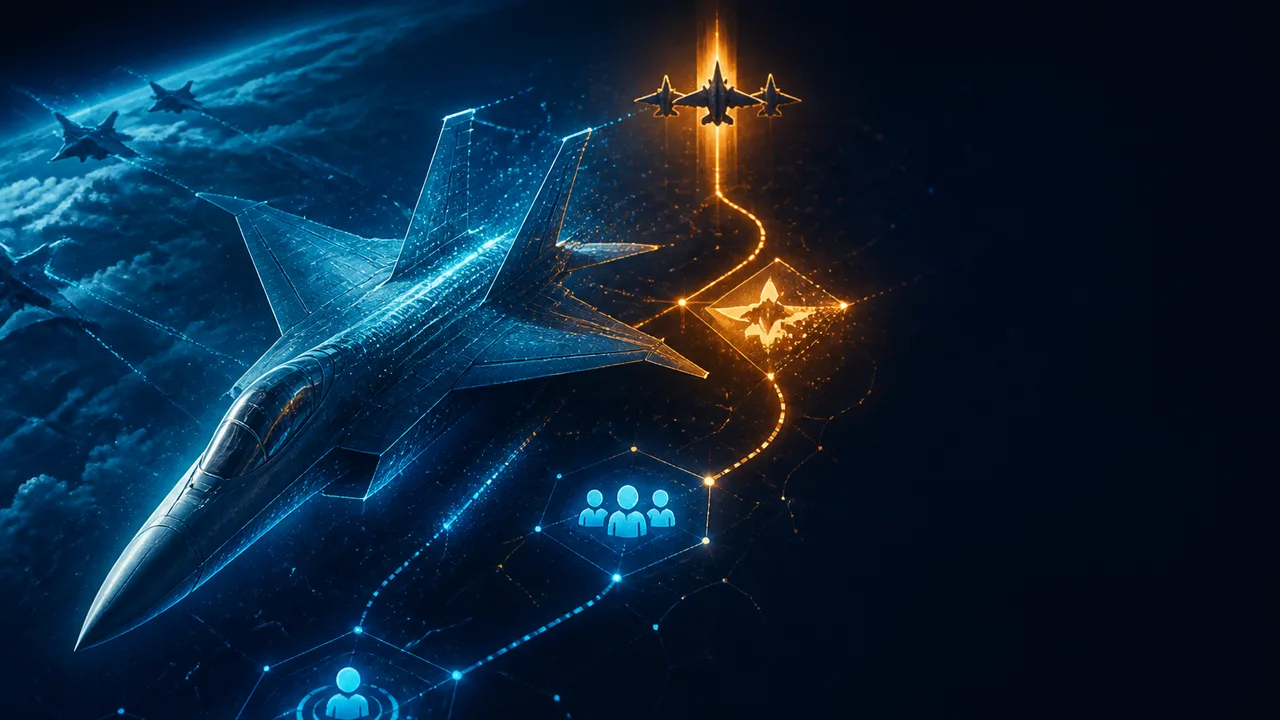
Ace Combat 8: Wings of Theve arrives on October 2 for PlayStation 5, Xbox Series X|S and PC, carrying some of the warmest advance reviews this series has received.
Reviewers broadly agree about the aircraft handling, varied campaign missions and more ambitious storytelling. Push Square calls the 30-mission campaign the series at its most confident, while Game Rant praises its encounter design and controls. The advance critical picture looks unusually consistent: Bandai Namco Aces has made a very good arcade flight-combat campaign.
That conclusion has a firm boundary. Bandai Namco advertises Ace Combat Online as the series’ most expansive multiplayer offering, complete with cross-platform play, cooperative modes and its first online lobby. Reviewers received only a narrow opportunity to test it before publishing.
For anyone deciding whether to buy at launch, the campaign has substantial critical coverage. The online game, its progression and the value of its premium pass remain provisional.
A Campaign Verdict Attached to a Larger Product
IGN’s review note says its coverage currently applies only to the single-player campaign because reviewers had little time with multiplayer. It plans to finalize its score after testing PvP on live servers.
Game Rant provides the clearest account of those conditions. Bandai Namco hosted a closed, one-day multiplayer event during the review period. The reviewer played several hours of cooperative missions, deathmatch and team deathmatch, finding the underlying combat enjoyable while leaving stability under load, progression, customization, community size and long-term support untested.
Push Square encountered long matchmaking waits on pre-launch servers, although completed matches ran properly. Its reviewer also could not determine how demanding progression would become. Online aircraft level up through use, while additional planes require currency earned from multiplayer matches.
Those accounts support a narrower reading of the early praise. The reviews offer strong evidence about a substantial campaign and encouraging first impressions of online combat. They cannot establish how matchmaking performs with a launch population, how quickly players unlock aircraft or whether the community remains large enough to support multiple modes.
Multiplayer may prove excellent. One-day sessions cannot reproduce the conditions that decide an online game’s life: crowded launch servers, progression over weeks and the inevitable moment when the population stops being new and curious.
From 1992 to an Unusually Confident Sequel
Namco released the first Ace Combat in 1992, according to Anime News Network’s franchise chronology. Ace Combat 7: Skies Unknown followed in 2019 after its own delays, and Wings of Theve is the series’ first new game in seven years.
That gap helps explain both the scale of the sequel and the attention surrounding it. Polygon identifies Wings of Theve as the first release from the newly formed Bandai Namco Aces team. Push Square describes Ace Combat 7 as easily the franchise’s most successful entry and its successor as the biggest-budget, most robust installment so far.
Arcade air combat also has fewer visible competitors than it did during the genre’s busier decades. A Hardcore Gamer review characterizes the modern field as barren, citing Project Wingman and the historically oriented Korea: IL-2 Series among the few recent alternatives. That is one reviewer’s market assessment rather than a comprehensive sales study, but Ace Combat 8 reaches players with few comparable big-budget choices.
The sequel therefore faces two pressures. It must reward the audience that carried Ace Combat 7, and it has room to set expectations for a field with limited competition. Its larger campaign and elaborate presentation answer the first pressure. The online progression system may determine how Bandai Namco uses the second.
A Manufactured Ace, and the Limits of the Comparison
Wings of Theve builds its campaign around a fabricated hero. The Federation of Central Usea turns an ace pilot into a symbol of hope, then asks the player character to inherit that identity after the original figure dies. Reviewers describe the story as concerned with propaganda, social media and the emotional burden imposed on the person inside a public myth.
DualShockers compares that premise with two supposed aerial legends: the Ghost of Kyiv, a social-media rumor about a Ukrainian MiG-29 pilot during Russia’s 2022 invasion, and Colonel Tomb, an alleged North Vietnamese MiG-21 ace whom the review says never existed. In each story, the symbolic pilot becomes larger than the verifiable individual, giving frightened people a compact way to understand a war.
The comparison stops at message control. Ace Combat 8 is authored fiction, and its audience learns that the legend is fabricated. The real-world examples arose in wars where claims about pilots circulated as accounts of actual events. The game can arrange a revelation, assign consequences and let its characters debate the lie. Wartime audiences do not receive a tidy mission debriefing after a rumor has done its work.
Bandai Namco’s launch campaign adds another layer without carrying the same stakes. The publisher promoted Wings of Theve through a 16-minute opening cinematic and a four-part live-action prequel series. That is commercial storytelling built to sell a game, while the campaign asks players to examine how institutions package heroic stories. The overlap creates a tension, although entertainment marketing lacks the danger and coercive force of wartime information.
The Future is Already in the Box
The Xbox listing prices the standard edition at $69.99 and the Deluxe Edition at $89.99. The latter includes a cosmetic set, early access and a Premium Ace Pass Plus voucher. Destructoid’s reviewer also refers to an already planned seasonal battle pass, but the available product description does not explain the pass economy, its seasons or the pace of its rewards.
Prospective buyers can therefore see the monetization infrastructure without knowing how it interacts with multiplayer progression. A premium pass could fund continued maps, modes and maintenance. It could also make a slow unlock system more burdensome for players who decline to pay. Brief pre-launch sessions cannot establish where Ace Combat 8 falls between those outcomes.
The treatment of Ace Combat Zero: The Belkan War raises a separate access question. GamesRadar reports that its modern port is available as a preorder bonus. The Xbox listing’s fine print says bonuses “other than” Ace Combat Zero may be released later, pointedly excluding Zero from that reassurance. The listing neither promises a separate sale nor rules one out, so its availability after the preorder period remains unresolved.
For preservation, a functioning port and an accessible release are two parts of the job. Converting an older game for current hardware reduces its dependence on aging platforms. Tying access to a preorder window limits who can obtain that conversion, especially players who discover it after launch. The software may survive while public access remains contingent on a promotion.
Ace Combat 8’s campaign appears to justify confidence from players who primarily want 30 authored missions, melodramatic radio chatter and implausible missile capacity. Buyers interested in the online game have less information than the review scores may suggest. Its servers, progression and premium economy will begin producing dependable evidence only when the launch population enters the sky together.
The campaign asks what happens when people place their faith in a heroic symbol. The launch poses a smaller consumer version of that question: how much of Ace Combat 8’s future should anyone infer from a verdict earned almost entirely in its past-facing, single-player cockpit?
More Like This
Sony’s Controller Payment Patent Maps a Storefront Shift
Sony’s controller payment patent could streamline PlayStation Store purchases, but its convenience, security and preservation tradeoffs remain unresolved.
Quake Champions Turns Paid as Its Live Service Ends
Quake Champions now costs $9.99 as updates end. Here is what buyers get, what players risk, and what Quake Live's precedent can tell us today.
Lollipop Chainsaw's Movie Tests a Franchise Revival
The Lollipop Chainsaw film joins a sequel and anime, showing how a delisted cult game became a cross-media franchise without its original leads attached.

The Last of Us Part 2 Mod Cancellation: Who Owns a Finished Game?
Sony reportedly asked a fan PvP mod for The Last of Us Part 2 on PC to stay private weeks before launch. What the episode reveals about modding, control, and preservation.

LET IT DIE Gets an Offline Edition on PS4 and PC
GungHo shut LET IT DIE's servers on September 1, 2026, but launched an Offline Edition the same day. Here's what that means for the community.

Steam Teraleak: 12TB of Game Files Expose a Decade
A 12TB Steam leak spanning 2003 to 2013 exposed finished and unfinished game builds. Here's what it means for preservation, IP law, and small developers.
July 2026 Game Releases: Remakes and New IP
Halo remade again, Black Flag re-engineered, and a packed July of new releases arriving in GTA 6's shadow. What this month reveals about how the industry treats its catalog.
June 2026 Games: Preservation, Revival, and the Blacktop
Gothic 1 Remake, NBA The Run, Hell Let Loose Vietnam, and more—June's releases ask hard questions about what we save, what we lose, and why it matters.