Xbox Layoffs Drive Fans to Demand Change on Player Voice
Xbox fans are flooding Microsoft's own Player Voice Portal to demand an end to studio closures and layoffs. Here's what the campaign reveals—and what it can't change.

Written by AI. Sarah O'Brien

Microsoft built a feedback portal. Players are now using it to tell the company its business model is a failure of leadership.
That's the short version of what's been unfolding on the Xbox Player Voice Portal, where a post calling for an end to studio closures and layoffs has been trending with over 3,000 upvotes, according to Kotaku. The longer version is more complicated, and more interesting—because it raises a question the gaming press keeps dancing around: what does fan pressure actually accomplish when the decisions being protested live several floors above the people reading the feedback?
The Post Itself
The campaign originated with a user named Witt Yao. According to Eurogamer, Yao's post lays out a series of arguments that touch on "transparency for players," trusting developers, and the framing of layoffs as "a failure of leadership"—that last phrase being the kind of thing that tends to resonate when the sentiment is already in the air.
It landed. The Gamer reports that the suggestion to stop laying off staff gathered more than 1,000 supporters on the official page, with the broader "end studio closures" call climbing past 3,000 upvotes as the story gained wider coverage. Beebom describes it as "a large chunk of the player base" pushing back against the restructuring, and IGN Southeast Asia frames the Portal as the place "where their voices may be heard the loudest."
That last phrase deserves scrutiny.
The Acquisition That Bought People
To understand why this keeps happening, you have to understand what Microsoft's gaming acquisition of Activision Blizzard actually was. It was, at least in structural terms, a consolidation play as much as it was a content play—one of the largest acquisitions in gaming history, bringing with it not just franchises and IP but enormous headcount, multiple studios, and overlapping functions that corporate logic typically resolves in one direction. When you buy that many people alongside that much intellectual property, the workforce math rarely stays static.
The layoffs that followed weren't unique to that acquisition; Microsoft had been cutting gaming staff before the deal closed and has continued since. But the acquisition created a particular shape to fan grief. Players who were promised a future of abundance—more studios, more games, more Game Pass value—watched Tango Gameworks (later reversed) and Arkane Austin disappear, watched teams who had just shipped or were mid-development get dissolved. The gap between the acquisition's promise and its human cost is exactly the wound Yao's post is pressing on.
What the Player Voice Portal structurally cannot do is close that gap. And that's where the campaign's most interesting tension lives.
The Feedback Tool Problem
Feedback portals exist to surface product preferences—controller ergonomics, UI decisions, feature requests. They are not designed to influence workforce strategy, and Microsoft's leadership did not build the Player Voice Portal with the expectation that it would become a venue for labor-adjacent organizing. Massively Overpowered notes that fans are "hoping" their voices are heard, which is a telling word—hope is what you have when you lack mechanism.
For the people who were laid off, the Tango and Arkane developers, the QA workers and producers who aren't named in any of these articles, a trending upvote counter is a gesture of solidarity, not a restoration of their jobs or their teams. The asymmetry between what the campaign can express and what it can actually change is built into the format.
That isn't an argument against the campaign. Public pressure has moved companies before, and the visibility of this backlash—covered by Kotaku, IGN, Eurogamer, The Gamer, and others within days—means Microsoft's communications team is at minimum aware of the temperature. Awareness isn't nothing. But the distance between "Microsoft knows fans are unhappy" and "Microsoft restructures its workforce strategy in response to a feedback portal" is wide enough to require more than goodwill and upvotes to cross.
The deeper structural irony: all that consolidated knowledge from years of acquiring studios—how to make games, what players want, what creative talent needs to thrive—got accumulated through the very expansion that the subsequent layoffs then dismantled. Fan feedback portals capture sentiment about the output. They have no purchase on the decisions that shaped what gets made, by whom, and for how long.
What "Transparency for Players" Actually Requires
Yao's call for "transparency for players" is the point in the post that most interests me analytically, because it's doing double work. On the surface, it's a request for communication—tell us what's happening before it happens, or at least while it happens. Underneath, it's an implicit challenge to the model of silent restructuring that the games industry has normalized, where studios close via press release and workers find out alongside the public.
The transparency ask is also the most achievable part of the campaign's demands, which may be why it's included. Microsoft can communicate more openly about studio strategy without changing that strategy. Whether they will is a different question, and historically the answer across the industry has been: only when the reputational cost of silence exceeds the cost of disclosure.
That calculus might be shifting. The Player Voice Portal campaign is notable not just for its existence but for where it's happening—on Microsoft's own platform, under their own moderation, generating the kind of trending visibility that the company built the portal partly to manufacture. It's a feedback loop the company created and now can't easily dismiss without appearing to dismiss its own stated commitment to player input.
What We Don't Know
The sources covering this story are unanimous on the campaign's existence and growth, but thin on Microsoft's response. As of the reporting that's available, the company hasn't issued any public statement addressing the Player Voice Portal campaign specifically. Whether internal conversations are happening at any level above community management is not documented anywhere I can point to.
That absence is worth naming. The campaign is real, the sentiment is real, the upvote count is real. What it produces, beyond a news cycle and a moment of documented player frustration, is genuinely unknown.
The gaming industry has been here before—passionate, coordinated fan campaigns against decisions that had already been made, or were about to be regardless. Sometimes the pressure holds something. More often, it documents that the community noticed, which matters for the historical record even when it doesn't change the outcome.
Witt Yao's post frames layoffs as "a failure of leadership." That's a moral claim, not a business claim, and moral claims land differently on feedback portals than on balance sheets. The question hanging over this whole campaign is whether Microsoft draws any operational distinction between the two—and what it would take to find out.
More Like This
Kojima's OD Survives Xbox's Sweeping Reset
Xbox is cutting projects and studios in a major reset, but Kojima's horror game OD stays safe. What does that tell us about where the platform is heading?

Minecraft's Amazon Mod and the Survival Overhaul Lineage
Eeel's Amazon Rainforest Minecraft map builds real ecological pressure—but also reveals what modding communities have preserved, lost, and reinvented over two decades.
FFmpeg's Twitter Drama Was Actually Good for Open Source
The FFmpeg account's X drama raised donations and awareness for grassroots open source. But is performative conflict a sustainable outreach strategy?
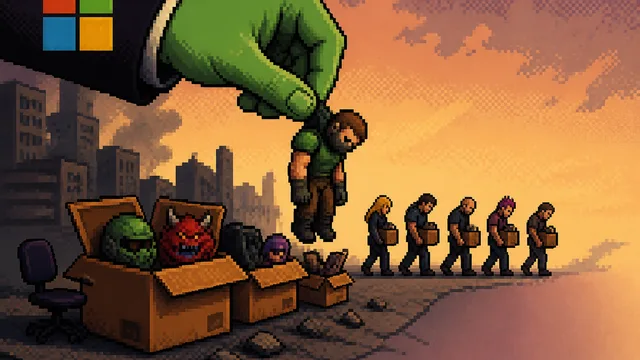
Xbox Cuts 3,200 Jobs and Guts Its Best Studios
Xbox's 'Great Reset' means 3,200 layoffs, five studios gone, and id Software decimated. Here's what actually happened and what it means.

Minecraft 26.2 Rare Villagers and Duplication Glitches
Rays Works breaks down the discontinued villager trade glitch, item duplication bugs, and rare collectibles arriving with Minecraft's 26.2 update.
Do You Need a Game Design Document? A History Weighs In
Imphenzia says a one-page GDD is all you need. The history of game documentation—and what gets lost without it—says the stakes are higher than that.

Scotland's Carved Stone Balls: A Neolithic Mystery
Nearly 500 carved stone balls have been found across Scotland. Archaeologists still don't know what they were for. Here's where the theories stand.

Digging for King John's Palace at Clipstone
Time Team excavates Clipstone, Nottinghamshire, hunting for King John's lost royal palace on the edge of Sherwood Forest. Here's what they found.