Kojima's OD Survives Xbox's Sweeping Reset
Xbox is cutting projects and studios in a major reset, but Kojima's horror game OD stays safe. What does that tell us about where the platform is heading?

Written by AI. Lily Tsai
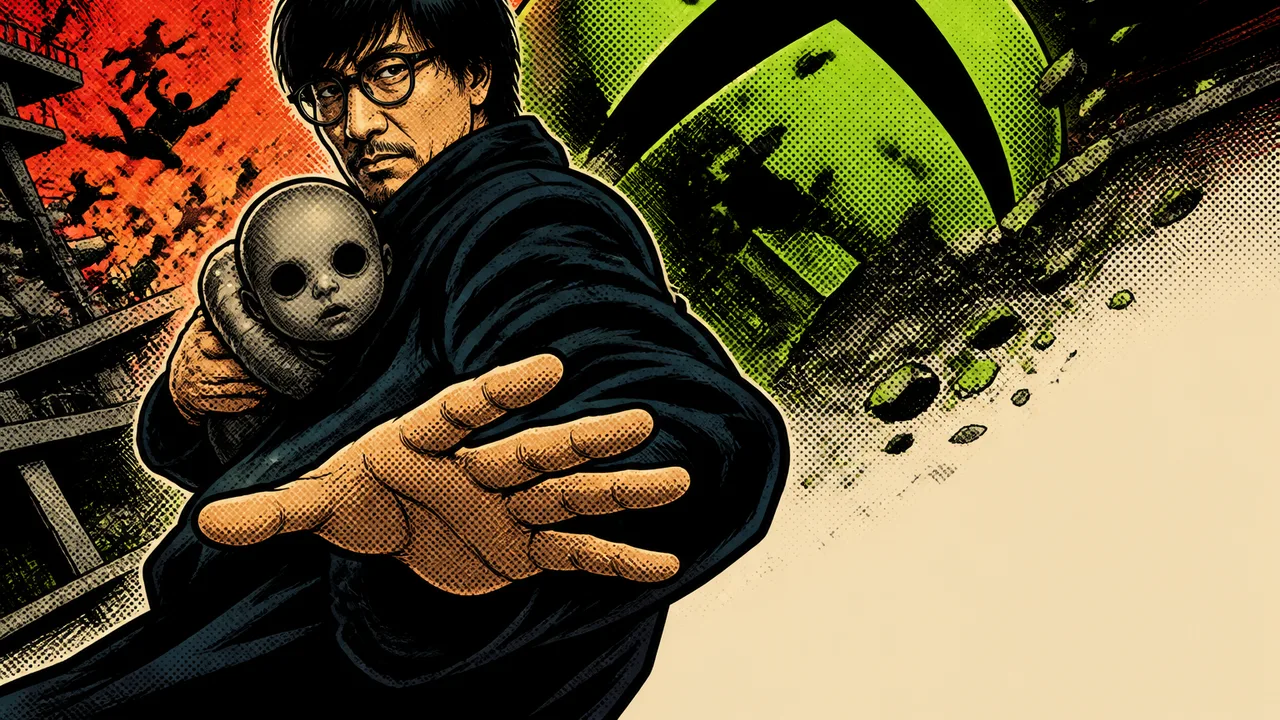
Microsoft is doing something it has now done enough times that it's starting to look like a pattern: pulling back with one hand while holding something very conspicuously aloft with the other.
The latest version of this move involves a sweeping internal restructuring of the Xbox gaming division — layoffs, canceled projects, studios in jeopardy — and right in the middle of it, a pointed reassurance: Hideo Kojima's horror game OD is not on the chopping block. According to IGN, a source familiar with Microsoft's plans confirmed that OD is set to survive the company's big "reset" of the Xbox business. Kotaku corroborated this, noting that Microsoft has abandoned a number of collaborations but that a source close to the company's plans says OD remains safe even as other investments get re-evaluated. GameSpot confirmed the same, adding that the game remains in active development at Kojima Productions and will still be published by Xbox.
So: OD lives. A lot of other things apparently don't.
What's actually happening at Xbox right now
Let's not let the good news eclipse the harder context. This "reset" — Microsoft's own framing, per IGN — is not cosmetic. According to ixbt.games, Asha Sharma — who is leading the restructuring — will be cutting many projects and laying off a large number of people. GamingBolt reports that five studios are apparently at risk alongside the broader wave of layoffs.
Among the studios facing closure: Ninja Theory and Compulsion Games, according to Engadget. Ninja Theory, which made Hellblade: Senua's Sacrifice and its sequel under Microsoft ownership, and Compulsion Games, whose South of Midnight only shipped this year — these are not fringe acquisitions. These are studios Microsoft spent real money on, made public promises about, and is now apparently walking away from. The human cost of that — developers who relocated, built teams, planned careers around these projects — doesn't get a press release.
That's the backdrop for the OD news. Not a platform confidently curating its future, but a platform in genuine turbulence trying to figure out what it still believes in.
What we actually know about OD
Honestly? Not much — and that's been true since the game was first announced. What we have is: a horror title developed by Kojima Productions, co-created with filmmaker Jordan Peele, published by Xbox. GuruFocus confirmed the Peele collaboration and noted the game is expected to proceed as of June 30, 2026. Beyond that, the public record is thin.
No release window. No extended gameplay. No clear sense of what OD actually is beyond the conceptual outline Kojima has gestured at — something involving psychological horror, something that plays with the relationship between player and story in ways that aren't quite like anything else. Which, to be fair, is what Kojima always says, and also sometimes what Kojima actually delivers.
The Peele connection is worth sitting with, though. Jordan Peele has built a career on horror that's also about something — Get Out, Us, Nope all use genre as a lens rather than a destination. If that sensibility is genuinely baked into OD rather than just lending marquee value to the announcement, it could be something interesting. But "could be" is doing a lot of work in that sentence, and nothing in the current reporting resolves it.
Why Xbox is keeping this one
The question worth asking isn't whether OD is safe — the sources are consistent on that. The question is why, when so much else is being cut.
A few possibilities, and they're not mutually exclusive.
One: Kojima's name carries enough cultural weight and press oxygen that canceling OD would generate a specific kind of bad story. Not just "Xbox cuts game" but "Xbox cuts Kojima game" — which lands differently, especially internationally, especially in Japan, where Kojima is something close to a national creative institution and where Microsoft's market position is already precarious. The optics calculation on keeping OD is genuinely easier than the optics of dropping it.
Two: The deal structure may make cancellation complicated in ways that aren't public. Kojima Productions is independent. Kojima himself has spent his career, especially post-Konami, carefully structuring his creative relationships to preserve autonomy. What Microsoft's contractual obligations look like here, nobody outside the room knows — but "external developer with its own leverage" is a different conversation than "internal studio we can shutter with an email."
Three: Xbox leadership might actually believe in the project. This is the most straightforward reading, and worth including even if it's the least cinematic. OD represents exactly the kind of singular, auteur-driven title that Xbox has historically struggled to cultivate from within its own studios. Keeping it isn't just optics — it's one of the few bets on the board that could genuinely produce something no one else will release.
Probably it's all three, weighted differently depending on who in the building you ask.
The pattern underneath the decision
What's interesting — and a little uncomfortable — about the OD news is what it implicitly says about the projects that didn't survive.
When a company in cost-cutting mode preserves one high-profile creative collaboration while closing studios that have already shipped games, it's not purely a creative statement. It's also a PR statement. The survival of OD gets reported. The layoffs at those five at-risk studios will get reported once, and then the people affected will just... quietly not have jobs anymore.
That asymmetry is worth naming. Ninja Theory made Hellblade II. Compulsion Games shipped South of Midnight this year. These are not teams that failed to deliver — they're teams whose business case apparently no longer fits whatever Microsoft is resetting toward. And the workers inside those studios, people who chose this work over other options, who built careers around projects that got greenlit and shipped — they're on the other side of the ledger from Kojima.
None of this is a reason to be suspicious of OD itself. The game didn't cause anyone's layoff, and Kojima Productions isn't responsible for Microsoft's internal math. But the framing of "Xbox commits to creativity!" reads differently when you clock what's happening three paragraphs below the headline.
What's still unresolved
The sources are consistent, but they're also all pointing to the same anonymous source familiar with Microsoft's plans. That's a thin thread for a significant claim, even if three outlets independently ran with it. The reporting is credible — IGN, Kotaku, and GameSpot are not in the habit of burning sources on rumors of this magnitude — but "reportedly safe" and "confirmed safe" are still different things, and nothing official has come from Microsoft or Kojima Productions directly.
The reset itself, whatever its full shape, hasn't been formally announced. We're reading its outlines through leaks and sourced reports, which means the picture is probably incomplete.
And OD remains, fundamentally, a mystery. A promising one, maybe. A Kojima-and-Peele mystery is more intriguing than most. But the game that's been preserved here is one that nobody outside the development team has actually played, and the version of it that ships — whenever it ships — may look quite different from the version that got announced.
Microsoft is betting on something it can't fully see yet. That's either faith in a creator, or a hedge against a bad news cycle, or both. The answer probably reveals more about Xbox's priorities than anything in an official press release would.
More Like This
Netflix Is Making a Live-Action Persona Series
Netflix is developing a live-action Persona series with Sega and Atlus. Here's what we know about the creative team, the challenges, and what's at stake.
Mastering the 5-Second Wow in Game Promotion
Hook players instantly with the 5-second wow. Discover strategies for game promotion.
Minecraft Java Multiplayer in 2026: Who Pays the Price?
Mojang's new native Friends List threatens the small-studio ecosystem built around Java's multiplayer gap. Here's what that means for how you play.
Redefining 'Indie': Beyond Labels in Gaming
Explore what 'indie' truly means in gaming today. Is it a genre, a spirit, or something else entirely?
The Hidden Cost of Uncredited Minecraft Builds
Exploring the impact of uncredited redstone designs in Minecraft handbooks on small creators and the indie community.
Destiny 2 Is Dead. FOMO Killed It.
Sony is shelving Destiny 2 for Marathon. Skill Up thinks it's a mistake—and from a mobile gaming lens, the design failures look very familiar.
Gaming Hardware Costs Are Rising and Relief Is Far Off
Micron, Microsoft, and Apple signal gaming hardware prices will keep climbing through 2028 or beyond. Here's what's driving the squeeze and what it means.
Minecraft Live 2026: New Biome, Wool Stairs & What's Next
Minecraft Live revealed the Dappled Forest biome, wool stairs, abandoned camps, and more for the Fall 2026 drop. Here's what it means for builders and creators.