Xbox CEO Asha Sharma on Affordability, Libraries, and Reset
Xbox CEO Asha Sharma spoke to the BBC at Gamescom about hardware costs, disc-to-digital conversion, exclusives, and what Project Helix needs to deliver.

Written by AI. Mike Wierzbicki
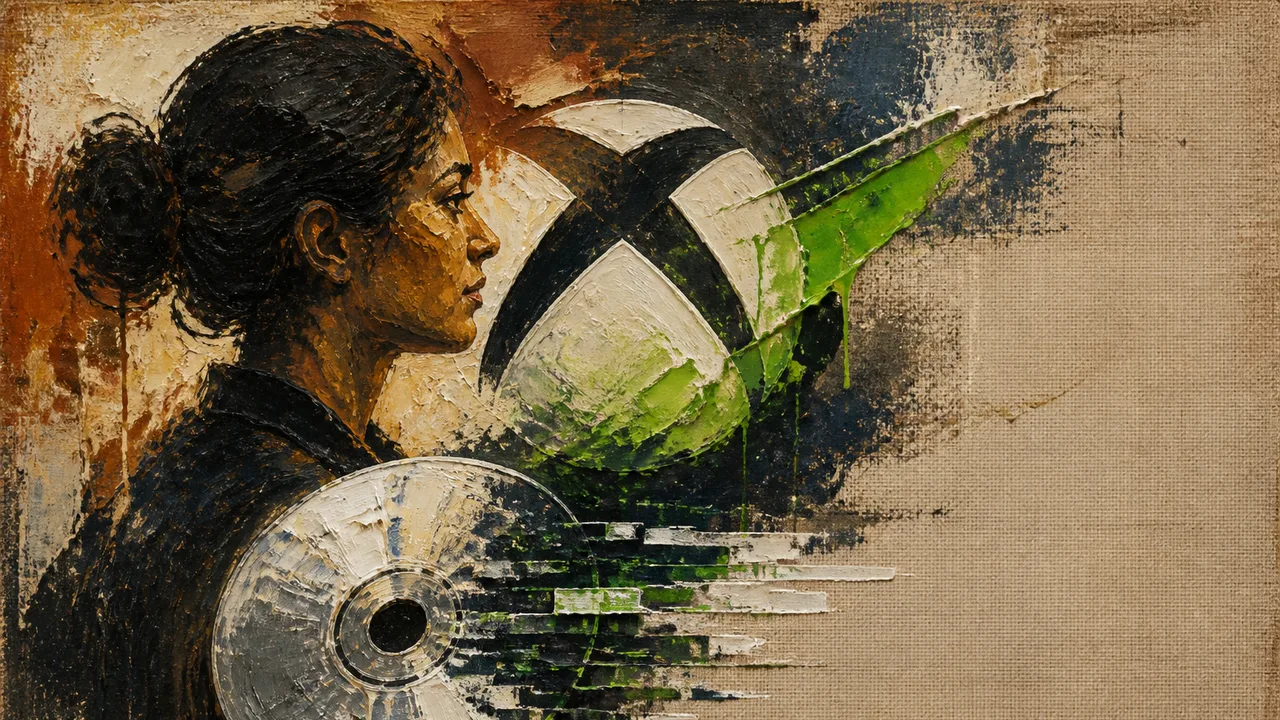
Photo: AI. Saskia Aaltonen
Asha Sharma walked into her first-ever Gamescom carrying a word that no platform holder typically volunteers about their own company: "rampocalypse." It's the term she used to describe where the broader industry finds itself right now — post-COVID normalization, shifting player habits, a new generation that plays differently, and hardware costs that are quietly becoming a structural problem. The candor is either genuinely refreshing or a very well-rehearsed version of it. Probably some of both.
Sharma, who took the Xbox CEO role earlier this year, sat down with BBC journalist Laura Cress in Cologne for what the BBC billed as an exclusive. The full interview covers a lot of ground: disc-to-digital conversion, the next-generation Project Helix console, exclusives strategy, Halo's uncertain future, and a billion-player ambition that raises more questions than it answers. What emerges is a portrait of a platform in genuine flux — and a leader who, to her credit, doesn't pretend otherwise.
"We haven't been healthy"
That's a direct quote. When Cress pushed Sharma on what went wrong during Gen 9, Sharma didn't reach for the usual deflections — competitive dynamics, market headwinds, the pandemic bump unwinding. She said it plainly: "Within Xbox, we haven't been healthy."
She also declined to name a single biggest mistake, which is either intellectually honest or strategically evasive depending on your read. Her actual answer — "there's no silver bullets" — is the kind of thing that can mean everything or nothing. What she did commit to, per GamesIndustry.biz, is a full reset of Xbox's direction, including a renewed emphasis on exclusivity and a direct reckoning with AI's role in the hardware cost crisis.
That last part deserves unpacking.
The AI Hardware Paradox
Microsoft is one of the largest investors in AI infrastructure on the planet. That investment is driving up demand for high-end GPU components — the same components that go into gaming consoles. Sharma was asked directly whether Microsoft is essentially creating the problem that Xbox then has to solve. Her answer was diplomatic: "Gaming has always been the proving ground for the GPU, and I think it is wonderful that there are more uses for this technology around the world."
Wonderful, maybe. Also inconvenient. Eurogamer's coverage of the interview highlighted her call for industry-wide innovation on "affordability and efficiency," which she described as something the industry "has not had to do" before but now must. When Cress asked if "efficiency" was a euphemism for layoffs — a reasonable question given the industry's recent history — Sharma was clear it wasn't: she meant hardware-level efficiency, storage, memory architecture, price-per-unit on components.
That's a real design challenge, and it's one that will define what Project Helix actually costs at retail. Sharma declined to say whether Helix will be disc-less — "we're not sharing more on Helix" — but the entire framing of the disc-to-digital announcement suggests the engineering roadmap is at least prepared for that possibility.
The Disc-to-Digital Announcement
This is the most concrete news out of the interview. Xbox is launching a program covering 1,000 titles that lets players with physical discs claim a digital entitlement for those games. The mechanics, as Sharma described them, work like this: you insert the disc, claim the entitlement, and then own that game digitally. If you sell the disc, the digital entitlement transfers with it.
The obvious question — "do I still need the disc once I've claimed it?" — got a notably player-friendly answer: no, that's up to the player. You can keep the disc for sentimental reasons or sell it. The digital entitlement stays with you either way.
The disc-to-digital program has been anticipated for a while, and with an August launch reportedly in the pipeline, Sharma's Gamescom announcement gives it the official green light. She framed it as "just the start," pointing to Xbox's existing backwards compatibility work and the recent PC back-compat announcement as evidence of a longer trajectory.
What this does for players with large physical libraries is real. What it does for the used game market, and for physical media retail more broadly, is more complicated. If you can extract the digital value from a disc and sell that disc onward, you're essentially creating a secondary market pathway that publishers have historically tried to wall off. Whether that's a consumer win or a supply-chain headache will depend on how publishers react at the licensing level — and Sharma didn't address that dimension.
The Exclusives Reversal
Here's where the corporate memory becomes relevant. Xbox under previous leadership famously described exclusives as "antiquated," which Push Square documented alongside Sharma's subsequent reversal — Xbox now says it "must have exclusive content and services." Sharma at Gamescom was consistent with that reversal: "Every platform needs some form of exclusive experiences and content."
The confirmed exclusives are Gears and Fable. Elder Scrolls 6 prompted a smile and the phrase "it's a beautiful game," which isn't a confirmation of anything but isn't a denial either. Pure Xbox noted that Sharma has called exclusives "a tough topic" — which, given the 180-degree shift from the previous public position, is something of an understatement.
The exclusives question connects directly to the platform's core problem: if your library follows you everywhere — to PC via Game Pass, potentially to other devices — the hardware itself has to justify its existence on experience grounds, not library lock-in. That's a harder sell, and Sharma's answer to it is essentially "console will always be the reference experience." That may be true. It may also be the kind of claim that sounds better in a press interview than it does in a sales chart.
The Billion-Player Math
Sharma wants Xbox to reach a billion players a day. Today, according to her own figure, the platform has more than 100 million. That's a 10x growth target, and Video Games Chronicle reported she wants Xbox to be the number one gaming and entertainment company by 2030. Four years. Ten times the player base.
Sharma's theory for how this happens is less about console sales and more about platform expansion — PC, mobile, Game Pass, indie developer onboarding, international growth. She noted that a third of Xbox's new indie developers over the last six months came from Europe, and she pointed to double-digit total cost growth year-over-year in markets like Germany and gains in the UK while competitors were shrinking.
Those are real numbers, but "TC is up double digits" covers a lot of ground. It's not the same as market share leadership, and Europe has historically been Sony and Nintendo territory for hardware. Growing from a low base is easier than displacing incumbents.
None of which means the ambition is hollow — it means it's genuinely uncertain. The path from 100 million to a billion runs through affordability, platform ubiquity, and a games portfolio that can carry the weight. Sharma says Xbox currently has three billion-dollar annual franchises and wants six to eight. That's both a reasonable goal for a publisher of Xbox's scale and an acknowledgment that the current catalogue doesn't fully get them there.
What the Reset Actually Means
Sharma used the word "reset" several times, and it's worth taking seriously as a descriptor rather than a spin term. A reset isn't a reinvention — it's a recalibration to what the platform was supposed to be before it drifted. The Activision Blizzard acquisition gave Xbox one of the largest content portfolios in the industry. The question was always whether the platform could monetize that content as effectively as the deal required. Early returns were mixed.
What Sharma is describing at Gamescom is an attempt to solve that — through library preservation (disc-to-digital), through hardware affordability (Project Helix and its efficiency mandate), through exclusives recommitment (Gears, Fable, the implied Bethesda titles), and through platform expansion (indie developer pipeline, PC integration, international growth).
Whether those levers pull in the same direction at the same time is the thing she can't yet know. Hardware affordability and performance are in tension. Exclusivity and platform ubiquity are in tension. Indie developer volume and AAA franchise investment compete for internal resources.
What Sharma has right now is a coherent direction. Whether it coheres into a coherent outcome is a different question — and one that Project Helix's launch will start to answer.
More Like This
Why Indie Devs Should Play More, Code Less
Imphenzia argues deep genre immersion—not coding skill—is the real differentiator for indie success in 2026. Here's what that argument gets right, and where it gets complicated.
Inside the Indie Game Pitch: Speed Dating for Dreamers
At London Games Festival, indie developers get 15 minutes to pitch their next big thing. Here's what publishers actually want—and what the indie boom really means.

Alpha Dog Games Re-emerges as Independent Studio
Alpha Dog Games, the Mighty Doom developer shut by Microsoft in 2024, has quietly re-emerged as an independent studio—the latest in a string of Xbox departures.
GTA 6 Leaks, 2XKO Ends, and a Rough Week for the Industry
GTA 6 gameplay leaked again, Riot kills 2XKO, Saber's AI scandal blows up, and Sony's live service pivot keeps costing developers their jobs.
Sunderfolk Is Free on Xbox — Here's What That Means
Sunderfolk is free to play on Xbox for a limited time. We dig into what this trial reveals about indie co-op marketing, Secret Door's origins, and the game's unusual design.
Xbox and PlayStation Retreat from Multiplatform Marketing
Xbox is scrubbing PS5 logos from trailers while Sony revives "Only on PS5" language. Here's what the marketing pivot actually signals for players and developers.
Pokémon Worlds 2026 Ticket Lottery Frustrates Fans
The Pokémon Worlds 2026 ticket lottery has left fans confused and locked out. Here's what the system actually looks like from the ground level.
AC Black Flag Resynced: Big Sales, Bigger Backlash
Assassin's Creed Black Flag Resynced sold 2 million copies in one day. It's also getting review-bombed on Steam. Both things are true, and that's the story.